Every civilisation that ever prayed, prayed with smoke. The Rishis of the Indus valley knew what the priests of Karnak knew what the Zen monks of Kyoto knew what the Franciscans of Assisi knew — that a fragrance made from fire is never just a fragrance. It is the visible form of a request. The moment a piece of matter — a chip of sandalwood, a tear of frankincense, a pinch of camphor — surrenders itself to flame and rises upward, something has been sent. That upward journey is the oldest ritual the human species has.
The independent invention
There is no evidence that the Vedic culture taught the Egyptian priesthood how to burn kyphi at the temple of Karnak. No trade route carried Japanese kōdō to the Catholic censer in Rome. No missionary put frankincense into a Sufi shrine at Ajmer, or sage into a Lakota lodge. And yet, on every inhabited continent, at every altitude, in every climate — the answer is the same. When a human being needed to speak to what could not be seen, they lit something. They made it fragrant. They watched it rise.
The word for this in Sanskrit is dhūpa — literally that which rises. In Latin it becomes incense, from incendere, to set alight. In Japanese kō, the character built from the radical for grain and the radical for sweetness. In Arabic bakhoor, from a root meaning to fumigate or purify. Different languages, different alphabets, different theologies — one word for one act. Set the material alight. Let its scent rise. Consider the prayer sent.
This is not coincidence. This is convergence.
Why upward mattered
Every one of these traditions independently decided that the direction of the smoke was the theological point. Upward — toward whatever the culture placed above. In Vedic yajna, upward is the world of the devas, and Agni himself is the hotr — the priest-messenger — who carries the offering from the human world to the divine. In Catholic liturgy, the censer is swung upward toward the altar and the raised host; the direction of smoke is the direction of prayer. In Shinto, the smoke rises to the kami who inhabit the higher regions. In Native ceremony, the smoke goes to Wakan Tanka, the Great Mystery of the sky.
The physical fact of smoke — that it rises because it is warmer and lighter than the air around it — became, in every culture, a theological fact. The prayer must rise. The prayer must be lighter than what surrounds it. The prayer must be transformed from matter into breath before it can travel. Fire is what performs the transformation. Fragrance is what makes the prayer legible — because a rising invisible column of hot air is not a prayer, but a rising invisible column of hot air that smells of sandalwood is a prayer received.
“Every culture that ever prayed, prayed with smoke. The Rishis knew what the Egyptian priests knew what the Zen monks knew — that a fragrance made from fire is never just a fragrance.”
Three things smoke does
If you strip the theology away and ask a purely practical question — what does smoke actually do for the person who lights it? — you find three answers. They are the same three answers in every tradition.
It carries prayer upward. The metaphysical function. Whatever you asked for, whatever you offered thanks for, whatever you mourned — the smoke takes it.
It cleanses the space around it. The physical function. Smoke — especially resinous smoke — is antimicrobial. Frankincense, camphor, guggul, sage, mugwort: all of them measurably reduce airborne bacteria. Ancient cultures did not have that vocabulary, but they had the experience. A room in which loban had been burned felt different. A house that had been fumigated with camphor slept differently. What we now call antimicrobial they called shuddhi — purification.
It marks the moment as sacred. The psychological function. A fragrance introduced into a room is a signal to the mind: this is not an ordinary moment. Every meditator learns this early — the same posture, the same time, the same fragrance, and the mind arrives faster. The smoke is a bell for the nose.
Fragrance is memory; smoke is memory in motion
There is a reason a single whiff of sandalwood can transport an Indian adult, instantly, to their grandmother’s puja room forty years ago. Olfactory memory is the most durable memory the human brain stores — it bypasses the thalamus and lands directly in the limbic system, in the same neural neighbourhood where emotion and long-term memory are held. Smell does not pass through analysis; it arrives already meaningful.
A fragrance is memory sealed in a molecule. When the molecule reaches the nose, the memory is returned to you intact. Smoke is what puts the molecule in the air. Which is to say — smoke is memory in motion. It is how the past becomes present in a room. It is how a mother’s aarti at six in the morning, remembered by a daughter forty years later in another city, becomes physically present in that daughter’s apartment when she lights the same brand her mother lit.
This is what a house of Indian incense is really selling. Not fragrance. Not smoke. The continuation of a remembered moment.
What comes next in this guide
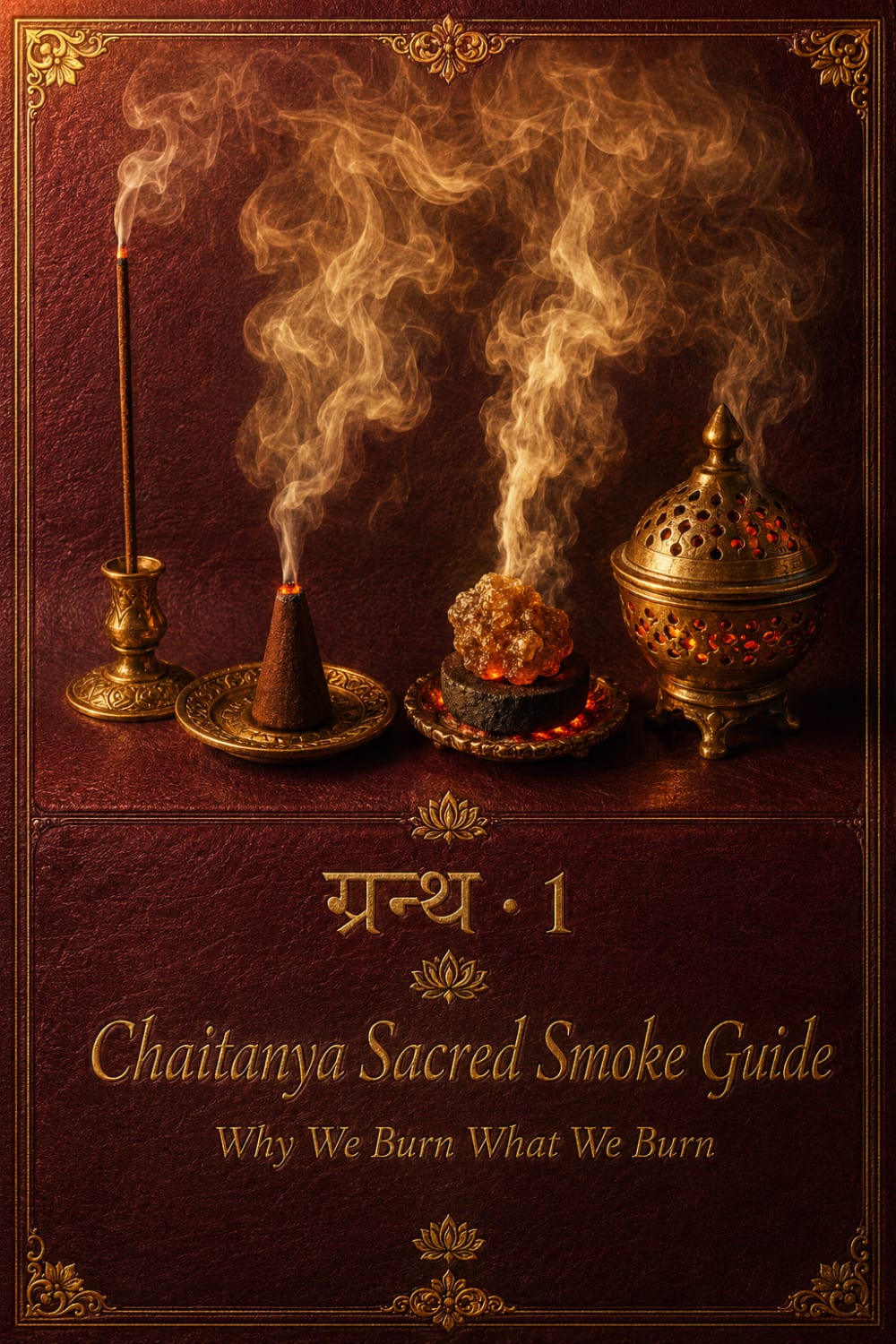
The chapters ahead take you into the material world of that continuation. The four forms Indian tradition has settled on — stick, cone, resin, powder. The nine raw materials the forms are built from — halmaddi, jiggat, guggul, loban, benzoin, camphor, sandal, agar, javadhu. The one Southern tradition — javadhu — that the North rarely knows the name of, and which we have chosen to publish. The moment-by-moment map of when to reach for which form. And finally, a short conversion — a decision tree that turns everything you will have learned into three specific things to light this week.
But before any of that, the point of this opening chapter must land, because everything else in this grantha rests on it: you are not choosing an air freshener. You are inheriting a five-thousand-year-old vocabulary. Chaitanya’s work — this grantha’s work — is only to help you speak it a little more fluently.
Chapter One of Twelve · Chaitanya Sacred Smoke Guide · Volume 1 of the Chaitanya Grantha