The Sandhya — Three Sun-Junction Practices
Dawn. Noon. Dusk. The three moments where the sun crosses classical astronomical junctions. The tradition assigned each a specific ritual. Most modern households have forgotten. This chapter opens the practice.
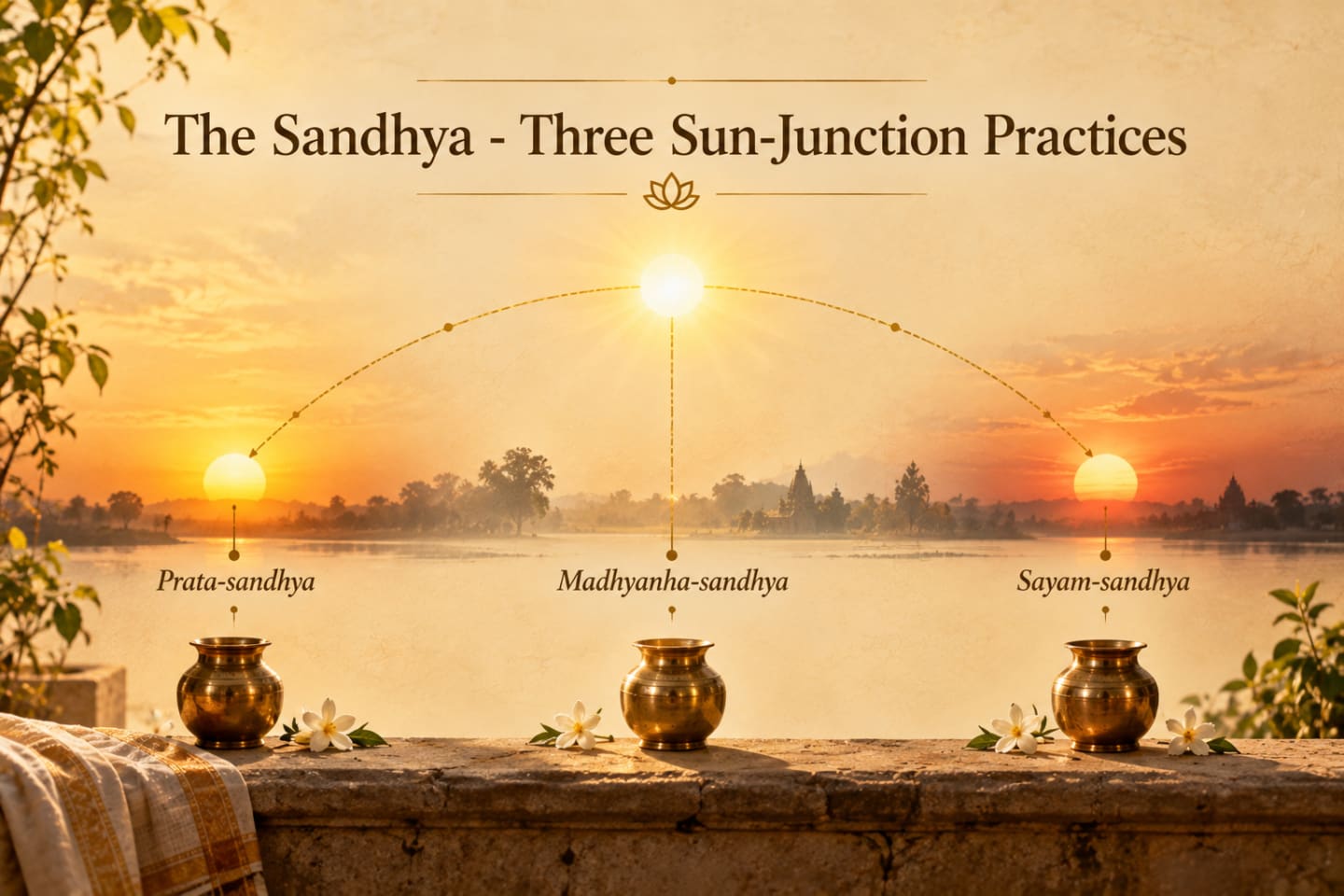
Sandhya vandana is the thrice-daily sun-junction prayer at dawn, noon, and dusk. The core practice is 108 Gayatri mantra repetitions at each junction, facing east in morning, north at noon, west at dusk. Of the three junctions, dawn sandhya is most important. Gayatri is the most widely chanted mantra in Hinduism.
Published · Updated · Chaitanya Global Research Team
Classical Vedic tradition recognises three specific moments of the day as ritually distinct - moments where the sun crosses classical astronomical junctions and the classical understanding held that the household should pause for a specific brief practice. These are the sandhyas (सन्ध्या, "junction"): prata-sandhya (dawn), madhyanha-sandhya (noon), and sayam-sandhya (dusk).
The classical practice at each sandhya is called sandhya-vandana (सन्ध्यावन्दन, "junction-adoration") - a specific brief ritual involving water offering to the sun, Gayatri mantra recitation, and specific mantras acknowledging the sun-junction. In serious classical households (particularly Brahmin, Kshatriya, and Vaishya traditional families in South India), sandhya-vandana was maintained as continuous daily practice through generations.
In modern practice, sandhya-vandana has largely faded outside specific traditional communities. This chapter opens the practice for the modern household - both what the classical tradition asks and how modern practice can recover the sandhya rhythm even in abbreviated form.
What sandhya means
The word. Sandhya (from Sanskrit sam + dhi - meaning "meeting" or "junction") refers to the specific moments when the sun crosses classical astronomical thresholds. Classical tradition names three:
Prata-sandhya (प्रातःसन्ध्या) - dawn junction. The moment the sun crosses from below the horizon to visible above. Typically 6:00-6:30 AM in Indian latitudes but varies seasonally.
Madhyanha-sandhya (मध्याह्नसन्ध्या) - noon junction. The moment the sun crosses through zenith. Typically 12:00 noon local solar time.
Sayam-sandhya (सायंसन्ध्या) - dusk junction. The moment the sun crosses from above the horizon to disappearing below. Typically 6:00-6:30 PM in Indian latitudes but varies seasonally.
Why these three specifically. Classical understanding: at each junction moment, the sun's ritual character changes. The dawn sun is associated with awakening and inspiration; the noon sun with fulfilment and abundance; the dusk sun with completion and ancestral connection. Each sandhya invites a specific practice appropriate to that character.
The classical practitioner. Traditional classical practice held that a serious household member (particularly initiated males in the classical tradition) should conduct sandhya-vandana at all three junctions daily. Modern practice varies significantly - many modern households conduct one sandhya, some conduct none, and few conduct all three.
Prata-sandhya - the dawn practice
Timing. The classical timing is roughly 45-90 minutes before sunrise (some traditions) or immediately at sunrise (others). Modern accommodation: anywhere between waking and sunrise-plus-30-minutes.
The classical elements:
- Preparation. Bath completed (see Ch 2). Dressed in fresh clothing. Small brass water pot (arghya-patra) filled with fresh water plus a drop of gangajal.
- Facing east. Face east toward the direction of the rising sun.
- Achamana. Small sip of water three times (right hand cupped, drop of water sipped from palm).
- Sankalpa. Brief internal intention statement - naming the day, the household member's role, the specific intention for practice.
- Water offering to the sun (arghya). Hold the small water pot with both hands, then slowly pour water toward the direction of the rising sun as offering, while reciting specific mantras. The classical mantra: Om Bhur Bhuvah Svah (invoking earth, atmosphere, heavens).
- Gayatri mantra recitation. The classical dawn Gayatri:
Om bhur bhuvah svah, Tat savitur varenyam, Bhargo devasya dhimahi, Dhiyo yo nah prachodayat. Recited 3, 11, 21, or 108 times depending on the household member's dedication level.
- Brief silence. A moment of internal presence.
- Closing. Namaskaram to the sun, brief acknowledgement, return to household activity.
Duration: 5-15 minutes depending on Gayatri repetition count.
Madhyanha-sandhya - the noon practice
Timing. Classical: at or around 12:00 noon solar time. Modern accommodation: any moment during the 11:30-12:30 window when possible.
The classical elements: Similar structure to prata-sandhya but with specific noon-appropriate elements:
- Brief preparation (need not include full bath - washing hands and face acceptable)
- Standing or seated facing east (or south in some traditions)
- Achamana
- Sankalpa
- Water offering (arghya) - toward east or south depending on tradition
- Gayatri mantra recitation (typically 11 times for noon; less than dawn)
- Brief silence
- Closing
Duration: 3-8 minutes.
Practical reality. Noon sandhya is the most-commonly-skipped in modern practice because it falls in the middle of typical working day. Some modern accommodations:
- Brief 2-minute practice at noon (achamana + brief Gayatri repetition + acknowledgement)
- Practice at nearest convenient moment (11 AM or 1 PM if 12 noon impossible)
- Skip noon and maintain dawn + dusk
Modern practical serious devotional households often maintain dawn and dusk sandhya only; noon is considered optional.
Sayam-sandhya - the dusk practice
Timing. Classical: at sunset. Modern accommodation: within the 30-minute window before or after actual sunset.
The classical elements:
- Preparation. Brief washing of hands and face (full re-bath not required unless significant intervening activity)
- Facing west (toward the setting sun) or east (in some traditions honouring the sun in both moments)
- Achamana (as morning)
- Sankalpa. Brief acknowledgement of the day completing, dedication of the day's activity as offering.
- Water offering (arghya). Slower and more deliberate than morning - the setting sun receives the day's activity as offering.
- Gayatri mantra recitation. Fewer repetitions than dawn (traditionally 11 for evening).
- Ancestor-honouring element. Distinctive to evening sandhya - brief water offering to ancestors (tarpana), a small drop of water offered in the palm and released with acknowledgement of departed family members.
- Brief silence.
- Closing. Namaskaram, transition to evening household activity.
Duration: 5-10 minutes.
Evening sandhya's specific quality. More than morning or noon, evening sandhya carries the ancestral connection. The classical understanding: the setting sun connects the living household to the departed lineage. This is why evening sandhya includes the tarpana element and why serious traditional families emphasise dusk practice.
What the Gayatri mantra is
Since the Gayatri mantra is central to all three sandhyas, a brief classical explanation:
Source. The Rig Veda (3.62.10) - the world's oldest continuously-recited religious text. The Gayatri is understood as one of the most ancient mantras in continuous ritual use anywhere on earth.
Composition:
- Om - the primordial syllable
- Bhur bhuvah svah - invocation of the three realms (earth, atmosphere, heavens)
- Tat savitur varenyam - "that supreme luminous Savitri (the sun)"
- Bhargo devasya dhimahi - "we meditate on the divine radiance"
- Dhiyo yo nah prachodayat - "that may inspire our intellect"
Meaning summary: A prayer to the divine solar principle asking that it inspire our intellect and meditation. Not merely worship of the physical sun but of the divine luminosity the sun manifests.
Traditional wearing rules. Some traditional practice held that only initiated (upanayan-completed) males should recite the Gayatri; other traditions permit all. Modern practice largely accepts all household members reciting the Gayatri regardless of formal initiation.
Traditional counting. Sacred rudraksha or tulsi mala (Vol 4) used for counting. Repetition counts: 3 (minimum), 11 (basic serious), 21 (elaborate), 108 (full round).
Modern practice - what the household can realistically maintain
For the modern household considering sandhya practice:
Basic modern sandhya (5 minutes twice daily):
- Morning: hand-viewing mantra + brief Gayatri (3 times) + acknowledgement
- Evening: brief water sprinkle facing sunset + Gayatri (3 times) + ancestor-honouring pause
Intermediate modern sandhya (10 minutes twice daily):
- Morning: full prata-sandhya with 11 Gayatri repetitions
- Evening: full sayam-sandhya with 11 Gayatri + tarpana
Serious traditional sandhya (25 minutes total daily):
- All three sandhyas maintained
- Full mantra sequences at each
- 21 or 108 Gayatri repetitions
Most modern devotional households can realistically maintain intermediate practice (morning + evening, ~20 minutes total daily) alongside standard morning aarti and evening acknowledgement.
Regional variants
North Indian tradition: Sandhya-vandana practice most commonly maintained by initiated Brahmin families; less common in general household practice.
South Indian tradition: Sandhya-vandana more widely maintained across communities. Traditional Tamil, Malayalam, Telugu Brahmin households commonly maintain three-sandhya practice.
Bengali tradition: Modified sandhya practice with regional mantras and specific Bengali variations.
Sikh tradition: Nitnem (five daily prayers) is functionally parallel practice with specific Sikh prayer text.
Vaishnava tradition: Additional sandhya-adjacent practice - the Sri Vaishnava sandhya with specific Vishnu-focused elements.
What the tradition asks of the household
Home ritual is not accomplished by material acquisition. It is accomplished by rhythm. The sandhyas provide the classical rhythm framework - three moments across the day when the household pauses for brief classical practice. Even in reduced form, maintaining any of the three sandhyas re-establishes the classical daily rhythm the tradition designed.
The tradition understands that most modern households will not conduct three full sandhyas daily. But even a brief morning acknowledgement + brief evening acknowledgement, with the mantras approximate rather than perfect, restores something significant.
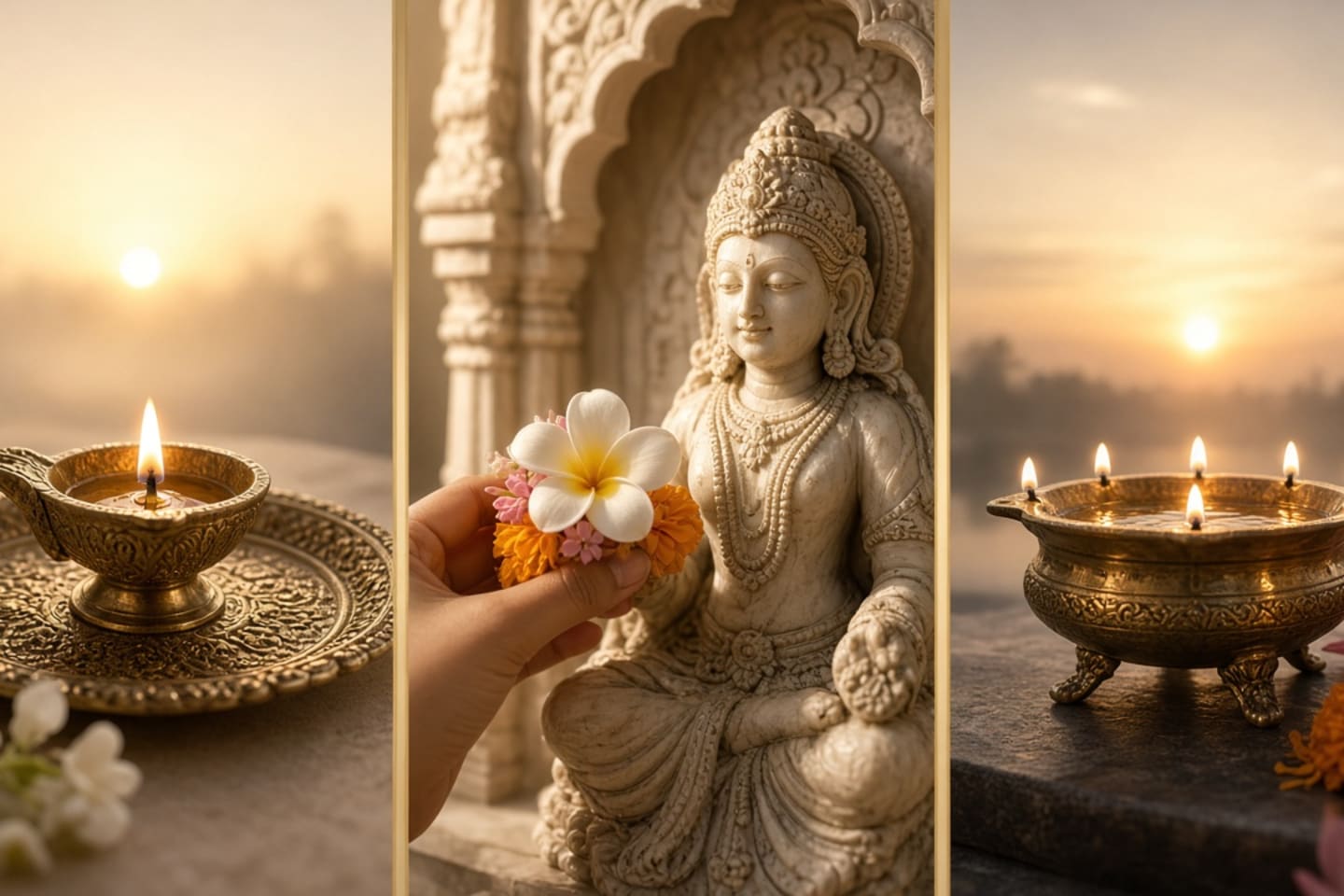
The midday sandhya for the working household
The hardest of the three. Morning and evening sandhya happen at home. The midday sandhya (madhyahna) falls in the working day, which is why it is the first to be lost in modern households.
A form that fits a workplace. The classical essence of a sandhya is a pause at a junction of the day. At a desk, that pause can be kept in three minutes, without flame or smoke:
- Step away from the screen and sit upright
- Take a fragrance cue - sandalwood oil at the wrist, or camphor kept in a small bowl
- Ten slow breaths, or a short mantra repeated silently
- Return to work
Why it matters. The three sandhyas give the day its rhythm. A household member who keeps even the reduced midday pause holds the full three-point structure the tradition intended.
“The three sandhyas are the tradition's classical daily framework. Not required. Not perfectly-observed by most modern households. But present as living practice in serious traditional communities, and available to any household willing to recover them. The rhythm is what matters; even reduced sandhya practice is better than none.”

The Gayatri mantra's place in classical literature is worth understanding for households approaching sandhya practice:
Rig Veda (3.62.10): The mantra's original source. Composed by the seer Vishvamitra as part of the Rig Vedic collection - the world's oldest continuously-recited religious text (composed roughly 1500 BCE, in continuous liturgical use since).
Upanishads: Multiple Upanishads discuss the Gayatri as one of the most sacred mantras.
Bhagavad Gita (10.35): Krishna says "among metres, I am Gayatri" (gāyatrī chandasām aham) - the Gayatri metre in which this mantra is composed, named among the forms of the divine.
Puranas: Multiple Puranas discuss Gayatri practice, initiation, and daily observance.
Tantric tradition: The Gayatri has variants in different tantric traditions - Devi Gayatri, Ganesha Gayatri, specific-deity Gayatris exist alongside the classical solar Gayatri.
The classical solar Gayatri (the version taught in this chapter) is the most universal. Deity-specific Gayatris are used in specific traditions but the solar Gayatri is appropriate to any household.
Modern households approaching sandhya practice for the first time should begin with the classical solar Gayatri. Deity-specific variants are for households with established practice and specific tradition-alignment.

Published by the house of Chaitanya · www.chaitanya.global
Kits & products from this chapter
Available wholesale, or under your own label.

