Maker-direct for importers, distributors & grocery chains  ·  On shelves in 30+ countries  ·  Since 2008Karwa Chauth, 29 Oct: what goes on the thali? Read in the Grantha ›
The Grantha · Volume 1
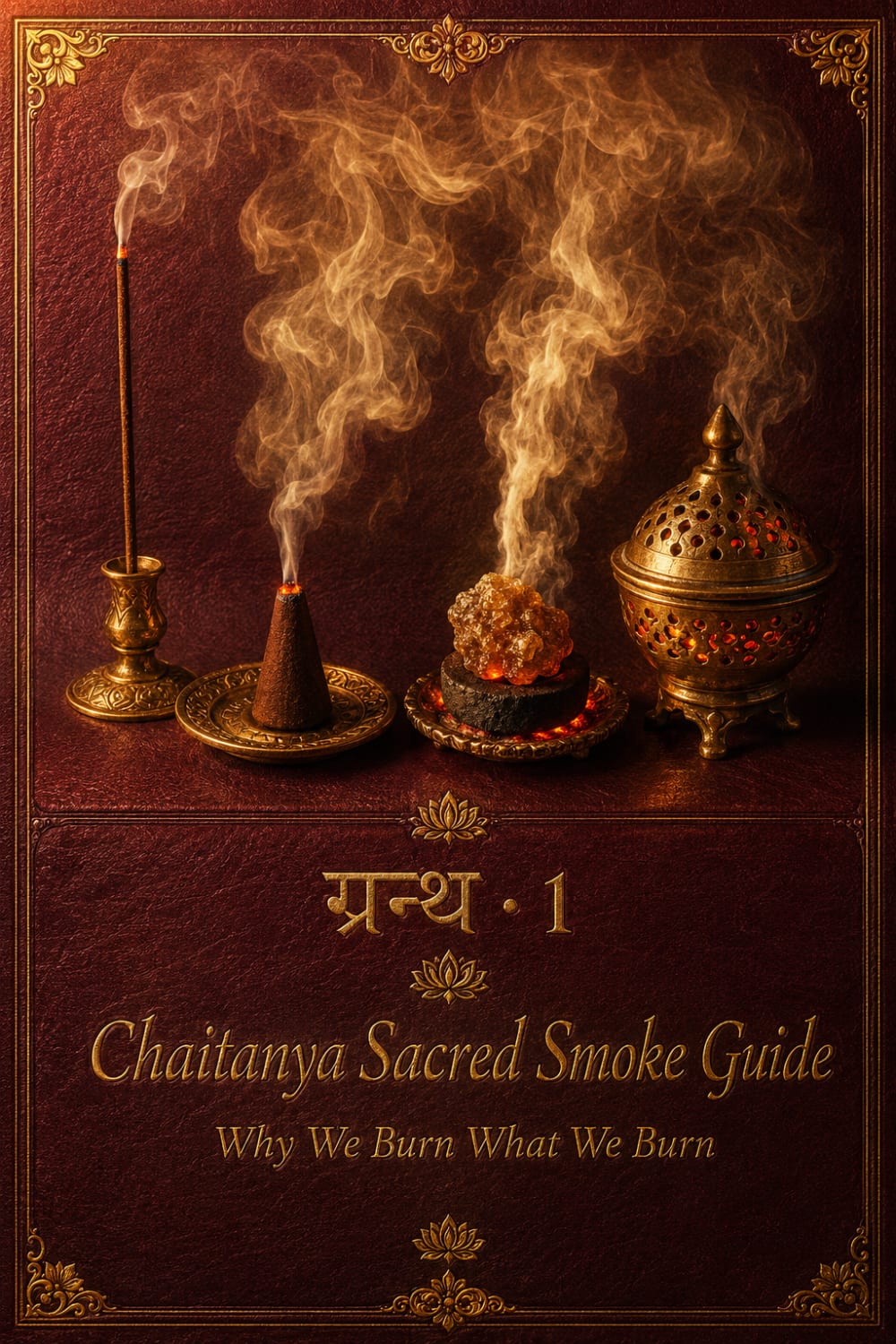
Chaitanya Sacred Smoke Guide
Volume 1 · The Chaitanya Grantha

Chaitanya Sacred Smoke Guide

Why We Burn What We Burn

Every civilisation that ever prayed, prayed with smoke. The Rishis knew what the Egyptian priests knew what the Zen monks knew — that a fragrance made from fire is never just a fragrance. This first volume of the Chaitanya Grantha opens the entire library. It answers the question no Indian brand has ever answered in print: why do we burn what we burn, and how do we know when to reach for the stick, the cone, the resin or the powder? Twelve chapters. Forty-eight pages. Every material of the Indian smoke ritual, explained.

Read online free → All twelve chapters, no sign-up required
No spam. Just the guide, straight to your WhatsApp.
What is inside

Twelve chapters

Chapter One

What Home Ritual Is

The materials matter. The kits matter. What matters most is the daily rhythm — the specific times of day, the specific gestures, the specific words that make an ordinary household a ritually-continuous one.

Illustration: What Home Ritual Is

Daily home ritual (nityakarma) follows the pancha-mahayajna framework — five daily obligations: Brahma Yajna (scripture study), Deva Yajna (aarti and incense), Pitri Yajna (ancestor offering), Manushya Yajna (hospitality and service), and Bhuta Yajna (feeding all beings). In modern practice: morning aarti, mantra, feeding birds, evening deepak.

Eight previous volumes have opened the materials of Indian devotional tradition. Smoke (Vol 1). Fragrance (Vol 2). Samagri of the tray (Vol 3). Malas on the wrist (Vol 4). Sacred objects of the mandir (Vol 5). Diyas and flame (Vol 6). Ritual kits (Vol 7). And the festival calendar (Vol 8).

This final volume of the Grantha is different. It does not open new materials. It opens the daily practice — the specific ways the household weaves everything the previous volumes documented into the ordinary rhythm of its day. Morning aarti at sunrise. Meal blessing before eating. Threshold-touching when leaving and returning. Body-anointment during bath. Evening closure at bedtime. This is home ritual (grihya-karma, गृह्यकर्म) — the household's own liturgy through which the classical tradition lives in the ordinary hours.

Continue reading Chapter 1 →

The eleven that follow

A preview of every chapter

Each of the remaining chapters, previewed below. Click any chapter title above to read the full text free.

Chapter Two

The Four Forms of Indian Smoke

You have four traditions in your hands and probably don’t know their names.

Every Indian household reaches, on autopilot, for one of four forms of smoke — and almost nobody can name all four. The stick that burns for the morning aarti. The cone that sits in the temple. The lump of resin that fills the room on shraddha day. The powder in the small brass cup that walks room to room at dusk.

Agarbatti. Dhoop. Loban. Sambrani. Four forms, four smokes, four moments. Each is made from a different material, burns for a different length of time, carries a different weight of fragrance, and belongs to a different corner of the ritual calendar. The tradition has assigned each one its purpose over centuries; the modern household has forgotten most of the reasoning while continuing the practice.

This chapter is where the vocabulary is restored — the taxonomy every household uses without naming, laid out with the physical anatomy of each form and the moment each one belongs to…

Chapter Three

Agarbatti — The Incense Stick, Explained

The sixty-minute burn and the twenty-minute burn look identical on the shelf. What is actually inside them?

It comes down to one word most incense buyers have never heard: halmaddi. It is the sticky black resin that binds the masala to the bamboo core in every properly-made agarbatti — and it is expensive, controlled, and increasingly rare. A stick that has halmaddi burns slowly, glows warm-orange, and carries fragrance in three-note complexity. A stick that has been dipped in synthetic fragrance after rolling burns hot, glows cool, and delivers one flat note.

This chapter takes the anatomy apart — bamboo core, wet-rolling vs dry-rolling, halmaddi vs jiggat, the paste ratio, the drying process. And it hands the reader a thirty-second field test: how to tell a good stick from a bad one before you burn it…

Chapter Four

Dhoop — The Coreless Flame

If the stick is the modern convenience, the dhoop is what came before.

Pure paste, no bamboo, no compromise. The dhoop cone is what temple priests still burn — not the stick — because tradition considers the bamboo an unnecessary dilution of the offering. The smoke sits heavier in the room; the base notes speak first; the whole air changes.

This chapter takes the older path — where dhoop comes from, why South Indian and Vaishnava tradition still hold it above the stick, the three formats it takes (cone, stick, cup), and the moments it earns pride of place over agarbatti…

Chapter Five

Loban — The Resin of Prayer

At every Sufi shrine, every Ajmer Dargah, every Catholic censer — the same resin.

Frankincense. Called loban here, called olibanum there, called the same thing everywhere for four thousand years.

Loban is the raw form. No paste, no binder, no bamboo — just tree resin dropped onto a lit charcoal disc. The smoke is dense, immediate, unmistakable, and carries a weight the crafted forms cannot. Which is why every tradition on earth reaches for it at moments of deep ritual — grief, shraddha, house cleansing, illness, prayer that needs to be heard.

This chapter is where the cross-cultural line is drawn: the same frankincense that fills a Catholic church has been filling Indian temples since the Ramayana. The chapter walks through the three grades, the two companion resins (benzoin, guggul), and the six household moments that call for it…

Chapter Six

Sambrani — The Powder Ritual

Every South Indian evening at dusk, in millions of homes, this powder is lit. The North rarely knows its name.

A small brass cup is lit with charcoal, a spoonful of sambrani powder placed on top, and the cup walked slowly through every room of the house. The smoke rises through the drilled lid pattern in warm perfumed curls. The whole home smells of it by nightfall.

Sambrani is benzoin resin, ground with turmeric, camphor, sandal and herbs into a fragrant grey-brown powder. The evening walk with the cup is not decorative — it is functional. Sambrani calms vata, keeps insects away, dries wet hair after the evening bath, purifies the space before sleep. The Ayurvedic layer runs deep. The ritual runs deeper.

This chapter opens the Southern tradition to a national audience — the five-minute sambrani walk, room by room, the brass cup, the charcoal, the powder, and the reason this particular smoke belongs to the hour between day and night…

Chapter Seven

Javadhu — The Temple Perfume

In the Tamil temple tradition there is a fragrance so old that its name is not in most dictionaries.

It is applied. It is worn. It is burned. It is Javadhu.

The Chola bronzes have been bathed in this fragrance for a thousand years. The Meenakshi Amman temple still uses it. It is one of the most ancient continuous perfumery traditions on earth — sandalwood, agar, saffron, musk, spice — compounded by hand in temple kitchens using formulas passed from priest to priest.

Nobody outside South India knows the word. The Chaitanya Grantha has chosen to publish it. This chapter opens the tradition — the ingredients, the compound, the three forms it takes (paste for anointment, powder for worn wear, dhoop for offering), and why this house believes javadhu is one of India’s great uncatalogued cultural inheritances…

Chapter Eight

Hom & Havan — The Sacred Fire

Fire is not smoke. But it is where smoke begins.

Havan is the sacred fire ceremony — the fire itself as the ritual, and dravya (havan mixture) offered into the flames with mantra. Ghee. Dry fruits. Herbs. Samidha wood. Guggul. Ashvagandha. Jatamansi. Kush. Brahmi. Each material offered to the fire carries a purpose — invocation, protection, prosperity, healing — and the composition of the dravya changes with the puja being performed.

This chapter opens the dravya itself. What goes into a Ganesh havan versus a Lakshmi havan versus a Navagraha havan. Why each herb was chosen. What the mantras are asking the fire to carry. And where the household priest sources the real dravya — because the packet you bought at the corner shop probably isn’t it…

Chapter Nine

The Materials — A Field Guide

You have read the forms. Now meet the materials the forms are made of.

Nine raw materials build the entire Indian smoke tradition. Halmaddi, the sticky black resin from Madhya Pradesh forests that is the soul of every premium agarbatti. Jiggat, the wood powder binder. Guggul, the sharp-spicy Rajasthani resin of protection. Loban, the frankincense every tradition burns. Benzoin, the vanilla-warm resin of Sumatra that becomes sambrani. Camphor, the cooling white crystal of aarti. Sandalwood, the temple material. Agarwood, the most expensive incense material on earth. Javadhu, the Tamil temple compound.

Each material gets its own page in the full grantha — botanical origin, harvest region, olfactory character, burn behaviour, and how to spot the real one from the fake. The nine materials are the alphabet of Indian smoke. Learn them, and every future purchase becomes an informed one…

Chapter Ten

When to Burn What — The Moment Guide

You know the forms. You know the materials. Now — the map of when.

Morning aarti calls for a different smoke than evening deepak. Meditation calls for a different smoke than grief. A festival aarti calls for a different smoke than a house cleansing. The tradition has an answer for every one of these moments — a form, a family, a duration, a placement — and the answer is usually not the one you’re using on autopilot.

This chapter is the decision matrix. Eleven ritual moments mapped to their proper form, their proper fragrance family, their duration and the reasoning behind each match. It closes with the “five must-knows” cheat card — the always-answers your grandmother knew and you probably don’t yet…

Chapter Eleven

How to Burn Properly

A single tradition. A thousand ways to get it slightly wrong.

Most Indian households do three or four things wrong every day without knowing — and the chapter is not a scolding, but an elder’s field manual. Which direction to face when lighting. What holder is appropriate. Why the ash must be caught, never brushed aside. Where cold ash goes (flowing water; under a tree; never the trash). What auspicious counts to burn (1, 3, 5, 11, 21 — never 4). Why you never blow out a diya. Why you never step over incense ash. Why loban and sambrani do not share a charcoal disc.

The full chapter is presented as elder-wisdom, not rules. And it closes with a printable “elder’s five rules” card — the reference you stick above your mandir, so the rules stay near the ritual…

Chapter Twelve

Choosing Your First Smoke

If you have read this far, you are ready. Here is where to start.

The final chapter is the decision tree. Five questions — when do you burn most, do you prefer light or full smoke, sweet or woody or fresh, daily or occasional, festival or meditation — and your answers assemble a curated three-SKU starter set. One agarbatti for daily. One sambrani or dhoop for evening. One loban or Heritage-tier dhoop for occasion.

The reader who has walked through eleven chapters of theory now walks out with three specific things to light this week. Everything above meets this moment. If this is the only page you read, this is the page that turns the reading into a practice…

Read online — free

All twelve chapters are available to read right here, no sign-up required. Start with Chapter 1 or jump to any chapter above.

Read all 12 chapters →
Download the PDF

The beautifully-designed PDF — forty-eight pages, full imagery, formatted for print and offline reading.

One message on WhatsApp when the PDF is ready. Nothing before.

Related Volumes in the Grantha

Samagri Guide The materials your daily practice uses Diya & Flame Guide The lamp at the heart of every ritual moment Festival Calendar The wider rhythm your daily practice fits into