How Chaitanya Sources Its Diyas
A diya is only as good as the workshop that cast it and the wick that saturates it. This chapter opens the chain — supplier by supplier, region by region.
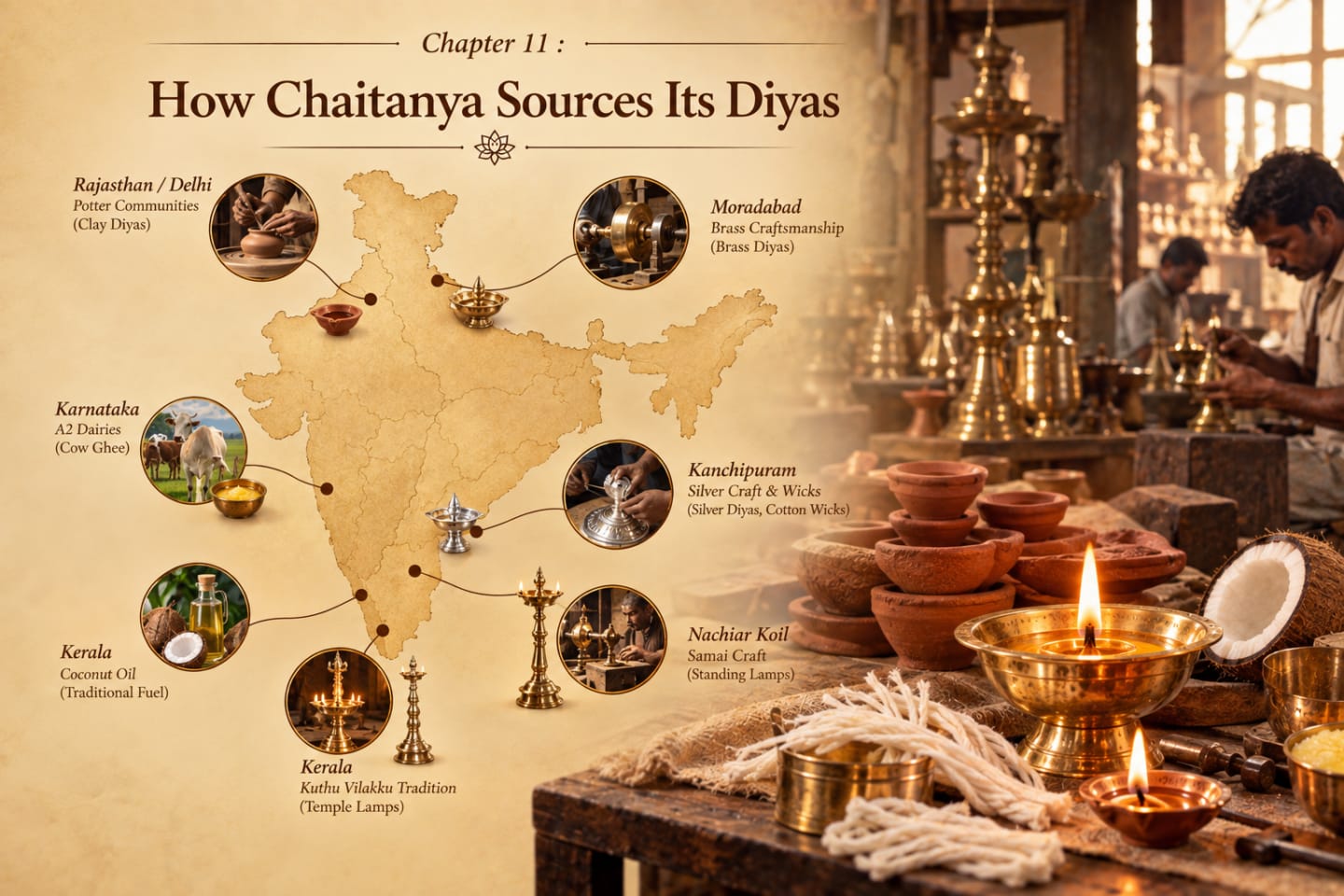
Traditional brass diyas come from five craft centres: Moradabad (India's largest brass hub, exports worldwide), Nachiar Koil (Chola-tradition lost-wax casting, ornate samai lamps), Kerala (nilavilakku standing lamps), Rajasthan (hand-hammered village-style), and Karnataka (Udupi tradition, functional temple designs).
Published · Updated · Chaitanya Global Research Team
Every previous chapter of this volume has spoken about materials — the brass diya, the panchamukhi, the samai, the wick, the ghee, the sesame oil, the coconut oil, the clay lamps for Diwali. This chapter opens the chain — where each of these comes from, who has been making them, and how a serious diya house sources honestly.
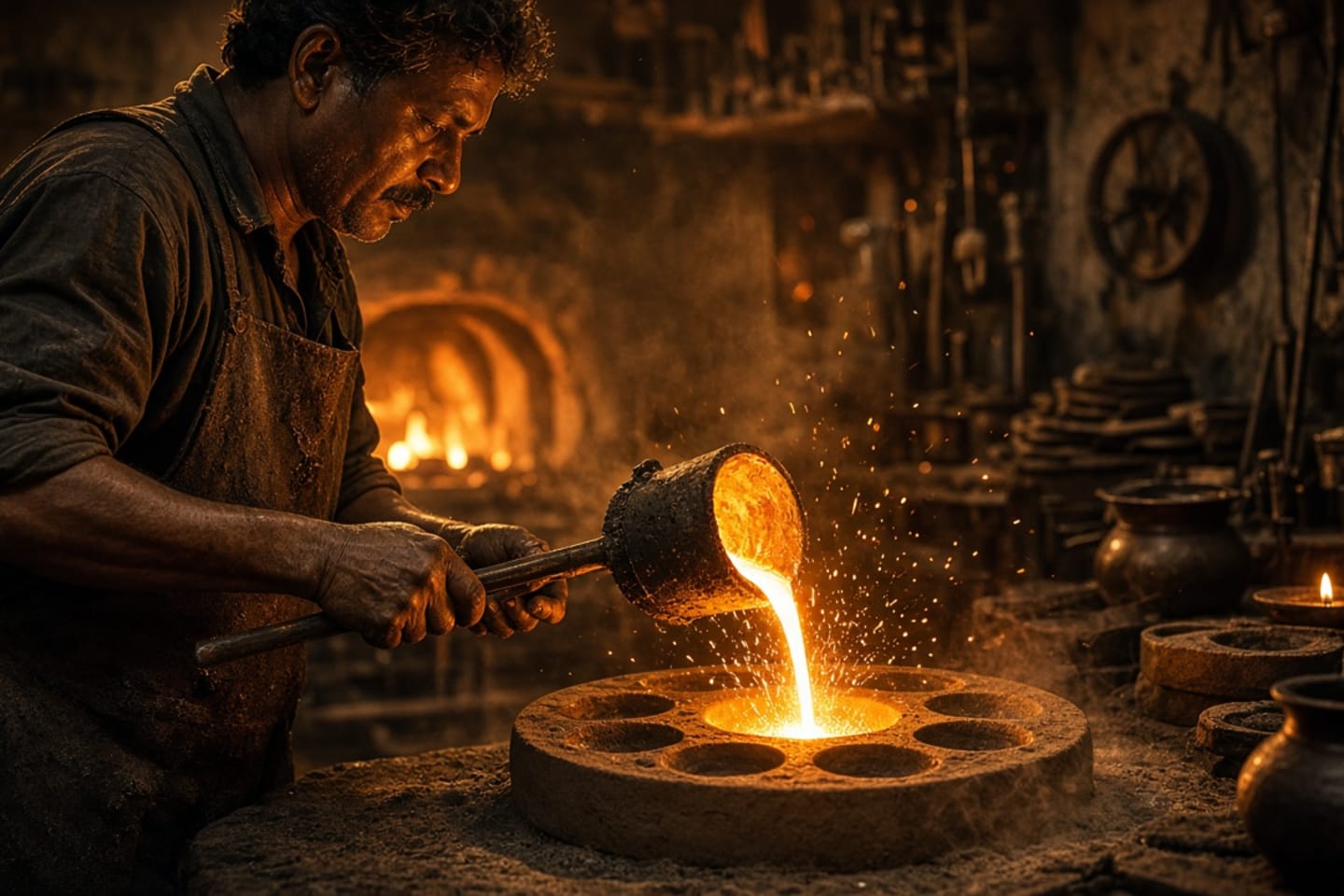
Vols 2 through 5 each closed with sourcing chapters. Vol 6's chain overlaps substantially with Vol 5 (Moradabad brass, Karnataka ghee) but adds specific new categories — potter villages for clay Diwali diyas, Nachiar Koil and Kerala workshops for samai, wick-rolling workshops in Kanchipuram. This chapter makes Chaitanya's diya sourcing visible.
Moradabad — the brass diya capital
The place. Moradabad in western Uttar Pradesh has been India's brass capital for four hundred years (see Vol 5 Ch 11 for the fuller Moradabad treatment). For diyas specifically, Moradabad workshops produce the substantial majority of India's brass household lamp inventory — the small brass deepak, the hand-diya, standard panchamukhi, standard ashta-diya, and standard household-scale samai for non-South-Indian regional variants.
Chaitanya's Moradabad diya relationship. Chaitanya sources brass diyas through the same Moradabad workshop lineage covered in Vol 5 (four-generation family). The workshop supplies:
- Small brass household deepaks in Signature, Heritage and Royal grades
- Hand-diyas with ornamental handles
- Panchamukhi in 10cm to 25cm range
- Sapta and ashta-diya in several scales and grades
- Akhand-format diyas with extended-reservoir design
- North-Indian-style standing lamps (smaller than South Indian samai)
Nachiar Koil — the samai capital
The place. Nachiar Koil in Tamil Nadu — a small town near Kumbakonam — has been the classical South Indian brass-lamp casting centre for over a thousand years. The town's tradition is on UNESCO's list of intangible cultural heritage. Nachiar Koil samai are the classical Tamil Nadu standing-lamp tradition.
Chaitanya's Nachiar Koil relationship. Chaitanya sources Tamil Nadu-style samai through a Nachiar Koil workshop with continuous four-generation family history. The workshop supplies:
- Small household samai (~60cm)
- Medium household samai (~75cm)
- Larger household samai (~90cm+)
- Premium ornate samai with fine detail work at Royal-tier pricing
Kerala kuthu vilakku — a distinct tradition, sourced through a Kerala-based workshop separately from Nachiar Koil. Kerala kuthu vilakku are made on order (traditional craftsmen work with 4-8 week lead times).
Kanchipuram — silver work and specific temple metal work
The place. Kanchipuram in Tamil Nadu (opened in Vol 5 Ch 11). For diyas specifically, Kanchipuram is central to:
- Silver diyas (particularly for Lakshmi practice)
- Small ornamental silver diyas for gifting
- Silver-embellished brass diyas
- Wick-rolling workshops that supply Chaitanya's Heritage-tier hand-rolled cotton wicks
Chaitanya's Kanchipuram relationship.
- Silver diyas sourced through a Kanchipuram silver workshop
- Traditional hand-rolled cotton wicks (samai batti style) sourced through a wick-rolling workshop
Rajasthan and Delhi periphery — the clay diya chain
The places. Rajasthan (Bikaner, Jodhpur, and various small pottery villages) and the Delhi periphery (potter communities in Uttam Nagar and adjacent areas) are the classical clay-diya sources for northern India. Bengal (particularly Kolkata potter villages) supplies eastern India; Karnataka and coastal Andhra supply southern.
Chaitanya's clay diya sourcing. For Diwali-season clay diyas, Chaitanya works with a Rajasthan-based supplier consortium that pools output from multiple small potter families. This is deliberately structured to support the potter community economy (see Ch 9). Chaitanya's clay diyas:
- Hand-formed on traditional potter's wheel (not machine-molded)
- Sun-dried (not kiln-fired for standard household grade — kilning is reserved for premium grades)
- Sold in packs of 21, 51, 108, or larger quantities for household Diwali arrangement
- Priced substantially below premium metalware — because the classical tradition treated clay Diwali diyas as one-time-use humility objects, not premium purchases
Ecological positioning. Clay diyas are fully biodegradable. After Diwali, they can be composted, returned to earth, or offered to flowing water. This is classical and ecologically-honest simultaneously.
Karnataka + Gujarat + Uttar Pradesh — the ghee chain
The places.
- Karnataka (Gir + Sahiwal dairy communities) — A2 cow ghee source
- Gujarat (traditional dairy communities) — additional A2 sourcing
- Uttar Pradesh (Braj region — Vrindavan surroundings) — small dairy communities with Krishna-tradition association producing ghee specifically for Krishna-focused households
Chaitanya's ghee sourcing.
- Royal-tier A2 cow ghee — Karnataka Gir-cattle dairy farm with A2 beta-casein certification
- Heritage-tier traditional cow ghee — general Indian dairy sources
- Signature-tier commercial ghee — good commercial dairy ghee
For serious ritual moments (Diwali, wedding, grihapravesh, Navratri akhand), Chaitanya recommends Royal-tier A2. For daily practice, Heritage-tier suffices.
Kerala + coastal Karnataka — the coconut oil chain
The place. Kerala and coastal Karnataka's coconut regions. Kerala particularly has continuous multi-generation coconut oil supply chains — the classical fuel for South Indian samai.
Chaitanya's coconut oil sourcing. Cold-pressed pure coconut oil through a Kerala-based supplier. Sold in dedicated ritual-purpose containers separated from cooking coconut oil. Small (500ml) and medium (1L) containers appropriate for household samai use.
Sesame oil chain — Tamil Nadu + Andhra Pradesh
The place. Tamil Nadu and Andhra Pradesh have the classical sesame (til) supply chains. Traditional sesame oil pressed from black til produces the classical Shani-day oil.
Chaitanya's sesame oil sourcing. Small dedicated ritual containers (250ml or 500ml) for Shani-day and specific ritual use. Small quantity purchase discouraged for casual use; households buying sesame oil are typically Shani-day-observing families with specific ritual reason.
Chaitanya's honest disclosures
Three specific disclosures about Chaitanya's diya sourcing:
1. Not every diya carries paper documentation. Signature-tier brass diyas are honestly sourced but not individually documented — they are commercial-quality items sold at commercial-quality prices. Heritage and Royal tiers carry paper documentation naming the workshop and grade.
2. Kerala kuthu vilakku require lead time. Traditional craftsmen work slowly and with attention. Orders for premium Kerala samai typically require 4-8 weeks. This is real supply chain reality, not artificial scarcity.
3. Clay diyas are seasonal. Chaitanya's peak clay-diya stock is pre-Diwali. Off-season availability is limited. Small quantities can be procured for off-season ceremonies but the primary supply period is September-October.
4. Ghee quality is variable across time. Cow ghee quality varies seasonally with the cattle's feed and health. Chaitanya's Royal-tier A2 ghee comes from a specific certified dairy but the specific batch character varies month-to-month. This is honest reality of traditional dairy sourcing.
What Chaitanya sourcing gives the customer
Craft honesty. A Chaitanya Heritage brass deepak is not the same object as a mass-market brass diya, and the difference is entirely craft — proper wall thickness, proper wick channel design, ornamental detail, workshop attention. Tier names reflect tier reality.
Supplier relationships named. If a customer asks where their samai was cast, the answer exists (Nachiar Koil workshop, specific family lineage, specific casting date). This is what a serious diya house should be able to provide.
Sustainability with respect to clay diyas. Our clay diya sourcing supports classical potter community livelihoods. When a customer buys 100 Chaitanya clay diyas for Diwali, they are simultaneously supporting classical craft economy and getting an ecologically-honest product.
Ghee quality declared. Every ghee tier is honestly named. Royal-tier is genuinely A2 with dairy documentation; Signature-tier is honestly labelled as commercial ghee. Neither is misrepresented.
“A diya is downstream of sourcing. The flame on the household mandir tomorrow morning is only as good as the brass that holds it, the wick that carries it, and the ghee that feeds it. This is Chaitanya's chain, made visible.”
Use these to evaluate any diya supplier — Chaitanya included.
1. Where is your brass from — Moradabad, Nachiar Koil, or general? All classical centres are legitimate; the answer should be specific and honest.
2. Are your samai from Nachiar Koil or Kerala workshops (traditional casting), or from generic brass factories? Real samai command real workshop-tradition; generic brass "samai-shaped" objects don't.
3. Are your clay diyas hand-formed by potter communities or machine-molded factory products? Machine-molded clay diyas are widely sold in the modern market; hand-formed clay diyas support the classical potter economy and burn cleaner.
4. Is your ghee cow ghee or mixed, and if cow, A2 or commercial? The classical hierarchy matters and should be honestly named.
5. Are your wicks pure cotton (bleached or unbleached) or synthetic-blend? Synthetic-blend wicks are unacceptable; the honest wick supplier will name the material.
6. What is your fire safety guidance for akhand deepak customers? A responsible diya house will discuss fire safety without evasion.
7. Do you support returns and independent testing? A house confident in its sourcing offers this; a house that refuses is a house whose sourcing you should not trust.
A house that answers all seven honestly is a house you can buy from with confidence. A house that gives vague answers is a house whose diyas may not be what they claim.
Published by the house of Chaitanya · www.chaitanya.global
Kits & products from this chapter
Available wholesale, or under your own label.

