Single-Wick & Multi-Wick Diyas
One wick is the household's daily instrument. Five wicks is Navratri. Seven wicks is the seven sages. Eight is the eight directions. The number of wicks on a diya is never arbitrary.
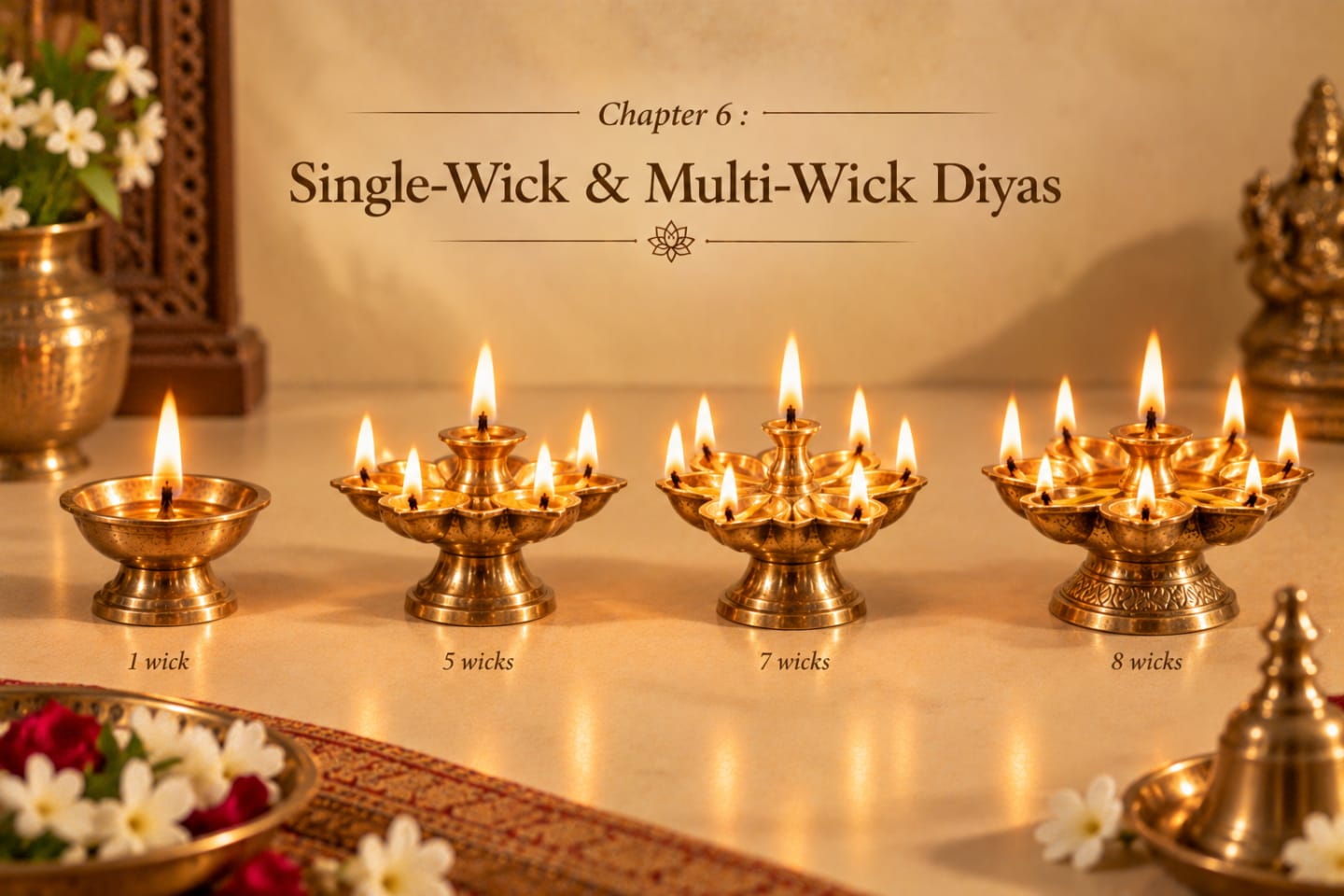
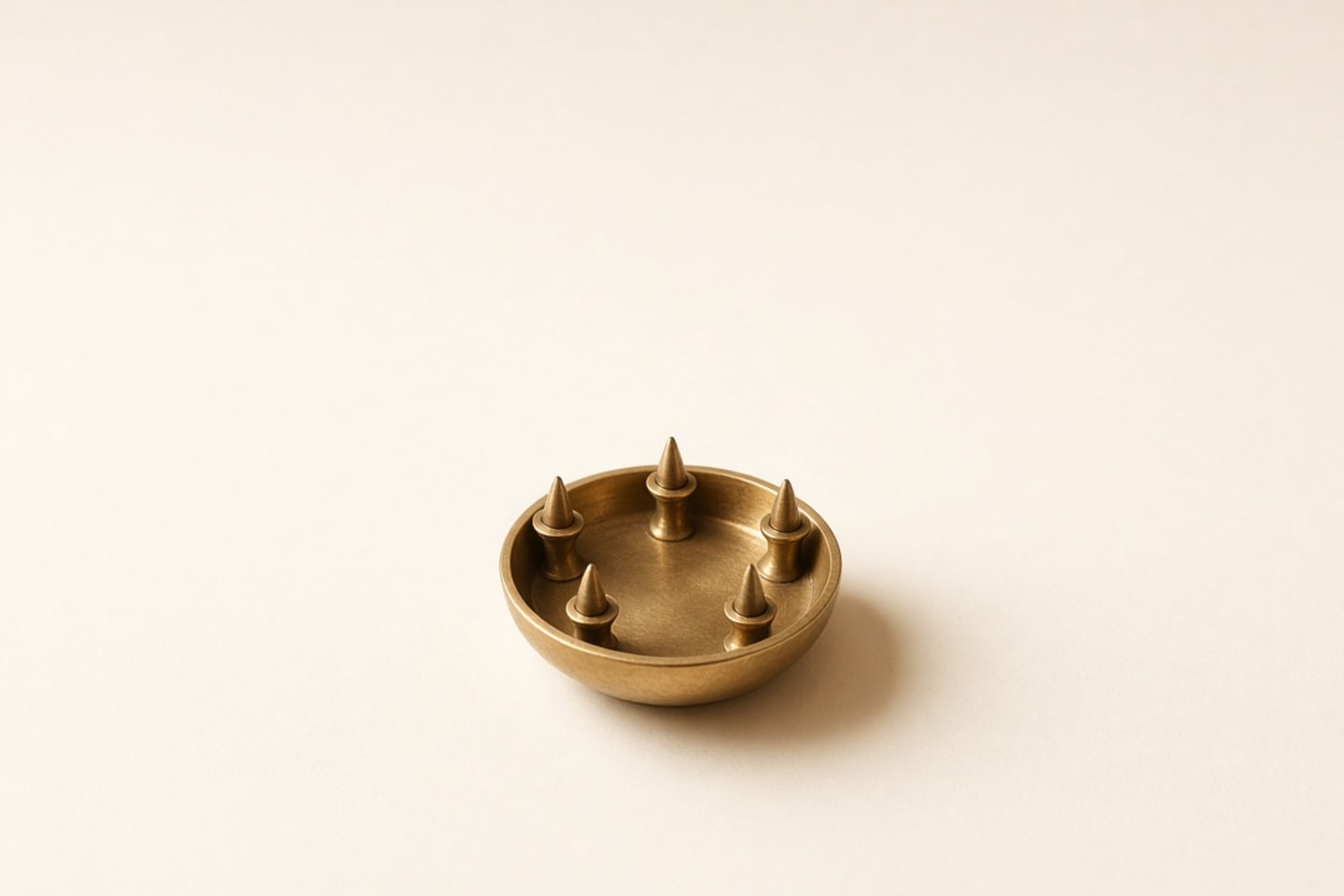
A panchamukhi diya has five wicks representing the five elements (pancha tattva): earth, water, fire, air, and ether. Classical multi-wick configurations: single (daily aarti), five (special pujas), seven/saptamukhi (Lakshmi), and eight/ashtamukhi (Durga during Navratri). More wicks indicate a more significant occasion.
Published · Updated · Chaitanya Global Research Team
Every household mandir owns at least one single-wick diya — the small brass deepak for daily morning aarti. Every serious mandir owns at least one multi-wick variant — a panchamukhi (five-face) or saptamukhi (seven-face) or ashtamukhi (eight-face) diya used for specific festival and ceremonial moments.
The number of wicks is not decorative. Each number the tradition uses carries specific tradition-meaning tied to specific ritual moments. This chapter opens the classical numerology of the wick count — why the tradition made lamps with five wicks, and seven, and eight, and what each is for.
Why the wick count matters
A single-wick diya produces one flame. A five-wick diya produces five simultaneous flames. This is not the same as five single-wick diyas placed together. In the classical tradition, the multi-wick diya is understood as producing a compound flame — five (or seven, or eight) flames that arise from a single fuel reservoir and are read collectively rather than individually.
The compound flame has specific ritual properties:
- Intensified light. More flames produce more light in the mandir zone.
- Compounded fuel-offering. More wicks burn more fuel per hour — the offering is quantitatively greater.
- Symbolic multiplication. The classical meanings of the specific number (five directions, seven sages, eight guardian deities) are simultaneously invoked.
- Larger ritual moment. A multi-wick diya lit for a specific puja announces that the moment is not ordinary daily practice; something ceremonial is happening.
The tradition holds specific multi-wick diyas for specific moments. This chapter opens what those are.
Single-wick — the household daily
The classical household morning aarti uses a single-wick brass deepak — the small round diya opened in Chapter 3. This is the daily instrument.
The single flame carries its own tradition-meaning:
- Unity. One flame representing the one deity present in the mandir.
- Focus. Single attention, single mantra, single household member's presence.
- Simplicity. Not ceremony; simply daily practice.
- Repeatable. The single flame is what the household can maintain morning after morning, decade after decade.
Every serious devotional practice starts with the single-wick daily diya and stays with it as the base. Multi-wick variants are added for specific moments — but the daily practice remains single-wick. To upgrade to multi-wick as daily practice is to over-elaborate what the tradition designed for consistency.
Panchamukhi (five-wick) — the elements and directions
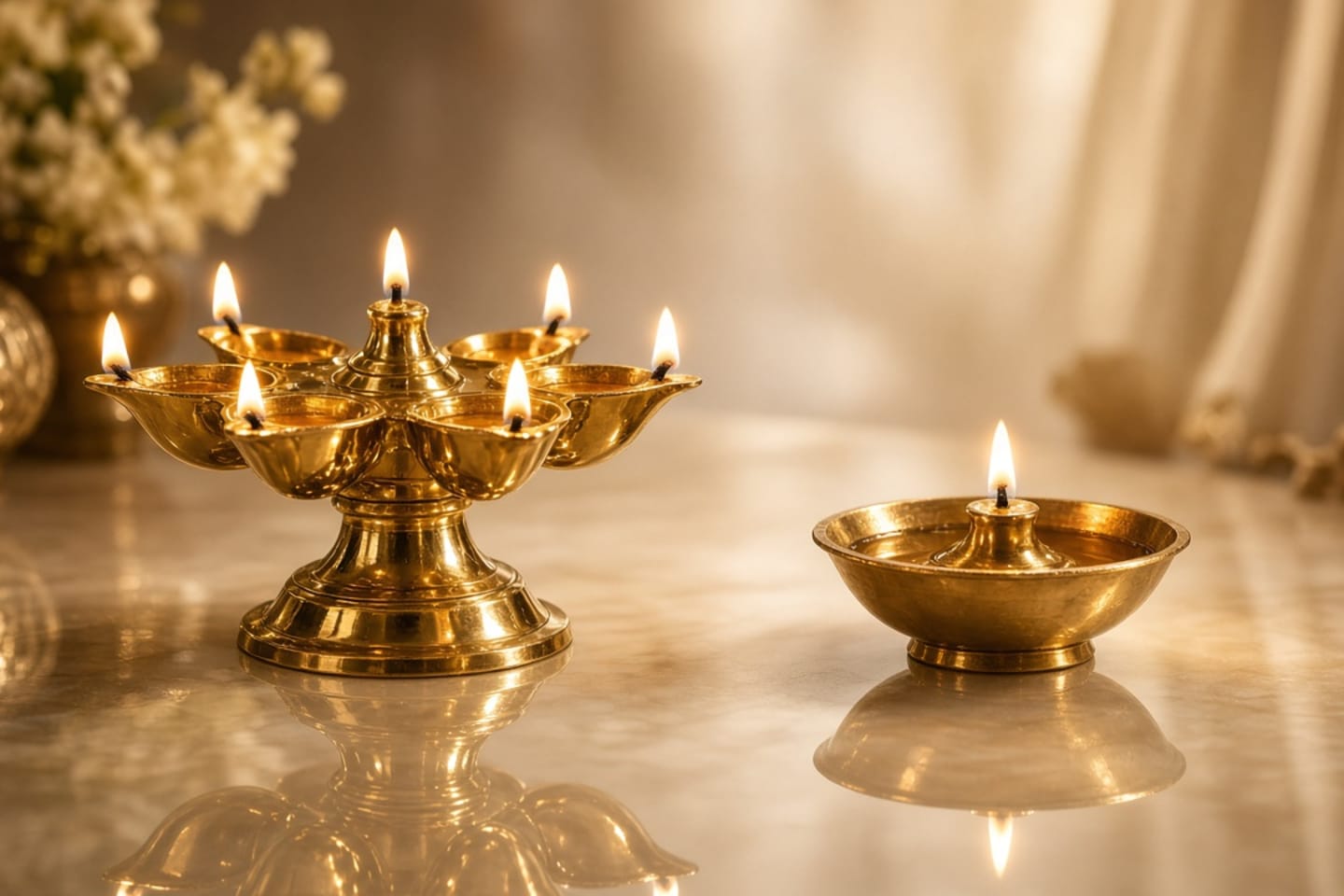
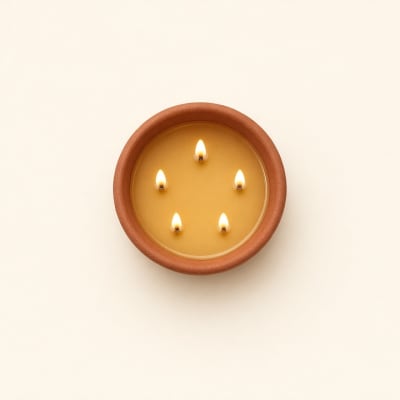
The panchamukhi diya (पञ्चमुखी दीप) — literally "five-faced lamp" — has five wick positions arranged around a central fuel reservoir. The traditional form: a shallow brass bowl with five small pinched extensions at 72-degree intervals around the rim, each holding a cotton wick.
Classical meanings. The five wicks represent:
- The five elements (pancha-mahabhuta) — earth (prithvi), water (jala), fire (agni), air (vayu), ether (akasha). Every act of manifest reality involves these five; the panchamukhi diya honours them all simultaneously.
- The five directions — east, west, north, south, plus centre. The diya's flames send light in all five directions simultaneously.
- The five sensory faculties (jnana-indriyas) — sight, hearing, smell, taste, touch. The five wicks honour the five ways manifest reality reaches consciousness.
- The five heads of Shiva (Panchanana Shiva) — the five-faced form of Shiva that classical iconography depicts. This is why the panchamukhi diya has particular association with Shaiva tradition.
Household use.
- Navratri (nine nights of Devi). Panchamukhi is the classical Navratri lamp — often lit on the first night and kept burning through all nine (see Chapter 7 on akhand practice).
- Maha Shivratri. The panchamukhi's five-Shiva-heads association makes it appropriate for the classical Shiva-night puja.
- Ganesh Chaturthi. Panchamukhi at the puja with the Ganesha murti.
- Grihapravesh. Some traditions light a panchamukhi for the household entry ceremony.
- Diwali Lakshmi puja. Some traditions use panchamukhi alongside single-wick diyas for Lakshmi puja.
Sizes. Small panchamukhi (~10-15cm across) for household mandir; medium (~20-30cm) for larger ceremonies; large (~40cm+) for temple use.
Materials. Brass is standard; premium silver panchamukhi diyas are made for Lakshmi puja and ceremonial gifting.
Saptamukhi (seven-wick) — the seven sages, seven chakras, seven days
The saptamukhi diya (सप्तमुखी दीप) — seven-wick — has seven wick positions. Less common than panchamukhi in household use; more common in temple settings.
Classical meanings. The seven wicks represent:
- The seven Rishis (sapta-rishi) — the seven sages of classical Vedic tradition (Vasishtha, Bharadwaja, Vishwamitra, Gautama, Atri, Kashyapa, Jamadagni in one classical list). These are the composers of the Rig Veda and considered the founding lineage of Vedic knowledge.
- The seven chakras (sapta-chakra) — the seven principal energy centres of the subtle body in tantric tradition.
- The seven days of the week — each day associated with a specific deity (Sunday-Surya, Monday-Chandra, Tuesday-Mars/Hanuman/Kartikeya, Wednesday-Buddha/Mercury, Thursday-Guru/Jupiter/Vishnu, Friday-Shukra/Devi, Saturday-Shani).
- The seven notes of the classical Indian music scale (sa-re-ga-ma-pa-dha-ni) — flame as sound-adjacent.
- The seven flames of Agni — a specific classical Vedic reference to Agni's seven tongues.
Household use. Saptamukhi is used for:
- Weekly meditation practice — some serious practitioners light a saptamukhi for meditation sessions dedicated to specific chakra work.
- Guru Purnima — the festival of the classical guru tradition.
- Sapta-rishi puja — specific classical rituals honouring the seven sages.
- Extended pujas (Satyanarayan, elaborate weddings) — as one of multiple diyas in a larger ceremonial arrangement.
Saptamukhi is less of a household-daily instrument and more of a serious-ceremonial instrument. Modest household mandirs typically own a panchamukhi but not a saptamukhi; more elaborate household mandirs own both.
Ashtamukhi (eight-wick) — the eight directions
The ashtamukhi diya — eight-wick — has eight wick positions arranged around a central reservoir at 45-degree intervals.
Classical meanings. The eight wicks represent:
- The eight directions (ashta-disha) — the four cardinal (east, west, north, south) plus the four intermediate (northeast, northwest, southeast, southwest).
- The eight direction-guardian deities (Ashta-dikpala) — Indra (east), Yama (south), Varuna (west), Kubera (north), and their intermediate-direction counterparts (Agni southeast, Nirriti southwest, Vayu northwest, Ishana northeast).
- The eight forms of Lakshmi (Ashta-Lakshmi) — the eight aspects of Lakshmi's manifest presence.
- The eight-fold path of yogic realisation (in some classical enumerations).
Household use.
- Ashta-Lakshmi puja — the specific eight-Lakshmi celebration.
- Diwali — some households use ashtamukhi alongside other diyas for extended Diwali night puja.
- Vastu-related rituals — because the eight directions align with Vastu tradition, ashtamukhi is used for grihapravesh and specific Vastu-focused practices.
- Temple use — common in South Indian temples with elaborate architectural direction-symbolism.
Ashtamukhi is rarer than panchamukhi in modern household use. It appears in serious Vaishnava households and in Lakshmi-focused traditions.
Twelve-wick and beyond
The tradition occasionally uses higher wick counts for specific ceremonial contexts:
Dvadasha-mukhi (twelve-wick) — twelve wicks for the twelve months, twelve zodiac signs, or the twelve principal Adityas (solar deities). Rare; used for annual-cycle rituals.
Ekavimshati-mukhi (twenty-one-wick) — very rare; specific temple ceremonies.
Sahasra-jyoti (thousand-flame) — not a single diya but an arrangement of one thousand small diyas lit together, primarily during Karthigai Deepam (Tamil Nadu November festival) and specific major temple events. Ceremonially spectacular.
What the tradition asks of the household
Not every household needs every multi-wick variant. The classical guidance:
A single-wick brass deepak — every household mandir has one, used daily. Essential.
A panchamukhi (five-wick) — every serious devotional household should have one. Used for Navratri, Shivratri, major festivals. Modest one-time investment that enables classical festival practice.
A saptamukhi or ashtamukhi — added when household practice deepens into specific traditions (Devi-focused meditation, Ashta-Lakshmi practice, elaborate weekly puja). Not required for standard household observance.
Higher wick counts — reserved for serious tradition practice or temple settings.
The household with a good single-wick and a good panchamukhi has the vast majority of what daily and festival practice requires.
“One flame is the daily. Five is the Devi's presence in the elements. Seven is the sages. Eight is the guardians. Each number the tradition specified was specifying something specific — and the household that owns the specific lamp is holding the specific tradition inside its own mandir.”
The classical wick counts skip specific numbers. Panchamukhi is common. Six-wick lamps are rare. Seven is common; four-wick lamps are essentially absent. Eight is common. Why the specific selection?
The pattern reveals the tradition's numerological logic:
Numbers with classical multiplicative structure appear often. Five = five elements. Seven = seven sages / seven chakras. Eight = eight directions. Twelve = twelve months.
Numbers without specific tradition-meaning appear rarely. Four could represent the four Vedas but doesn't have a distinctive lamp-tradition. Six doesn't map cleanly to any classical seven-fold-or-eight-fold enumeration. Ten is present in the Vishnu-Dashavatara tradition but doesn't have a specific lamp-form associated.
The rule: the tradition made lamps for numbers that had ritual power — numbers whose classical multiplicative meaning was strong enough to justify a dedicated lamp form. Numbers that were just "another integer" did not receive dedicated forms.
This is why walking through the classical lamp collection is walking through a classical numerology — not arbitrary counts, but a specific set of numbers each with tradition-weight. A serious household mandir's lamp collection reveals the household's own numerological literacy: whether it holds the five (panchamukhi for Devi), the seven (saptamukhi for meditation), the eight (ashtamukhi for Lakshmi), or higher.
Published by the house of Chaitanya · www.chaitanya.global
Kits & products from this chapter
Available wholesale, or under your own label.