Why the Flame
Every household mandir in India begins its day the same way. A small brass lamp is lit. This chapter opens why — and why the flame, of all the objects the tradition names, is the one that has never faded.
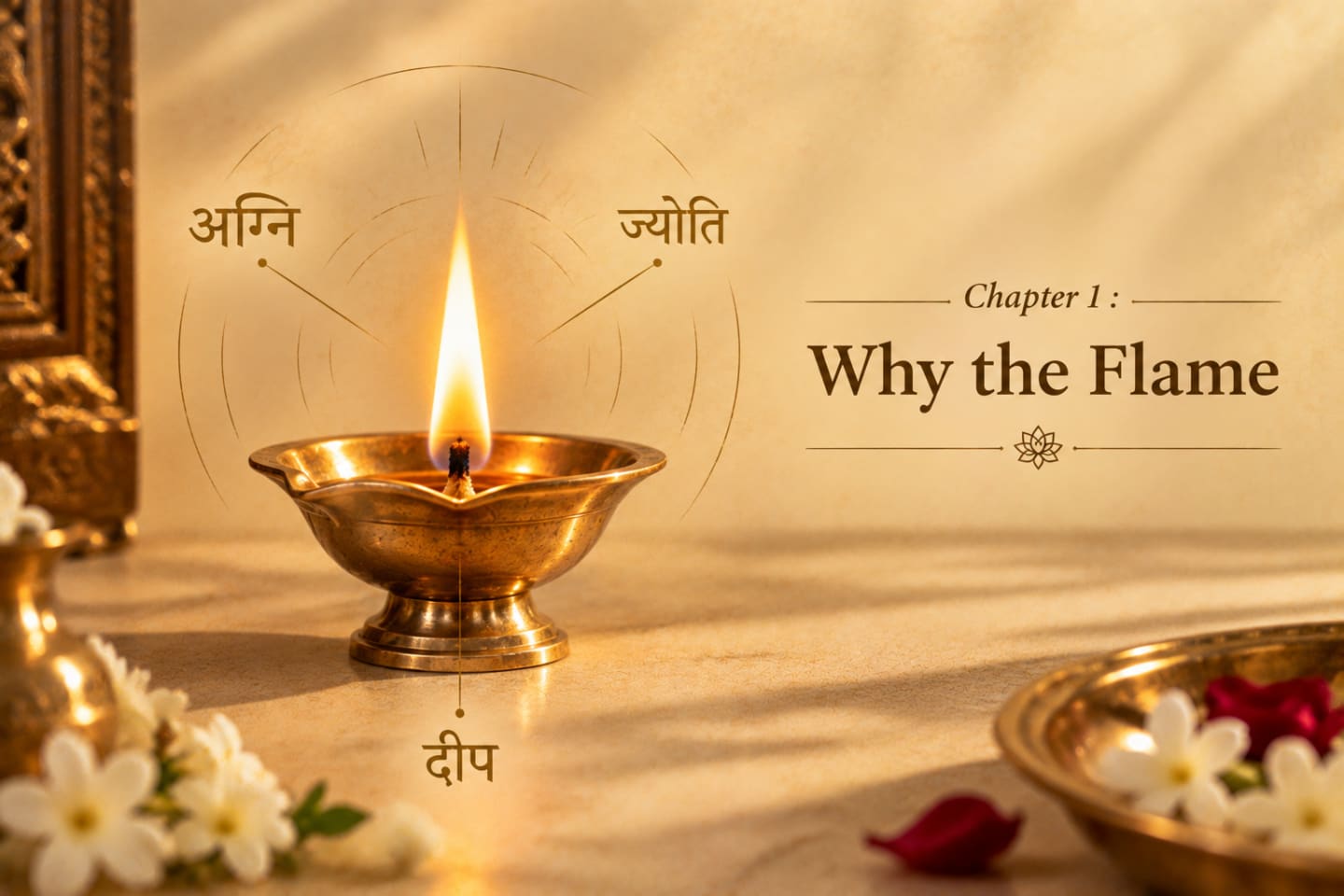
The diya (oil lamp) is the oldest continuous ritual instrument in the Indian household. It represents Agni (fire deity) and jyoti (divine light). Lighting a diya is the first act of every puja — without flame, no ritual is considered begun. The flame's direction, height, colour, and steadiness are interpreted as divine signals.
Published · Updated · Chaitanya Global Research Team
Walk into any Indian household mandir shortly after sunrise and you will find one thing lit. Not the incense — that comes second. Not the ghanta — that comes third. Not the murti — the murti sits in its place unlit until the flame arrives. The diya. A small brass or clay lamp holding a spoonful of ghee and a hand-rolled cotton wick, lit as the first act of the household's ritual day.
This precedence is not accidental. Across the four thousand years of documented Indian devotional practice, across every sampradaya (lineage) and every regional tradition, one instrument sits at the beginning of every ritual: the lit flame. Before the mantra, before the offering, before the incense, before the aarti — the flame. This volume of the Grantha opens why.
The flame in the Indian understanding
The Sanskrit word for flame is jyoti (ज्योति) — a word that carries a specific classical meaning. Jyoti is not merely light in the physical sense (that word is prakasha). Jyoti is consciousness itself as luminosity — the awareness that illuminates the objects of experience. When classical Indian tradition speaks of jyoti, it is speaking of the same reality that Western contemplative traditions call presence or awareness — the illuminating quality that makes any object of consciousness knowable.
The lit diya, then, is not merely a source of physical light. It is a physical instance of jyoti — a visible, contained, present-in-the-room manifestation of the same illuminating principle the tradition understands as consciousness itself. Every time a household lights the morning diya, the classical understanding is that the household is placing an instance of consciousness-as-luminosity into the mandir's physical space.
This is why the flame precedes everything else. Before offerings can happen, presence must arrive. Before mantras can be recited, consciousness must be invited. Before the deity can be worshipped, illumination must be established. The lit diya is the tradition's method for physically inviting these into the household mandir.
The flame and Agni — the messenger
The other classical Sanskrit name for the flame is Agni (अग्नि) — the same word that names one of the oldest and most central Vedic deities. Agni is not merely fire. Agni is the personified deity of fire — one of the Rig Veda's most-invoked gods, present in over 200 hymns of the world's oldest continuously-preserved religious text.
Agni's classical role is specific: Agni is the messenger between the human and the divine. Every offering made to any Vedic deity — from soma libations to ghee libations to grain offerings to sacred verses — is offered into fire. Agni receives the offering, transforms it into smoke and heat, and carries it upward to the deity for whom it was intended. Without Agni, offerings do not reach their destination. The flame is the classical Indian tradition's telephone line to the gods.
This is why every serious Vedic ritual — from the daily household aarti to the elaborate havan-kunda fire ceremony to the wedding around the sacred fire (the saptapadi seven-step ritual) — happens in the presence of a lit flame. The flame is not decoration or lighting. The flame is the messenger who carries the ritual to its addressee.
For the household morning aarti, the small brass diya is Agni in miniature — the same messenger, in a modest form, present in the mandir to carry the household's daily devotion to the deity present in the murti.
Why the household lights the diya, in specific
Beyond the philosophical understanding, the tradition names four specific reasons the household lights the daily diya:
1. To welcome the deity into the mandir. The classical understanding: the deity present in the murti is not permanently active. The household lights the diya each morning to awaken the deity — the flame is the announcement that the ritual moment has begun and the deity's active presence is invited. The evening aarti's flame is the counterpart — the announcement that the day's active ritual is closing.
2. To honour the deity present in the murti. The lit flame before the murti is an offering of light itself to the deity. In classical iconography, virtually every deity's darshan (visual encounter) happens in the illumination of a diya. Without light, the darshan is incomplete.
3. To purify the household space. The tradition attributes to the lit flame a specific purification function — the flame's heat and light are understood to remove subtle negative influences from the household mandir zone. This is why serious devotional households light the diya before any significant household activity (before major meals, before beginning study, before starting a new business venture).
4. To carry the household's offerings to the deity. As described above — Agni-as-messenger. Every mantra chanted before the lit diya is understood as amplified in its reach by the presence of the flame that will carry it upward.
Why the flame has never faded
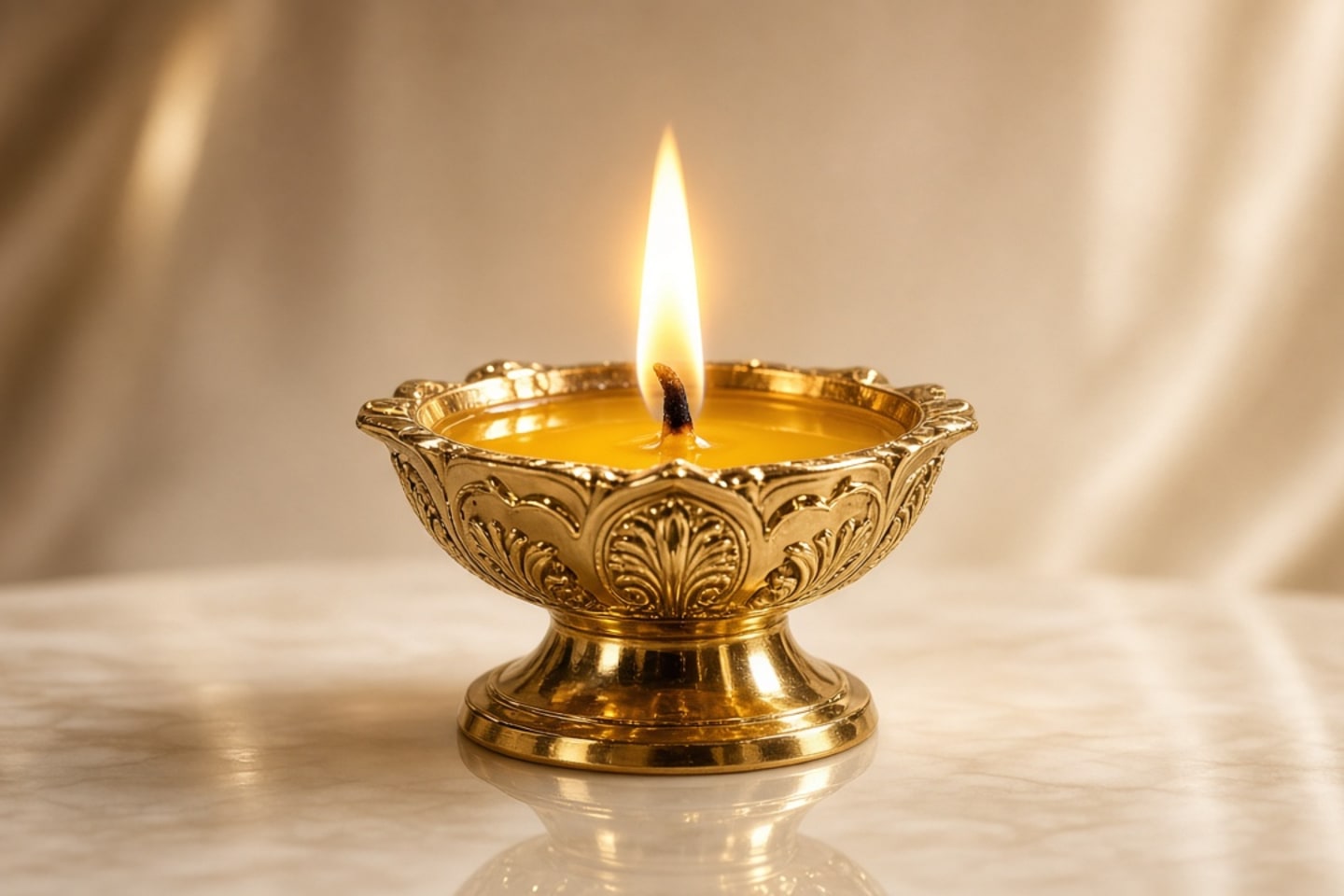
Across the four thousand years of documented Indian household devotion — across the arrival of Islam, the arrival of Christianity, the arrival of colonial modernity, the arrival of electric lighting, the arrival of LED tea-light substitutes — the traditional oil-and-wick diya has never faded from Indian household practice. It has adapted (electric diyas exist and are used in some contexts) but the classical brass-and-ghee-and-cotton-wick diya continues to occupy the centre of the household mandir with roughly the same practice as it held two thousand years ago.
Why?
Because no substitute performs the same ritual function. An electric diya provides light but not Agni — there is no combustion, no transformation of matter into flame, no rising smoke, no fuel being offered. A candle provides combustion but not the specific offering of ghee — the fuel matters (Chapter 4 opens the ghee tradition). A modern LED simulates the appearance of flame but lacks all the classical properties the tradition treats as essential.
The traditional oil diya is not the household's lighting choice. It is the household's ritual choice. The two are not the same, and the tradition has held this distinction continuously.
What this volume opens
Twelve chapters ahead:
Chapters 2-3 open the flame and the diya as physical objects — how the tradition reads the flame's direction, height, colour and steadiness (Ch 2); how the diya's materials and forms carry meaning (Ch 3).
Chapters 4-5 open the fuel and the wick — the ghee and oils the tradition uses (Ch 4); the specific cotton-wick tradition and its variants (Ch 5).
Chapters 6-8 open the specific diya types — single-wick and multi-wick variants (Ch 6); the akhand deepak continuous-flame tradition (Ch 7); the South Indian samai standing lamp tradition (Ch 8).
Chapter 9 opens Diwali — India's most flame-intensive festival — and the classical practices around the household row of lit diyas.
Chapter 10 is the moment guide — mapping every household ritual moment to the appropriate diya, fuel, and wick choice.
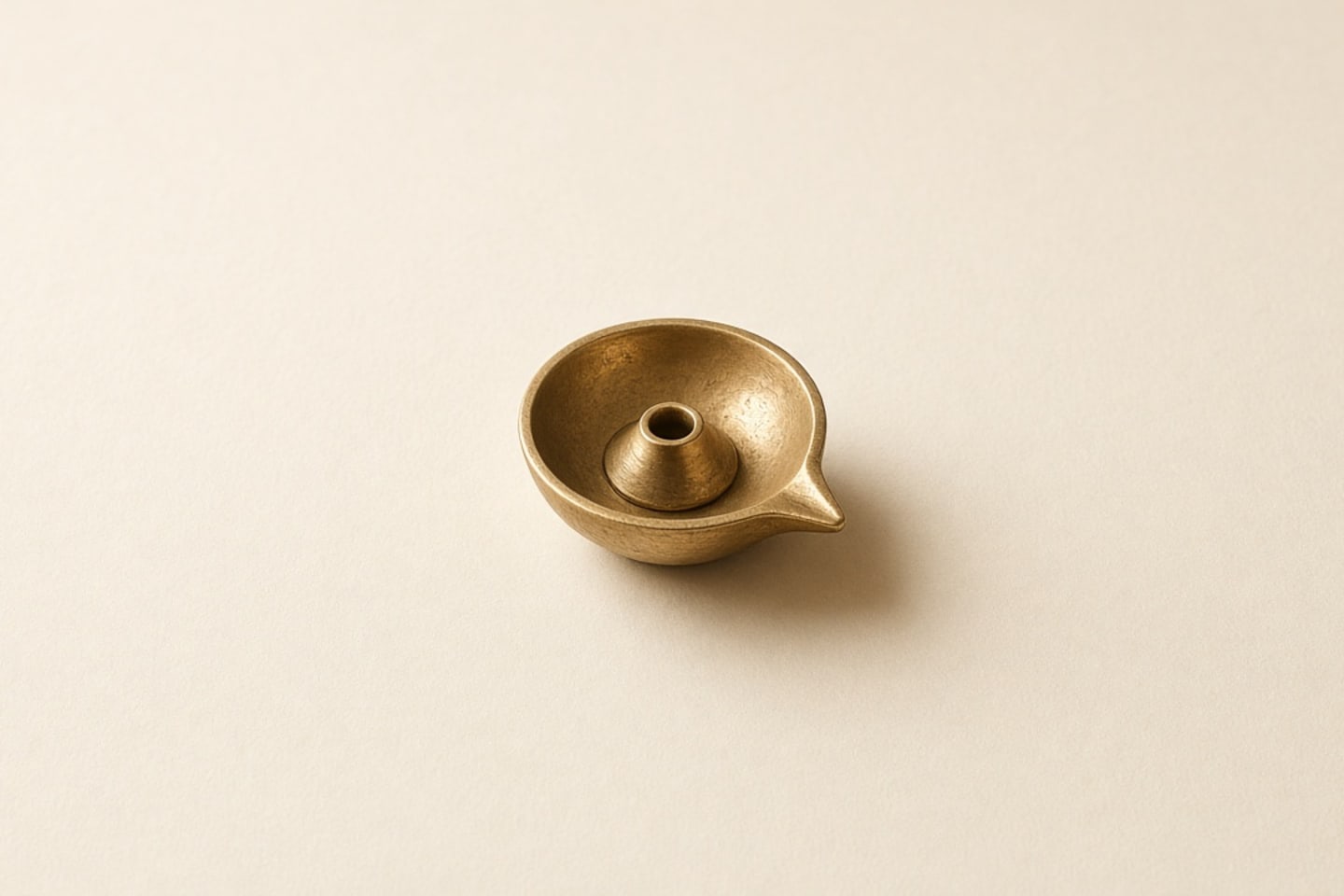
Chapter 11 opens Chaitanya's sourcing chain for diyas across brass, silver, and clay.
Chapter 12 is the decision tree — which diya set your household should start with, in three tiers.
“The flame is the household's oldest continuous ritual. Before the mantra, before the offering, before the incense, before the aarti — the flame. It has never faded, and this grantha's work is to open why it should not, in your household either.”

The classical Sanskrit vocabulary for flame has more names than most world languages. Each name carries a specific shade of meaning:
Agni (अग्नि) — flame as messenger deity. Personified. Rig Vedic. The classical fire-god.
Jyoti (ज्योति) — flame as consciousness-luminosity. Philosophical. Used in tantric and Vedantic contexts.
Deepa / Deepak (दीप / दीपक) — flame as household lamp. Domestic. The everyday word for the diya's light.
Jvala (ज्वाला) — flame as leaping fire. Descriptive. Used for larger fires and the aarti-camphor climax.
Analaha / Analam (अनल) — flame as consumer / transformer. Used in specific tantric and yogic contexts to describe fire's transformative function.
Five words. Five shades of the same flame. The tradition's language is more nuanced than the modern household's practice. Each name suggests a different relationship — with Agni you invite, with jyoti you recognise, with deepa you light, with jvala you witness, with anala you offer. The full Sanskrit vocabulary invites the household to hold all five simultaneously.
Published by the house of Chaitanya · www.chaitanya.global
Kits & products from this chapter
Available wholesale, or under your own label.

