The Household Mandir
Before the objects can matter, the mandir has to be right. This chapter opens the architecture — where, how big, facing which direction, made of what, and why.

A home mandir should face east or north, ideally in the northeast corner of the home, never adjacent to a bedroom or bathroom. The shelf or cabinet sits at chest height. Material: wood (teak, sheesham) or marble. Keep it clean daily, light a diya and incense at fixed times, and never store non-ritual items inside.
Published · Updated · Chaitanya Global Research Team
Every serious household in India has one. A dedicated space — sometimes a full room, more often a corner of the living room, most often a small wooden or brass unit mounted on the wall or on a shelf — where the sacred objects the tradition names sit together and where the daily aarti happens. The name is mandir (मंदिर) at the household scale; the same word is used for temples at the community scale, and this is not accidental. The household mandir is a small temple. It is meant to be treated with the same seriousness the tradition treats its larger cousins.
But the modern household mandir has drifted. Cardboard shelves in a bedroom corner. Deity pictures wedged between family photos. Diyas lit in inconsistent locations. Direction ignored. Material choices unconsidered. The tradition offers specific guidance on all of this — where the mandir sits, how it is built, which direction it faces, what material it is made from, what does and does not belong on it. This chapter opens that guidance.
The four categories of household mandir
Not every household has (or needs) the same scale of mandir. The tradition recognises four categories, each with its own rules.
1. The pooja alcove (small, wall-mounted or shelf). A small wooden or brass unit ~30×40cm — enough to hold a central murti or picture, three or four small brass instruments, a diya, and one katori set. This is what perhaps 60% of urban Indian households have. It fits on a bedroom shelf, in a kitchen corner, or on a small wall bracket. Simple, contained, adequate for daily aarti.
2. The pooja niche (medium, dedicated wall zone). A dedicated wall area or built-in cabinet ~60×80cm — with more storage, room for multiple deities, and space for larger instruments (a proper shankh, a full aarti thali). Common in slightly larger urban homes and in traditional row houses.
3. The pooja room (small dedicated room). A small dedicated room — sometimes converted from a walk-in closet, sometimes purpose-built in newer construction. The mandir occupies one wall; the room is used exclusively for devotional practice. Common in serious devotional households and in most South Indian traditional homes.
4. The pooja hall (temple-scale household space). A large dedicated room designed for extended puja, havan capacity, and periodic community gathering. Rare in modern urban settings but present in traditional joint-family homes, in havelis, and in devotional-community households.
The rest of this chapter's guidance applies most fully to categories 3 and 4, and progressively less strictly to 1 and 2. Every household adapts the tradition to its available space; the tradition understands and permits this.
Direction and placement
Direction — the mandir should face east. The classical instruction: the deity's face looks east, so the devotee stands facing west while offering puja. East is the direction of sunrise, of Surya (the sun god), of the classical morning aarti moment. If east is not architecturally possible, north is the second acceptable direction.
Directions to avoid. The mandir should not face south (south is associated with Yama, death, and inauspicious directions in classical Vastu). It should not face directly toward a bedroom door or bathroom (impure adjacencies). It should not be below staircases or under heavy furniture on the floor above (energy-suppressing placement).
Height. The mandir surface should sit approximately at chest height when the household member is standing — high enough that the deity is honoured (not looked down upon), low enough that morning aarti can be offered comfortably. For wall-mounted units, roughly 4-5 feet from the floor.
Adjacencies to preserve. The mandir should have some breathing space around it. Not crammed between the fridge and the shoe rack. Not directly behind a television. Not in a passageway of high foot traffic. The tradition asks for a small zone of relative quiet around the mandir.
Adjacencies to avoid. No bathrooms sharing walls behind the mandir. No dustbins or laundry piles near the mandir. No shoes stored under or adjacent to the mandir zone. No sleeping directly with feet pointing toward the mandir (traditional but a widely-observed rule).
Materials for the mandir itself
The physical construction material of the mandir — the shelf, unit, or wall structure — carries its own tradition.
Wood — the classical. Teak, rosewood, sheesham (Indian rosewood), or mango wood. Warm, natural, receptive to the daily aromatic materials that will settle onto it (incense residue, sandalwood, oil vapours). Wood mandirs age beautifully; they take on the household's own patina across decades.
Marble — the premium. White or coloured marble. Cool, formal, associated with temple architecture. Marble mandirs are considered particularly auspicious but are heavier, more expensive, and require solid wall support.
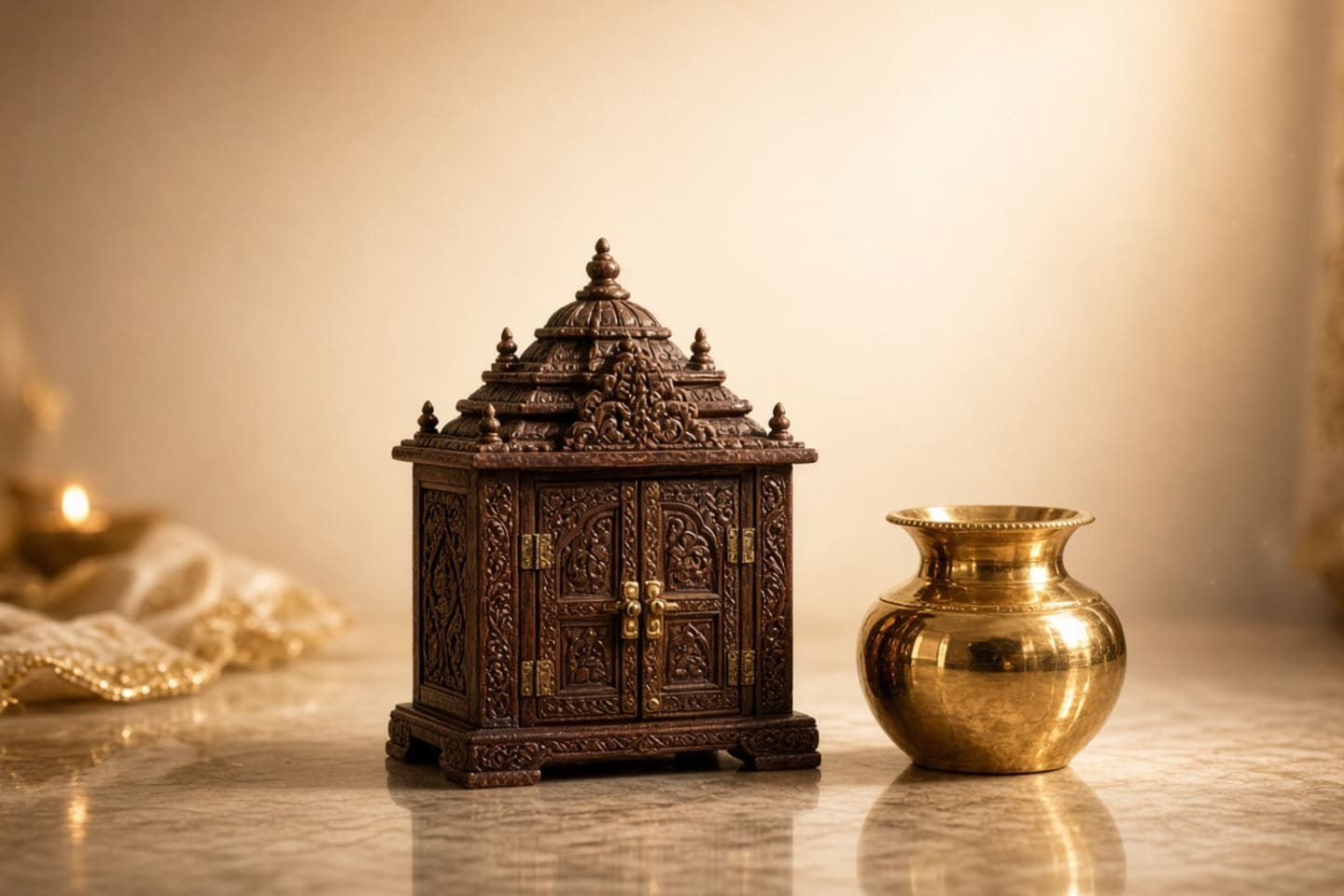
Brass — the compact modern. Small brass mandirs (typically 30-40cm) are used for wall-mount or shelf placement. Elegant, easy to clean, but limited in size.
Sandalwood — the premium classical. A small dedicated sandalwood mandir carries its own continuous fragrance through the wood, complementing the samagri chandan practice. Expensive and rare; found in serious traditional South Indian households.
Steel or glass — the modern shortcut. These exist in the modern market. The tradition does not endorse them. Steel is understood as too cold; glass as too fragile and transparent. Households using them are respecting practical constraints; the tradition's preferences remain wood or marble.
What goes on the mandir
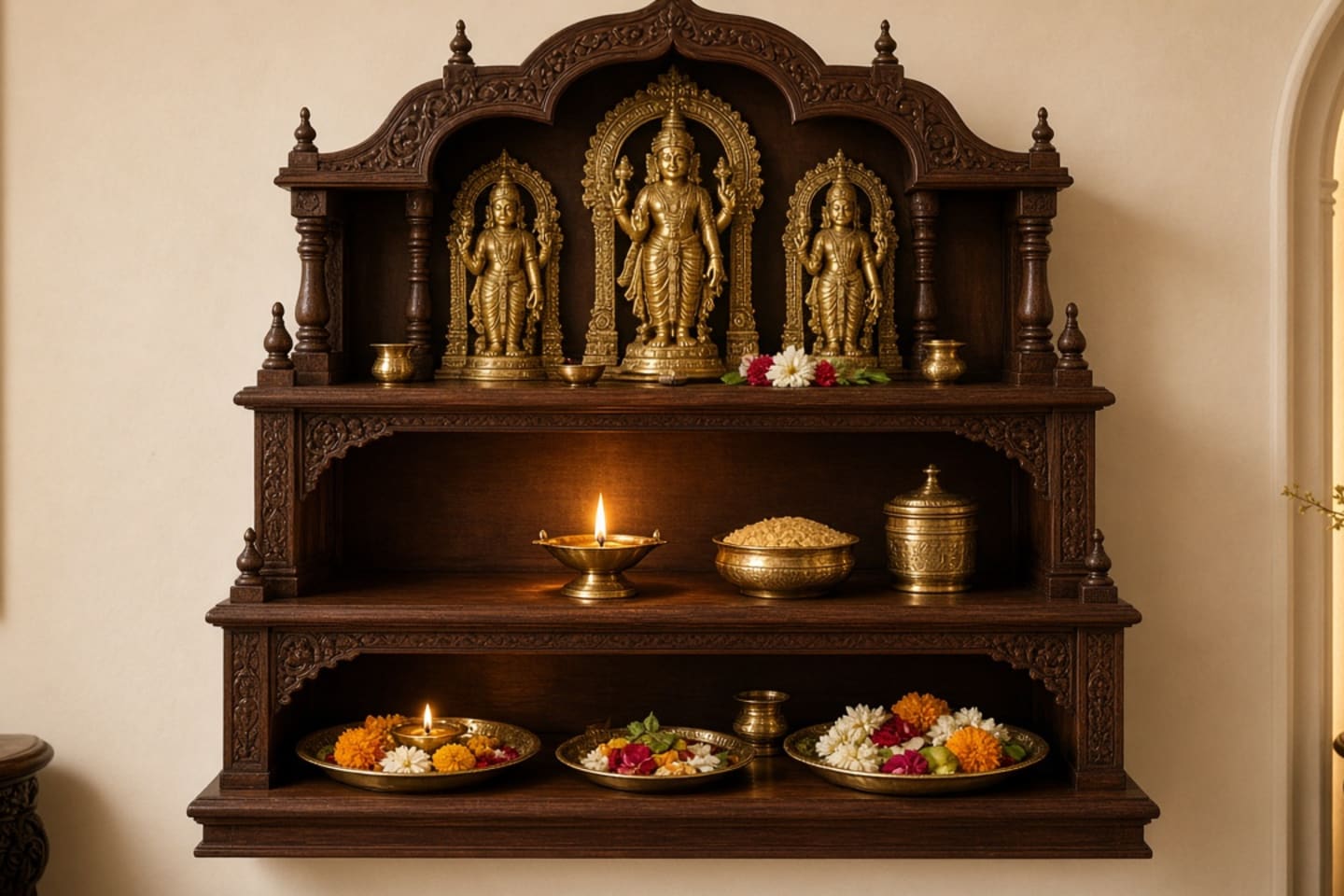
A properly-organised household mandir carries a specific hierarchy of objects, arranged from top (highest sanctity) to bottom (working surfaces).
Top shelf — the deity. The central murti, picture, or symbol of the primary deity. Larger household mandirs have multiple deities; the primary sits centre-top with secondary deities flanking or on the shelf below.
Second shelf — supporting sacred objects. Sri Yantra plaque, Ganesh murti (Ganesh is always installed first in Hindu tradition, even in non-Ganesh-primary households), shivling if Shaiva, shaligram if Vaishnava. Framed pictures of the household's chosen tradition (guru images, family lineage deity, particular saints).
Third shelf — instruments. The daily aarti kit — thali, diya, ghanta, panchapatra, camphor plate, agarbatti stand.
Working surface — samagri and consumables. The brass katoris with haldi/kumkum/akshata. The current samagri stock. A small shelf or drawer for fresh flowers, tulsi leaves, and daily-fresh items.
Below the mandir — storage. A small drawer or cabinet under the mandir traditionally stores mala, dabbi bags, backup samagri, and ritual materials not currently in daily use. This should be a separate zone from general household storage.
Daily maintenance of the mandir
A properly-maintained mandir requires daily attention. The tradition treats this as an ongoing spiritual practice, not a chore.
Daily cleaning. Before morning aarti, the mandir surface is briefly wiped with a soft dry cloth. Residual incense ash from the previous day is cleared; the diya is checked and refilled if needed; fresh water is placed in the panchapatra; fresh flowers or tulsi leaves are added to the offering plate.
Weekly deeper cleaning. Once a week (typically the day appropriate to the household's primary deity — Monday for Shaiva, Thursday or Friday for Vaishnava, Friday for Shakta), a more thorough cleaning: brass is polished, marble is wiped with a slightly damp cloth, wood is dusted, older flowers are respectfully retired.
Monthly attention. Once a month, on a full-moon or new-moon day, the mandir receives specific attention: brass items are properly polished with brass cleaner or traditional tamarind + salt, samagri stocks are refreshed, the mandir is briefly dusted top to bottom, and any accumulated ash from the incense stand is cleared and offered to running water.
Annual re-consecration. Serious households perform an annual re-consecration of the mandir on a specific auspicious day (often Diwali or the household's tradition-specific anniversary). This involves a full cleaning, a small puja to re-affirm the mandir's role, and often a fresh consecration of any objects that have accumulated ritual wear.
“The mandir is a small temple in the household's own home. The tradition treats it that way. The modern household that treats it as a shelf treats it as less than it is — and receives less from it than the tradition offers.”

The tradition maintains specific exclusions — objects that should not sit on the household mandir alongside the sacred objects.
- Photographs of living family members. Photographs of the recently deceased may be honoured elsewhere in the home (in a separate memorial zone) but should not sit alongside deity murtis in the mandir. The tradition distinguishes ancestor-honouring from deity worship.
- Broken or damaged sacred objects. Cracked murtis, broken yantras, damaged shivalinga should not continue on the active mandir. They should be respectfully retired — offered to flowing water or buried at the base of a peepal tree.
- Money or wallets. Cash and wallets should not be casually placed on the mandir surface. Some households do keep a specific ceremonial coin or offering money in a dedicated small tray, but general daily money should be kept elsewhere.
- Leather items. Wallets, belts, or bags with leather content are traditionally kept away from the mandir. This is a strict tradition observance in classical practice.
- Onion, garlic, meat, eggs. No non-sattvik food is prepared or brought near the mandir. This extends to prasad — the food offered to the deity is sattvik-only.
- Shoes and slippers. The mandir zone is entered barefoot; footwear is left outside the room or, at minimum, before approaching the mandir shelf.
- Menstruating household members traditionally do not approach the mandir. This is a classical Shakta and Vaishnava observance that many modern households have relaxed; the tradition's classical position is noted here without prescription.
These exclusions are not modern superstitions layered on top of tradition — they are the tradition's own observance, held continuously across two thousand years of practice.
Published by the house of Chaitanya · www.chaitanya.global
Kits & products from this chapter
Available wholesale, or under your own label.


