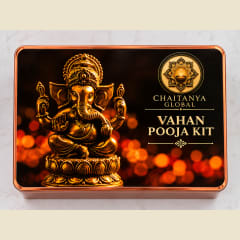
Bhadrapada — Ganesh + Krishna Month
Ganesh Chaturthi arrives. Ten days of the elephant-headed deity's household residence. Kerala celebrates Onam. Radhashtami honours Krishna's beloved. Bhadrapada is the festival month that follows Sravana's density with more density.
Bhadrapada (August-September) carries Ganesh Chaturthi (1.5 to 10 day celebration, clay murti, daily modak offering, visarjan procession) and Pitra Paksha (ancestor fortnight in Krishna Paksha — tarpan offerings of water, sesame, and rice for the departed). Onam falls in this period in Kerala.
Published · Updated · Chaitanya Global Research Team
If Sravana was the festival-dense month, Bhadrapada (August-September) matches it. Where Sravana centred Shiva across a month of Mondays, Bhadrapada centres Ganesha across the ten-day Ganesh Utsav (the elephant-headed deity's own extended festival). Beyond Ganesh, the month contains Onam (Kerala's central festival), Radhashtami (honouring Radha), and multiple regional observances.
Bhadrapada falls in the middle of Chaturmas (see Ch 3 sidebar). The Shaiva intensification of Sravana yields to Vaishnava emphasis in Bhadrapada. This chapter opens the month.
Bhadrapada Shukla Chaturthi — Ganesh Chaturthi
Timing. 4th day of bright fortnight of Bhadrapada (roughly late August or September).
Classical significance. Ganesha's birth day. The elephant-headed deity is understood classically as the remover of obstacles and pratham pujya - the first deity worshipped in any Hindu ritual. Ganesh Chaturthi celebrates his birth with elaborate ten-day household residence tradition.
The ten-day observance (see Vol 7 Ch 3 for the complete kit and ritual sequence).
Day 1 - Installation (Ganesh Chaturthi proper):
- Clay Ganesha murti installed with prana-pratishtha
- Traditional puja with modak preparation
- Extended family gathering
- Full aarti with camphor climax
Days 2-9 - Ongoing observance:
- Daily morning + evening aarti with Ganesha focus
- Fresh durva sprigs offered (21 or 108 per day)
- Modak preparation on major days
- Extended community celebrations
Day 10 - Visarjan (Anant Chaturdashi):
- Final elaborate puja
- Murti immersion in flowing water
- Family gathering and community meal
Regional variants (substantial):
Maharashtra: The classical epicentre. Mumbai particularly - both massive community pandals (some hosting Ganesha for entire 10 days with thousands of visitors) and household observances. Extensive modak preparation. Loudspeaker-based bhajan traditions (increasingly regulated for modern practical noise considerations).
Karnataka: Similar 10-day intensity. Regional variant modak preparation.
Tamil Nadu / Andhra: Vinayaka Chaturthi observance. Different regional prasad emphasis.
Kerala: Modest household observance (Kerala focus shifts to Onam - see below).
Bengal: Modest observance; Ganesh not primary Bengali focus.
North India: Widely observed but generally less elaborate than Maharashtra.
Modern ecological accommodation: Modern practice has raised concerns about Plaster of Paris (POP) Ganesha murtis that don't biodegrade in visarjan. Chaitanya sources only traditional clay murtis; POP is not stocked.
Kit reference: Vol 7 Ch 3 (Ganesh Chaturthi Kit) - Signature / Heritage / Royal tiers, each added to the daily kit.
Bhadrapada Shukla Sixth Day — Onam (Kerala)
Timing. Ten-day Kerala festival culminating on Thiruvonam - typically late August or early September. Overlaps with Bhadrapada bright fortnight but tied to Malayalam calendar Chingam month rather than lunar Bhadrapada specifically.
Classical significance. Kerala's central festival. Commemorates the classical Vaishnavite narrative of King Mahabali's annual return to visit his subjects. Mahabali - a righteous asura king whom Vishnu (in Vamana avatar) sent to the netherworld - is understood as returning once a year to see that his people are prosperous. Kerala households celebrate his return with elaborate observance.
Household observance:
- Pookalam (flower rangoli) - elaborate floral designs at household entrance, growing across ten days
- Onasadya - traditional 26-dish Kerala feast served on banana leaf
- Traditional Onam attire - Kerala silk saree with gold border for women, kasavu dhoti for men
- Traditional games and community celebrations
- Vallam Kali (traditional boat races) in Kerala
- Community gathering meal
Classical narrative deepening: Mahabali is understood as classical example of righteous ruler. Onam celebrates not just cultural tradition but classical dharmic principle - the good king's continued care for his people even from another realm.
Regional variants:
- Central Kerala: The classical heartland
- Kerala Christian and Muslim households: Onam observed as cultural festival regardless of religious affiliation - Kerala's most inclusive celebration
- Kerala diaspora (Gulf, US, UK): Elaborate community Onam celebrations wherever Malayalis gather
Modern practical practice: Full Onam observance requires community context. Diaspora Malayalis maintain Onam through community associations.
Kit reference: Chaitanya's Onam preparation available for Kerala households and diaspora - traditional flower supplies for pookalam, Onasadya coordination.
Bhadrapada Shukla Ashtami — Radhashtami
Timing. 8th day of bright fortnight of Bhadrapada. 15 days after Krishna Janmashtami.
Classical significance. Radha's birth day. In classical Vaishnava tradition, Radha is understood as Krishna's eternal beloved and divine feminine consort. Radhashtami celebrates Radha's classical presence.
Household observance:
- Extended Krishna-Radha focused morning aarti
- Fresh flowers extensively (particularly pink and yellow)
- Traditional prasad emphasising Radha's classical associations
- Small Radha-Krishna paired murti observance if household has one
- Community bhajan gatherings in serious Vaishnava households
Classical tradition significance: In classical Vaishnava tradition (particularly Gaudiya Vaishnavism), Radha is understood as classical manifestation of the deepest form of divine love. Radhashtami observance is central to serious Gaudiya practice.
Regional variants:
- Vrindavan / Mathura area: The classical heartland. Extensive community celebrations. Serious observance.
- ISKCON communities: Major festival observance.
- General Vaishnava households: Modest but present observance.
- Non-Vaishnava households: Often not observed.
Modern practical practice: For serious Vaishnava households, extended morning + evening aarti + community gathering. For general Vaishnava households, brief acknowledgement suffices.
Kit reference: Small Krishna-Radha extension of standard daily kit.
Bhadrapada Shukla Ekadashi — Parivartini / Vamana Jayanti
Timing. 11th day of bright fortnight of Bhadrapada.
Classical significance. Multiple layered meanings:
- Parivartini Ekadashi: Parivartini means "turning." Traditional belief: Vishnu in Chaturmas sleep turns to his other side on this day.
- Vamana Jayanti: Vishnu's dwarf incarnation birth day - the incarnation that suppressed Mahabali (see Onam narrative above).
Household observance:
- Vishnu-focused Ekadashi fast
- Extended aarti with Vamana-form Vishnu focus
- Traditional Ekadashi prasad
- Small charitable giving
Kit reference: Ordinary Vaishnava Ekadashi kit.
Bhadrapada Purnima — Anant Chaturdashi (day 14, not full moon)
Timing. 14th day of bright fortnight of Bhadrapada - the day BEFORE the full moon, on which Ganesh visarjan takes place.
Classical significance. Anant means "endless" or "infinite." This day commemorates Vishnu's Anant form (the cosmic serpent form). Also the day Ganesh Chaturthi 10-day observance concludes with visarjan.
Household observance:
- Anant Sutra Vrat: some traditions tie sacred thread (Anant Sutra) around the wrist with 14 knots, representing Vishnu's fourteen forms
- Ganesh visarjan (afternoon/evening)
- Community gathering for Ganesh farewell
- Traditional food and celebration
Bhadrapada Krishna Paksha (dark fortnight)
Bhadrapada Krishna Chaturthi - Sankashti: Every month has a "Sankashti Chaturthi" on the 4th day of the dark fortnight - Ganesh-focused fast observance. Bhadrapada's is particularly significant given Ganesh emphasis of the month.
Bhadrapada Krishna Ekadashi - Indira Ekadashi: Vaishnava Ekadashi fast.
Bhadrapada Krishna Ashtami: Multiple traditions - some observe Radha-associated practices, some ancestor practices.
Bhadrapada Krishna Amavasya - Pitra Paksha begins: The dark fortnight of Bhadrapada is the classical Pitra Paksha (ancestor fortnight) - 15 days of intensified ancestor honouring.
Pitra Paksha - The Ancestor Fortnight
Timing. The Krishna paksha (dark fortnight) of Bhadrapada. 15 days.
Classical significance. The classical period for honouring departed ancestors. Every departed family member is understood as returning during this fortnight to receive offerings from living descendants.
Household observance during Pitra Paksha:
- Daily tarpana (water offering to ancestors)
- Small pind-daan offerings on specific days
- Traditional shraddha rituals on specific days (particularly the tithi matching the ancestor's death day)
- No auspicious activities during this period (weddings, grihapravesh traditionally avoided)
- Family reflection and gratitude toward ancestors
Regional variants:
- North India: Serious observance in most households
- South India: Different regional shraddha traditions
- Bengali tradition: Mahalaya at end of Pitra Paksha marks Devi's arrival (transition to Ashwin Navratri)
Modern practical practice: Even brief daily tarpana practice during Pitra Paksha honours the classical ancestor-connection framework.
Kit reference: Shraddha materials from Vol 7 Ch 10 (Samskara Kit).
The month's practical rhythm
Week 1 (Ganesh Chaturthi arrives): Full Ganesh 10-day observance begins with elaborate installation.
Week 2: Ongoing Ganesh Utsav intensification. Onam observance for Kerala households.
Week 3: Ganesh visarjan (Anant Chaturdashi). Radhashtami intensification for Vaishnavas.
Week 4: Pitra Paksha begins. Ancestor-focused practice for the fortnight.
Month character: Ganesh-centered festival month with substantial regional variation (Kerala Onam parallel), Vaishnava traditions maintained (Radhashtami, Ekadashis), and the fortnight-long ancestor-honouring period beginning.
What Chaitanya makes for Bhadrapada
Everything below is made in Signature, Heritage and Royal grades and supplied wholesale or under your own label to grocery chains, importers and distributors.
Ganesh Chaturthi Kit (Vol 7 Ch 3). Full three-tier kits. Regional customisation (Maharashtra intensive, Karnataka, Tamil Nadu variants).
Clay Ganesha murti sourcing. Traditional clay only. Range of sizes.
Onam materials. For Kerala households and diaspora - traditional flower supplies and Onasadya ingredients.
Radhashtami materials. Small Radha-Krishna paired murti and specific offerings.
Pitra Paksha materials. Shraddha materials, kush grass, black til, specific ancestor-honouring offerings.
Regional customisation. Bengali Bhadrapada, Kerala Onam, Maharashtrian Ganesh emphasis all supported.
“Bhadrapada is the year's second festival-dense month. Ganesh Chaturthi anchors ten days of elephant-headed deity's household residence. Kerala celebrates its central Onam parallel. Radhashtami honours Krishna's beloved. Pitra Paksha opens the ancestor fortnight. The Vaishnava emphasis of Bhadrapada follows the Shaiva emphasis of Sravana - the classical calendar's balanced twin-month peak.”
Published by the house of Chaitanya · www.chaitanya.global
Kits & products from this chapter
Available wholesale, or under your own label.