How Chaitanya Sources Its Fragrances
Fragrance is downstream of sourcing. The compound in the vial is only as good as the tree it began from.

Indian incense fragrances are sourced from seven major regions: Kannauj (attar and rose), Mysore (sandalwood), Assam (agarwood/oud), Kashmir (saffron and lavender), Somalia and Oman (frankincense), Sumatra (benzoin/sambrani), and Grasse, France (essential oil benchmarking).
Published · Updated · Chaitanya Global Research Team
Every previous chapter of this volume has spoken about materials — halmaddi, sandalwood, oud, frankincense, saffron, camphor, kewda, khus. This chapter opens the chain — where each of these materials actually comes from, who has been supplying it for how long, and how a fragrance house sources it honestly.
The single most important thing to understand about Indian fragrance is this: the material palette is not evenly distributed across the world. Some materials come from very specific places, controlled by government or by tradition, produced by a small number of families or houses who have held that supply for generations. A fragrance house that cannot name its sources on each material either does not have real relationships (and is buying commodified material through wholesalers) or is deliberately obscuring a supply chain it should be proud of.
This chapter names Chaitanya's sources, region by region.
Kannauj — the Indian perfumery capital
The place. Kannauj is a small town in Uttar Pradesh, about 120 kilometres northwest of Kanpur. Its historical importance as a fragrance centre traces to the Harshavardhana era (seventh century CE), when the town became a hub of botanical distillation. Since then, Kannauj has been the geographical centre of Indian attar-making, home to a hundred-plus attar-making families whose lineages run seven, eight, ten generations deep.
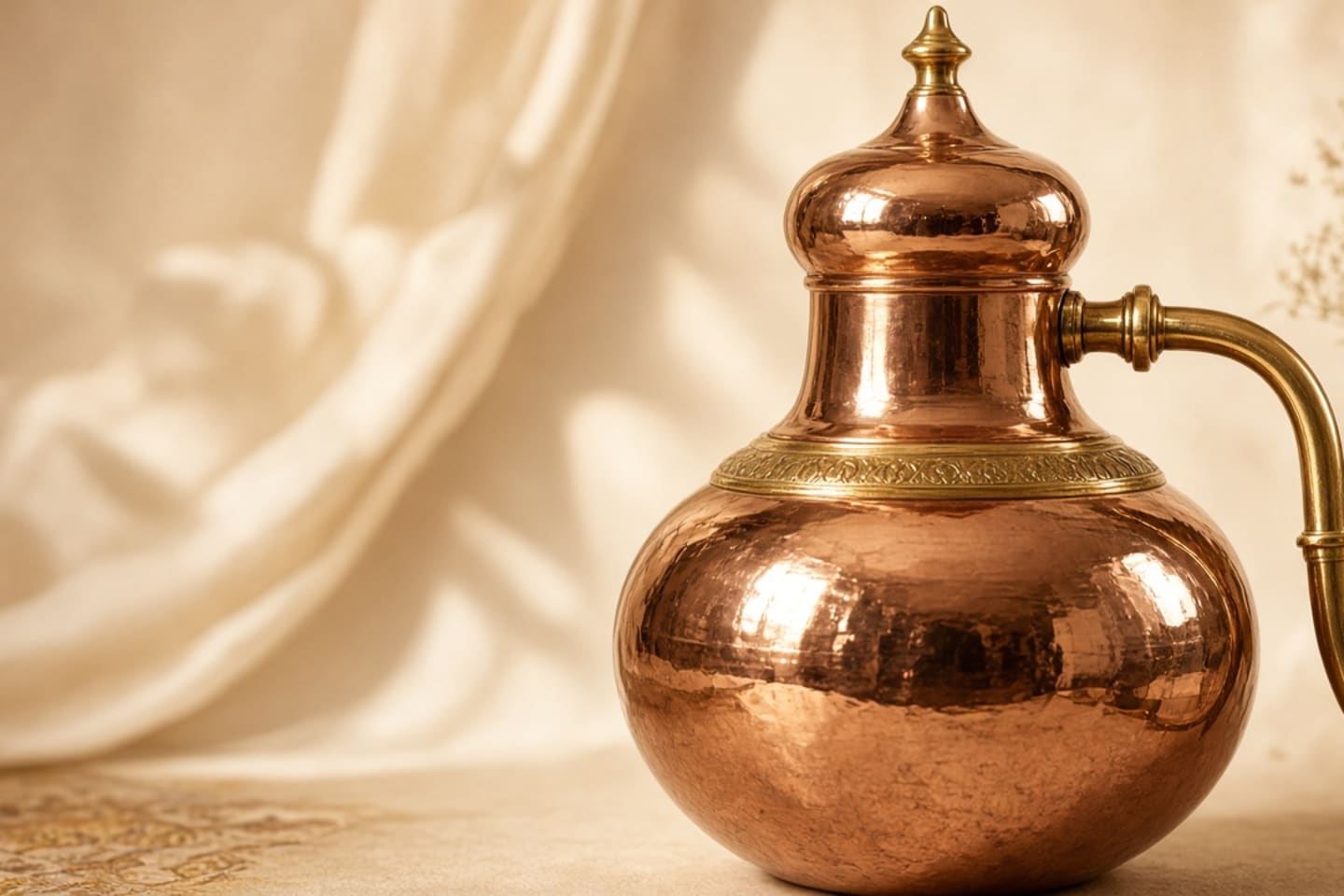
The technique. Kannauj is where deg-bhapka is practised — the classical Indian copper-pot hydro-distillation technique used to produce attars. In deg-bhapka, botanical material (rose petals, jasmine buds, vetiver roots) is placed in a large copper pot (the deg) with water, sealed, and heated. The vapour rises through a curved bamboo condenser (the chonga) into a receiving vessel (the bhapka) containing pure sandalwood oil. The fragrance vapour condenses directly into the sandalwood oil, integrating molecularly with the sandalwood carrier. This is unique to India. No other perfumery tradition uses this exact technique. The result is an attar with a chemistry and character no Western distillation method reproduces.
Chaitanya's Kannauj relationship. Chaitanya sources several of its attars from Kannauj families with continuous multi-generation lineage. Specific attars in the Chaitanya line — Ruh Gulab, Motia, Khus, Mitti, Kesar Oud — are made using the classical deg-bhapka technique by families whose ancestors were making these same attars for the Mughal courts in the seventeenth century. The house does not name its supplier families publicly (this is a common Indian trade convention — supplier discretion is a form of respect) but works directly, not through wholesale.
Mysore — the sandalwood chain
The place. Mysore (now Mysuru) in Karnataka has been the traditional heartland of Indian sandalwood (Santalum album) cultivation for centuries. Mysore-grade sandalwood has been the reference material for Indian fragrance since at least the medieval period, and the specific character of Mysore sandal — creamy, milk-warm, extraordinarily persistent — cannot be reproduced by sandalwoods from other regions.
The regulation. Beginning in the 1970s, in response to unsustainable harvest depletion, the Karnataka state government took full ownership of sandalwood trees — even trees growing on private land are legally the state's property. Harvest is licensed. Sale is licensed. Export is licensed. The entire supply chain is government-controlled. This has protected the trees but has also driven prices up substantially and made counterfeiting rampant (most "Mysore sandalwood" sold in the mass Indian market is not Mysore — it is Australian sandalwood or synthetic accord).
Chaitanya's Mysore relationship. Chaitanya's sandalwood attar and premium sandalwood dhoop/agarbatti use licensed genuine Mysore-grade sandalwood, sourced through a licensed distributor with direct auction access. This is verifiable — the government provides certificates of origin for licensed Mysore sandal, and serious fragrance houses can produce them on request. When Chaitanya's Mysore-labelled attar or premium agarbatti costs more than a mass-market equivalent, this is what the buyer is paying for: not the material as commodity, but the material as licensed, documented, authentic Mysore.
Assam — the agarwood chain
The place. Assam and northeast India (Nagaland, Arunachal Pradesh) are one of the world's classical agarwood-producing regions. Wild Aquilaria malaccensis and related species grow in Assamese forests and, when infected by the specific fungal-fungus complex that triggers resin production, form the fragrant heartwood the world calls oud.
The two chains.
- Wild-harvested Assam oud — from old-growth trees, decades of infection, extraordinary complexity. Increasingly rare (wild agarwood is CITES-protected internationally) and correspondingly expensive.
- Cultivated plantation oud — from Aquilaria trees deliberately inoculated with the infection-triggering fungus. More consistent, more available, more affordable. This is what most modern serious oud fragrance uses.
Chaitanya's Assam relationship. Chaitanya's Oud Signature and Oud Royal lines use cultivated Assam oud from CITES-compliant certified plantations. The house does not source wild oud (both because of cost and because the ethical/conservation position is unambiguous: wild-harvest of protected agarwood is not a supply chain any serious modern house should participate in). Chaitanya's premium tier uses higher-grade cultivated oud with longer infection-maturation time; standard tier uses mid-grade cultivated. Both are honest oud.
The global materials — frankincense, saffron, benzoin, French jasmine
Some fragrance materials are not produced in India at all, or produced in quantities insufficient for commercial supply, and must be sourced internationally.
Frankincense (loban). Volume 1 Chapter 5 opened the frankincense grades. Chaitanya sources Grade A hojari frankincense from Somaliland (via licensed trader), Grade B from Oman, and Indian Boswellia serrata for the mass-market grade. All three are on the shelf; the buyer chooses grade and price.
Saffron. The saffron in Chaitanya's Kesar Amber attar and Warm Oriental compound is Kashmiri saffron (Pampore region), sourced directly from Kashmir Handloom & Handicraft Development Corporation-certified producers. Kashmir saffron is the world's premium grade — deeper red, higher crocin content, more expensive per gram than Iranian saffron (the next-best alternative). Chaitanya uses Iranian saffron for the standard tier where Kashmiri would be prohibitive.
Benzoin. The benzoin base in Chaitanya's Sweet Gourmand Floral compound and sambrani powders is Sumatran benzoin (from Styrax benzoin trees in Indonesia), sourced through a specialist Indonesian trader. Some grades of benzoin are also used in Sacred Amber compounds.
French jasmine (grandiflorum). Where India uses mostly jasmine sambac (mogra), some fragrance compounds specifically need jasmine grandiflorum for its greener, more indolic character. This is sourced from Grasse in southern France — the classical Western perfumery centre — where jasmine grandiflorum has been cultivated commercially since the seventeenth century. Only Chaitanya's most premium jasmine-based compounds use Grasse jasmine; standard products use Indian mogra distillate.
What Chaitanya sourcing means practically
Three practical consequences of sourcing this way:
Material is honest. A Chaitanya Rose Signature agarbatti box is not the same product as a ₹40 rose agarbatti box, and the difference is entirely material. Real halmaddi paste, real damask rose distillate, real Mysore-grade sandalwood base. The tier system in Chaitanya's line — Signature, Heritage, Royal — corresponds to material tiers, not marketing tiers.
Supply is not always available. Some materials — genuine Mysore sandal in commercial quantity, high-grade wild oud, first-flush Kashmir saffron — are supply-constrained. Chaitanya sometimes runs out of specific Royal-tier products for weeks or months while sourcing a new batch. The alternative (substituting a lesser material silently) is not what the house does. The buyer waits for the real material.
Every product has a story you can ask about. If a customer wants to know where the sandalwood in their attar came from, or which grade of oud is in their dhoop, the answer exists and can be given. This is what direct-source fragrance means in practice — the buyer can hold the house accountable to the sourcing claims. A house that cannot answer the question is not sourcing this way.
“The fragrance in the bottle is only as good as the tree it began from. Every serious Indian fragrance house is a supply-chain house first, and a compound house second. This is Chaitanya's supply chain.”

Use these to evaluate any fragrance brand — Chaitanya included. A serious house should answer all seven without hesitation.
1. Where is your sandalwood from? If the answer is "Mysore" or "Karnataka" — ask for the certificate of origin. Licensed Mysore sandalwood always has one. Australian sandalwood is legitimate but should be named honestly.
2. Where does the oud in your compound come from? Answer should name Assam, or Cambodia, or Indonesia, or Vietnam. Should specify wild vs cultivated. A vague "Southeast Asia" answer is a warning.
3. What grade of frankincense are you using? Grade A, B, or C should be nameable. If the answer is just "loban" with no grade, the material is likely Grade C or synthetic.
4. Is your camphor bhimseni or synthetic? This is a binary question with a binary answer. A serious house will say bhimseni for the Royal tier; may honestly say synthetic for the mass-market tier. What matters is the honest answer.
5. Is your saffron Kashmiri, Iranian, or Spanish? All three are legitimate. Kashmiri is premium. Spanish is often lower-grade or blended. Ask.
6. Do you use kasturi (deer musk) or plant-based musk substitute? Real kasturi is CITES-protected and legally restricted; a house claiming real kasturi should be able to name provenance. Plant-based musk (ambrette, synthetic musks) is the responsible modern default.
7. Do you have direct supplier relationships or do you buy through wholesalers? Direct sourcing is more expensive but produces better material. Wholesale purchase is the mass-market default; nothing wrong with it at the mass-market tier, but should be named honestly.
A house that answers all seven honestly and can produce documentation on request is a house you can buy from with confidence. A house that hedges, or gives vague answers, or refuses to name specifics — is a house whose sourcing you should not rely on.

Published by the house of Chaitanya · www.chaitanya.global
Kits & products from this chapter
Available wholesale, or under your own label.

