Dhoop — The Coreless Flame
If the stick is the modern convenience, the dhoop is what came before.

Dhoop is coreless Indian incense — pure fragrance paste shaped into a cone, cylinder, or thick stick with no bamboo core. It produces heavier, denser smoke than agarbatti, with base notes speaking first. Dhoop is the older form, traditionally preferred by temple priests and in Vaishnava tradition.
Published · Updated · Chaitanya Global Research Team
Long before the bamboo-cored stick was invented in the twentieth century, Indian temples were burning dhoop. Pure paste, no core, no compromise. The dhoop is what South Indian temple priests still light for the morning offering. It is what Vaishnava tradition considers proper. And it is what the household reaches for when the moment is bigger than a daily aarti — a festival, a special puja, a moment that deserves more smoke than a slender stick can produce.
This chapter takes the older path.
Why bamboo is a compromise
The bamboo core in an agarbatti is a manufacturing convenience, not a ritual asset. Bamboo lets the stick stand upright. Bamboo lets the stick be handled easily. Bamboo makes mass production possible. All of this is practical, and none of it is spiritual.
Traditional Vaishnava and South Indian temple thought has always considered the bamboo an unnecessary intrusion between the offering and the fire. When you burn a stick, half of what is burning is bamboo — a neutral filler that produces smoke, ash, and heat but no fragrance and no meaning. The fragrance-bearing paste is only the outer coating. Dhoop removes the bamboo entirely. What burns is only the sacred material. Every gram of ash is meaningful ash.
This is not a small distinction. The theological argument runs: an offering that is 50% neutral filler is only 50% an offering. A dhoop is a whole offering. The tradition is quiet but firm about the difference.
The three formats
Dhoop comes in three shapes, each suited to a different context.
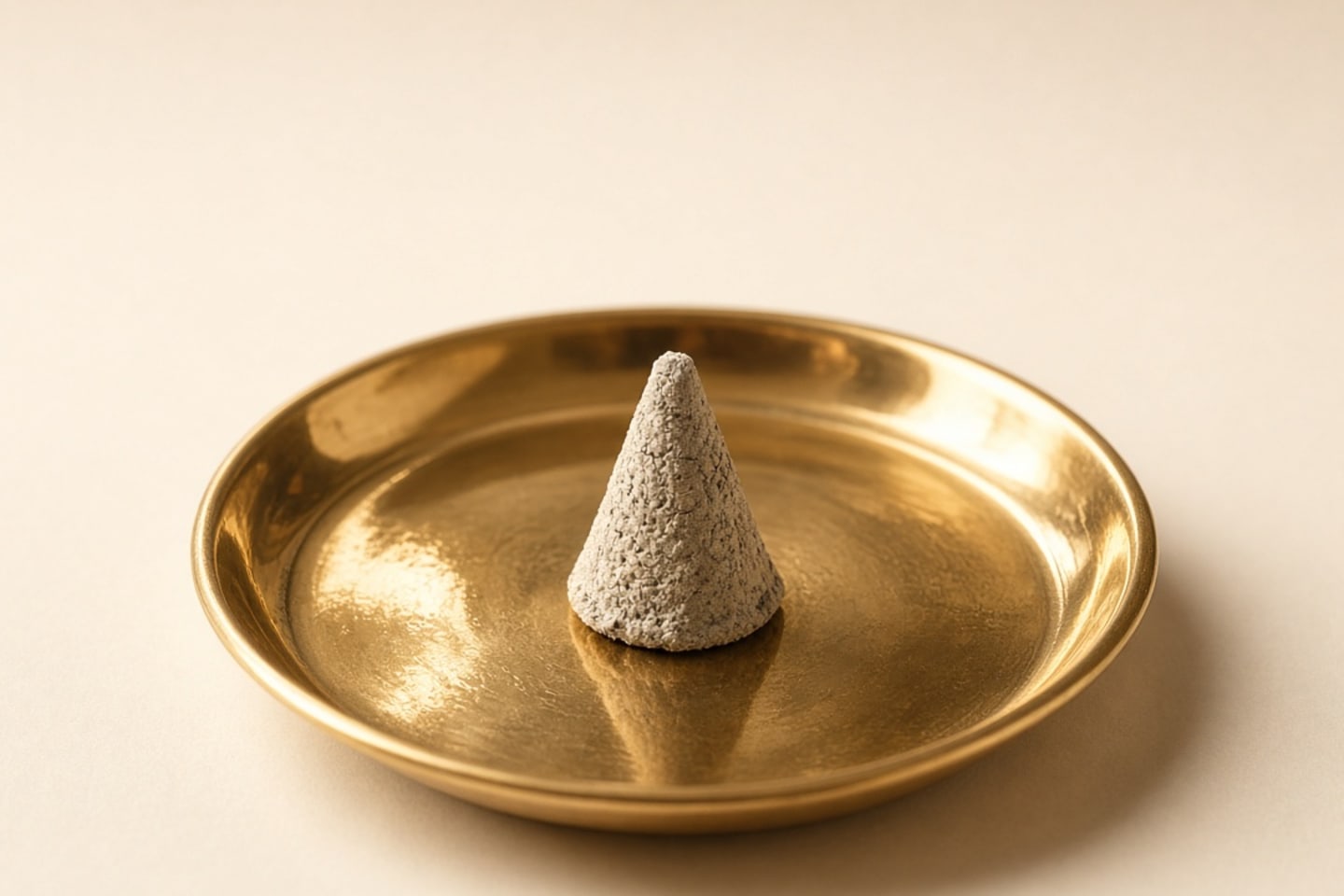
Cone dhoop. A pyramidal cone about 3-4 cm tall, sitting on its flat base. Lit at the tip, it burns downward through itself in 15-25 minutes. The smoke rises straight up in a heavier column than an agarbatti. Cones are the most common household format because they don't need a holder — they sit on any small brass plate. This is the format most households will use.
Stick dhoop. A slender cylinder about the same length as an agarbatti but with no bamboo down the middle. Pure paste extruded into a stick shape. Burns 20-30 minutes with the same base-heavy smoke as the cone. Sticks need a holder, since without the bamboo core they cannot stand upright on their own. Preferred in temple contexts where the visual of a burning stick in a proper brass holder carries weight.
Cup dhoop. A small cylindrical or bowl-shaped dhoop meant to sit in a special brass cup. Lit at the top, it smoulders slowly rather than burning with an open ember — closer to a resin than a stick. The smoke is thicker still. Cup dhoops are used in longer temple sittings where a single stick would burn out too fast.
Each format uses the same paste. The choice is about duration, smoke density, and the visual weight of the ritual.

When dhoop earns pride of place
Three moments where dhoop is the correct answer rather than agarbatti:
The festival aarti. When the household is celebrating — Ganesh Chaturthi, Lakshmi Puja, Diwali evening, Janmashtami — the moment asks for a fuller smoke. A dhoop cone at the front of the mandir (Vol 5 opens the sacred objects of the household mandir) marks the festival as different from a Tuesday morning. Agarbatti works, but dhoop is what the tradition would choose.
The morning temple offering. In serious Vaishnava households where the daily morning worship is treated with full formality, dhoop is preferred over agarbatti. The additional weight of the smoke, the base-heavy character, the fact that the offering is materially pure — all of this places dhoop in the right register for the moment.
A short intensive sitting. For a 20-minute meditation, a japa session, or a personal prayer where the sitter wants a rich atmospheric smoke for the entire duration, a dhoop cone is often better than a 60-minute agarbatti. The stick is too long and lingers past the sitting; the cone is sized for the moment.
Agarbatti remains the correct daily driver. Dhoop is what the tradition reaches for when the moment carries more weight.
“Temple priests still burn the dhoop, not the stick. The reason is theological, not aesthetic.”

Not every ritual moment is an agarbatti moment. Dhoop belongs at these three.
FESTIVAL AARTI. When the household is marking a festival, dhoop at the mandir front changes the register. Choose Rose, Amber or Sandal families for festival dhoop. One cone per aarti session is enough.
MORNING TEMPLE OFFERING. For Vaishnava, Iyengar or serious devotional households, morning worship is best served with dhoop. Choose Sandal or Sacred Amber. Light 5-10 minutes before the aarti begins so the smoke has filled the mandir.
SHORT INTENSIVE SITTING. A 20-minute meditation, japa or personal prayer benefits from cone dhoop over stick agarbatti. Sandal or Herbal Meditative families work best. Sit down, light, and the smoke lasts exactly as long as the sitting.
Published by the house of Chaitanya · www.chaitanya.global
Kits & products from this chapter
Available wholesale, or under your own label.
