Sphatik Mala — Clarity & Devi
A bead the tradition calls "clear as the mind at rest". Rock crystal on the wrist for Devi practice, for meditation, for the Shakta household.
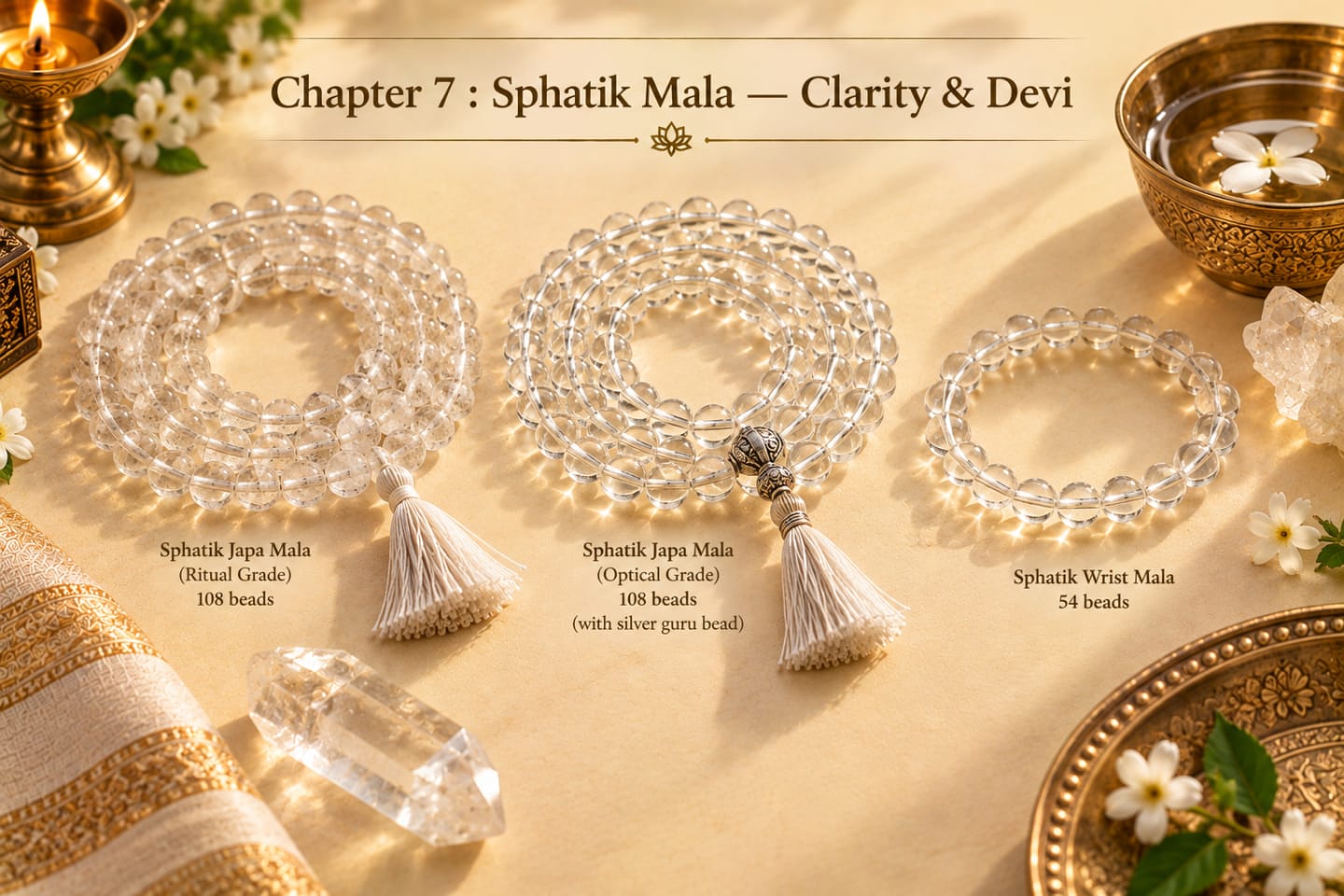
Sphatik (clear quartz crystal) mala is sacred to Devi and prescribed for Devi mantras, Gayatri japa, and Saraswati worship. Genuine sphatik is cool to the touch, has natural inclusions, and stays cool after extended handling. Glass imitations are perfectly clear and warm up quickly. Sphatik is the most universal mala after rudraksha.
Published · Updated · Chaitanya Global Research Team
Where rudraksha is the tear of Shiva and tulsi is the plant of Vrinda-devi, sphatik (स्फटिक) is a bead the tradition calls simply pure. Not a seed. Not a wood. A mineral. Clear quartz, faceted or polished round, transparent to the eye, cool to the touch, and understood in the Indian classical tradition as the material closest to the mind's own natural clarity when it is not in agitation.
The English name is rock crystal or clear quartz. The Sanskrit is sphatik — from a root meaning to break clear or to appear transparent. The mineral is silicon dioxide (SiO₂), the same substance as the sand of a beach, crystallised into transparent hexagonal points over geological time. In its ritual form the crystal is cut into round beads, drilled, and strung as a 108-bead mala.
What sphatik is
Mineralogical identity. Quartz — silicon dioxide, crystallising in the trigonal system, hardness 7 on the Mohs scale. The material is common globally; the difference between ordinary quartz and sphatik-mala grade quartz is entirely a matter of clarity, colour, and inclusion. Ritual-grade sphatik is clear to nearly clear, colourless, and free of major visible inclusions or fractures.
Bead identity. Sphatik mala beads are typically 6-10mm, cut round (never faceted — the tradition prefers the smooth surface for both aesthetic and japa-comfort reasons), drilled centrally, and polished to a fine finish. The bead is transparent — you should be able to see through it — with only very fine natural inclusions permitted. Occasional bubbles or thread-line inclusions are natural and considered part of the mineral's character.
Not to be confused with glass. The commercial market includes many "crystal" beads that are actually glass — moulded or cut glass with high refractive index. Genuine sphatik is a natural mineral, cut and polished from geological crystal; glass beads are man-made and, whatever their beauty, are not sphatik in the classical sense. Distinguishing tests appear in the sidebar below.
What the tradition assigns to sphatik
The classical texts assign sphatik several roles, all connected to the theme of clarity.
Primary role · Devi mala. Sphatik is the classical Devi bead — the mala of choice for practitioners of the Devi tradition (Shakta sampradaya). Where a Vaishnava wears tulsi and a Shaiva wears rudraksha, a Shakta practitioner typically wears sphatik. The mantras of Devi — the Devi Suktam, the Lalita Sahasranama, the Durga Saptashati seed-mantras, the Shri Vidya — are classically counted on sphatik.
Secondary role · Lakshmi mala. Within the broader Devi tradition, sphatik is specifically associated with Lakshmi — because of the classical understanding that clarity and prosperity share the same subtle root. Some households keep a sphatik mala specifically for Lakshmi-mantra japa on Fridays and during Diwali.
Tertiary role · Meditation and mental clarity. Independent of specific deity focus, sphatik is understood in the classical tradition as supportive of mental clarity — the mind counting japa on sphatik is understood to settle into calm more readily. This is why many practitioners who do not belong to a specific Devi tradition still keep a sphatik mala for meditation practice.
Cooling function. Like chandan, sphatik is classically categorised as sheetal — cooling. The mineral itself is physically cool to the touch (thermal conductivity higher than skin, so heat drains from skin to stone). Practitioners in hot climates often prefer sphatik body-wear during summer months.
Grades of sphatik
The market recognises several grades of sphatik quality:
Optical grade (highest). Fully transparent, no visible inclusions, no colour tint. Rare and expensive. A 108-bead 8mm optical-grade sphatik mala from certified suppliers may cost ₹5,000-15,000.
Ritual grade. Clear to slightly cloudy, minor inclusions permitted, no strong colour. The mainstream ritual-mala grade. ₹1,500-5,000 for 108-bead.
Standard grade. Slight cloudiness or minor bubble inclusions permitted, still transparent overall. Acceptable for daily practice, less prized aesthetically. ₹500-1,500 for 108-bead.
Below standard grade — heavily cloudy, milky, or noticeably tinted beads sold as "sphatik" are not ritual-grade and should be avoided. Some markets sell white-milky quartz as sphatik; this is technically quartz but not the classical clear grade the tradition prizes.
A note on Himalayan sphatik. Some traders specifically market "Himalayan sphatik" — clear quartz sourced from Himalayan mountain regions of northern India, Nepal, or Tibet. These commands a premium (30-100%) over other sources on the grounds of the high-altitude origin. The mineralogy is chemically identical to quartz from any other source; the premium is symbolic rather than material.
Kailash sphatik. A subset of Himalayan sphatik marketed as sourced specifically from the Mount Kailash region. These carry the highest premium and the highest counterfeit exposure. Chaitanya's honest position: we do not source or verify Kailash-specific sphatik; the supply chain authenticity is not sufficient for us to guarantee the origin claim.
Related crystal beads
Beyond sphatik proper, the Indian tradition uses several other quartz-family or gemstone beads for specific practices:
Rose quartz — light pink quartz. Used for compassion and heart-related practice; not classical Vedic but has entered mainstream Indian devotional use through modern yogic communities.
Amethyst — purple quartz. Used for meditative deepening; classical enough in tantric practice but less mainstream than sphatik.
Citrine — golden-yellow quartz. Associated with prosperity practice; classical in certain Devi traditions.
Smoky quartz — brown-grey quartz. Associated with grounding practice; less classical, more contemporary in Indian ritual use.
Moonstone (Chandrakanta) — feldspar family, milky-white with blue sheen. Classical in Devi tradition, particularly for Chandra (moon) practices.
The classical Devi tradition uses clear sphatik as the primary bead. The variants above serve secondary or contemporary practice; a practitioner beginning Devi tradition is advised to start with clear sphatik and consider variants only after establishing a base practice.
Wearing sphatik mala
Body-wear vs japa-use. Sphatik is more commonly used as a japa-mala (counting instrument in the hand) than worn continuously at the neck. This is because the mineral is denser and colder than tulsi or rudraksha; long body-wear can be less comfortable, particularly in cold weather.
Wrist-mala variant. Shorter sphatik malas (54-bead or 27-bead) worn at the wrist are common for continuous body-wear. Cooling function is preserved without the throat-wear discomfort.
Care. Sphatik is hardness 7 — will scratch softer materials, may be scratched by harder materials (topaz, diamond, corundum). Store separately from other malas. Rinse occasionally with plain water (the mineral is inert; no soaps or oils needed).
No dietary rule. Unlike tulsi and traditional rudraksha wear, classical sphatik-mala practice does not impose a sattvik dietary requirement. The bead is understood as clarifying regardless of dietary context, though many practitioners naturally observe cleaner diet as their meditative practice deepens.
Consecration. New sphatik mala is traditionally rinsed in gangajal or in gomutra (cow urine, in classical Vedic ritual) or simply in fresh water with a mantra offering, then blessed by an elder practitioner before first use. The consecration is briefer and less formal than rudraksha's.
“Sphatik is the tradition's mineral mirror. It carries no fragrance, no living presence, no seed-story — only the quality of a mind at rest. Which is exactly the quality the classical Devi practices are cultivating.”
Published by the house of Chaitanya · www.chaitanya.global
Kits & products from this chapter
Available wholesale, or under your own label.


