Chandan — Sandalwood Paste
The single most-substituted material in the modern Indian ritual toolkit. Almost no "chandan" sold today is chandan.

Real chandan (sandalwood paste) is made by rubbing a Santalum album heartwood piece on a wet stone slab — it produces a smooth, cool, pale-yellow paste with a soft woody-creamy fragrance. Fake chandan is pre-made from synthetic fragrance and clay. The test: genuine chandan feels cooling on the skin; synthetic feels neutral.
Published · Updated · Chaitanya Global Research Team
Of all the materials in the samagri catalogue, one deserves its own chapter for both cultural and commercial reasons: chandan — sandalwood paste. Chandan is central to Indian ritual across every regional tradition. It is applied to the deity daily. It is applied to the forehead of the pujari and the devotee. It is offered in havan. It is used to make the tilak that the guru applies to the disciple, that the priest applies to the worshipper, that the mother applies to the child before school.
And it is, without exaggeration, the single most-substituted material in the modern Indian ritual toolkit. Somewhere between 80% and 95% of what is sold as "chandan" in the mass Indian market — the small packets at every corner shop, the ready-made paste tubes, the pre-mixed "chandan powder" bags — contains no genuine sandalwood at all. What it contains is sawdust dyed the correct pale yellow-tan colour, perfumed with synthetic sandalwood fragrance oil, and sold at prices that make the substitution obvious to anyone who understands the material economics.
The tradition deserves better than this. This chapter opens what real chandan is, how to source it, and what to do with it.
What real chandan is
The material. Genuine chandan is the ground heartwood of the sandalwood tree — Santalum album (Mysore sandalwood, Indian sandalwood), or in commercial contexts Santalum spicatum (Australian sandalwood, a related species). The heartwood is what forms in the mature centre of the tree after 20-30 years of growth. Younger sandalwood is not usable for ritual chandan — the fragrance oils (santalol, santalyl acetate) accumulate over decades. This is why real chandan is so expensive.
Two forms in household use:
Chandan powder. Finely ground sandalwood heartwood, sold in small packets or containers. Should have a distinct creamy warm-woody smell even before any water is added. Used dry (dusted onto offerings, added to samagri tray as a small heap) or wet (mixed with water into a paste on the spot).
Chandan paste (chandan lep). The powder mixed with a small amount of water into a smooth paste, which is then applied to the deity's forehead or arms during morning worship (abhishekam), or to the forehead of the pujari and devotee as tilak. Traditional preparation: rub a piece of sandalwood on a wet stone slab with a few drops of water; the friction produces a fine paste that is scraped up with a small brass tool.
Chandan oil (sandal ka tel). Distilled from sandalwood chips via steam distillation; used in attar-making (see Volume 2 Chapter 11) and occasionally as a direct fragrance application. Not primarily a samagri material — belongs more to the fragrance library.
Why chandan is central to Indian ritual
Three reasons the tradition placed sandalwood at the centre of household worship:
Olfactory. Sandalwood is one of the most durable, complex, warm-persistent fragrances in nature. When applied to a metal or stone deity's forehead, the fragrance lingers in the mandir for hours and impresses itself on the metal over months and years. The Chola bronzes — many still in continuous worship after a thousand years — carry a residual sandalwood scent no other material could have created.
Cooling. Chandan paste applied to the forehead has a measurable cooling effect on the skin due to slow evaporation of the sandalwood's volatile oils. This is why Indian tradition applies chandan tilak in hot weather and during fever — the cooling is real, observable, and immediate.
Symbolic. Sandalwood grows slowly, requires decades to produce usable heartwood, is government-protected in India, and is expensive. The tradition uses the most valuable wood available for its most sacred application. This is not accidental; it signals that the deity deserves the household's best material, not its convenience material.
The substitution problem
Here is the honest state of the modern Indian chandan market.
Real Mysore sandalwood powder at wholesale costs approximately ₹15-30 per gram, depending on grade and licensing chain. This means a small 25g household packet of genuine Mysore chandan powder should cost ₹400-750 at retail, plus retailer margin — so the honest price range for a proper packet is ₹500-900.
The "chandan" packets sold at ₹30-80 for 25g at most Indian corner shops are, therefore, not chandan. They cannot be. The material economics do not permit it. What they contain, in most cases:
- Cedarwood dust (dyed pale yellow-tan)
- Sawdust from other Indian hardwoods (dyed, perfumed with synthetic sandalwood oil)
- Kaolin clay (as filler bulk)
- Synthetic sandalwood fragrance (isobornyl cyclohexanol and related compounds — see Volume 2 Chapter 7 for the full sandalwood-substitution profile)
This is not a hidden industry secret. Anyone who understands sandalwood pricing knows it. The household that has been using "chandan" from ₹40 packets for years has been using scented cedar dust or clay for years — a fact that once acknowledged is impossible to unsee.
How to source real chandan
Three viable paths:
1. Licensed Mysore chandan. Mysore (Karnataka) sandalwood is government-owned and government-licensed for harvest and sale. Licensed dealers can provide certificates of origin. Some serious samagri houses and temple supply shops in Bangalore, Mysore, Kanchipuram, and Chennai stock licensed Mysore chandan powder. Expect ₹500-1,200 per 25g packet. Verifiable via the licensing paperwork.
2. Australian sandalwood. Santalum spicatum is legitimate sandalwood, though lighter in character than Mysore. Not fraud when honestly named. Costs less than Mysore (~₹200-500 per 25g at retail). Serious brands are increasingly moving to Australian-source sandalwood as a middle-ground option that is genuine sandalwood without the Mysore-supply constraints.
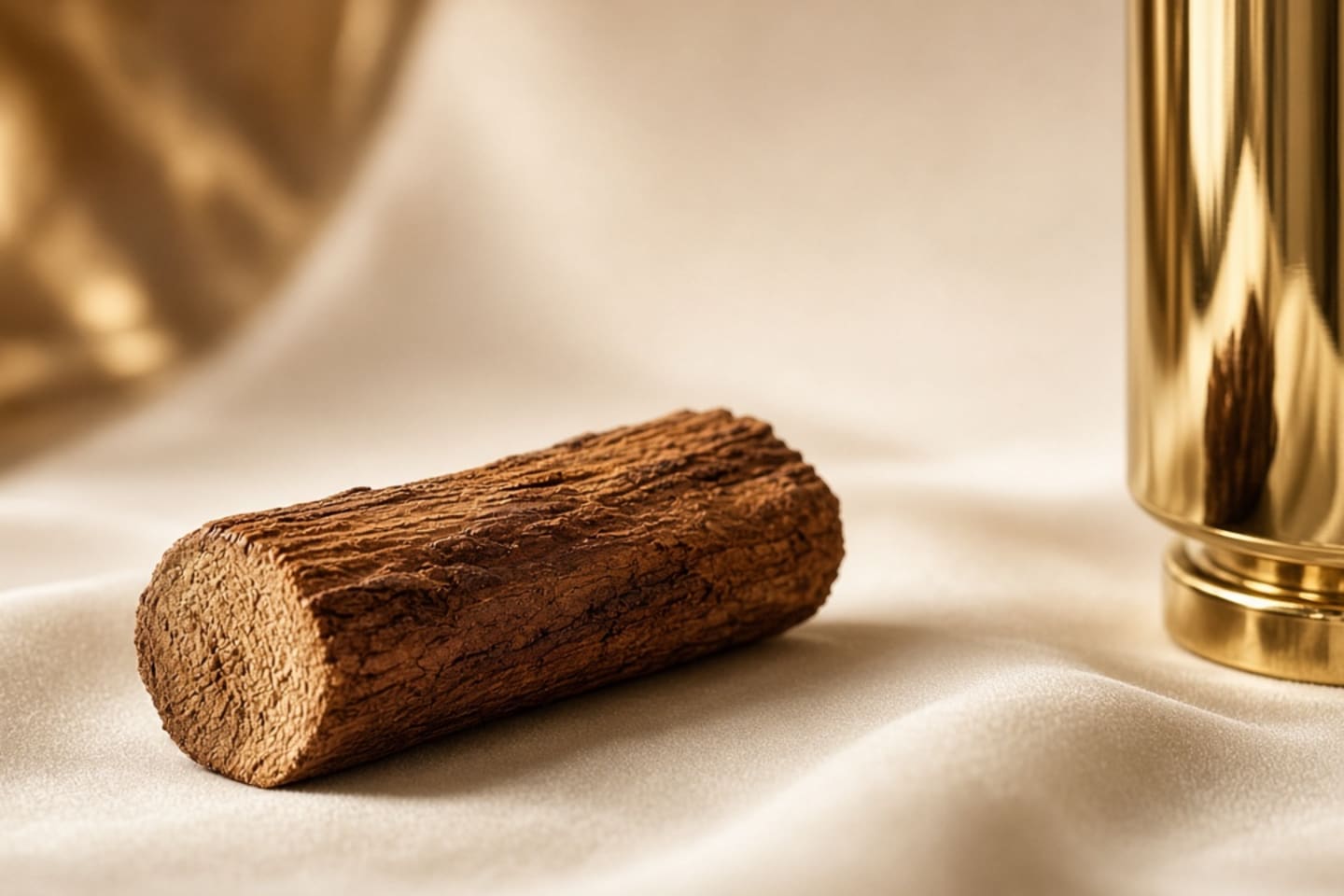
3. Making paste from a piece of raw sandalwood. The oldest household method: buy a small piece of genuine sandalwood (a stick or block ~5-10g) from a licensed supplier for ~₹150-400. Store the piece dry. Each morning, rub the piece on a wet stone slab with a few drops of water; the friction produces a small amount of fresh paste sufficient for the day's ritual. Advantages: the piece lasts many months of daily use; the paste is always fresh; you can visually verify (from the piece's colour and grain) that the material is genuine. This is the traditional household method that most Indian families have quietly abandoned in favour of pre-ground powder.
The Chaitanya position on chandan
Chaitanya's chandan products are honestly named. The house sells:
- Chaitanya Mysore Chandan powder (Royal tier) — licensed genuine Mysore sandalwood, sourced through licensed distributors with certificate of origin. Small packets (~25g). This is what temple-tradition households and serious devotional users buy.
- Chaitanya Australian Chandan powder (Heritage tier) — genuine Australian Santalum spicatum, honestly named, sourced from certified Australian suppliers. Larger packets (~50g). This is what most Chaitanya household buyers use for daily ritual.
- Chaitanya Chandan Stick (Signature tier) — a small piece of genuine sandalwood for households that want the traditional grinding-on-slab method.
The house does not sell "chandan" powder in the ₹40-80 mass-market tier. There is no honest way to produce that price with genuine material.
“Chandan is where the modern Indian ritual has drifted furthest from its material foundation. It is also where restoration is easiest — one honest packet, from an honest source, changes the household's daily worship immediately.”

Before spending on any chandan packet, or after buying one, three tests to confirm what you have.
1. The finger-rub test. Take a pinch of the powder, rub between your fingers for 20 seconds. Real sandalwood: leaves a warm sweet-woody scent on your fingers that persists for 30-60 minutes and no chalky residue. Filler: no persistent scent, or a sharp chemical scent that fades in 2-3 minutes, plus a chalky residue on the fingers.
2. The water-paste test. Mix a small quantity with a few drops of water into a paste. Real sandalwood: forms a smooth creamy pale-yellow paste with distinct sandalwood fragrance intensifying as the water activates the oils. Filler: forms a gritty paste (sawdust particles visible), often a slightly grey or brown tint (from dye separating from binder), fragrance is either absent or clearly synthetic.
3. The burn test. Take a pinch of the powder, place on a small metal spoon, hold over a match flame briefly. Real sandalwood: releases warm sandalwood smoke similar to burning agarbatti. Filler: smells of burning sawdust with a chemical undertone (from the fragrance oil vaporising).
Any packet that fails these three tests is not chandan. Return it if you can; discard it if not; do not use it on your deity or forehead.

Published by the house of Chaitanya · www.chaitanya.global
Kits & products from this chapter
Available wholesale, or under your own label.
