How to Burn Properly
A single tradition. A thousand ways to get it slightly wrong.
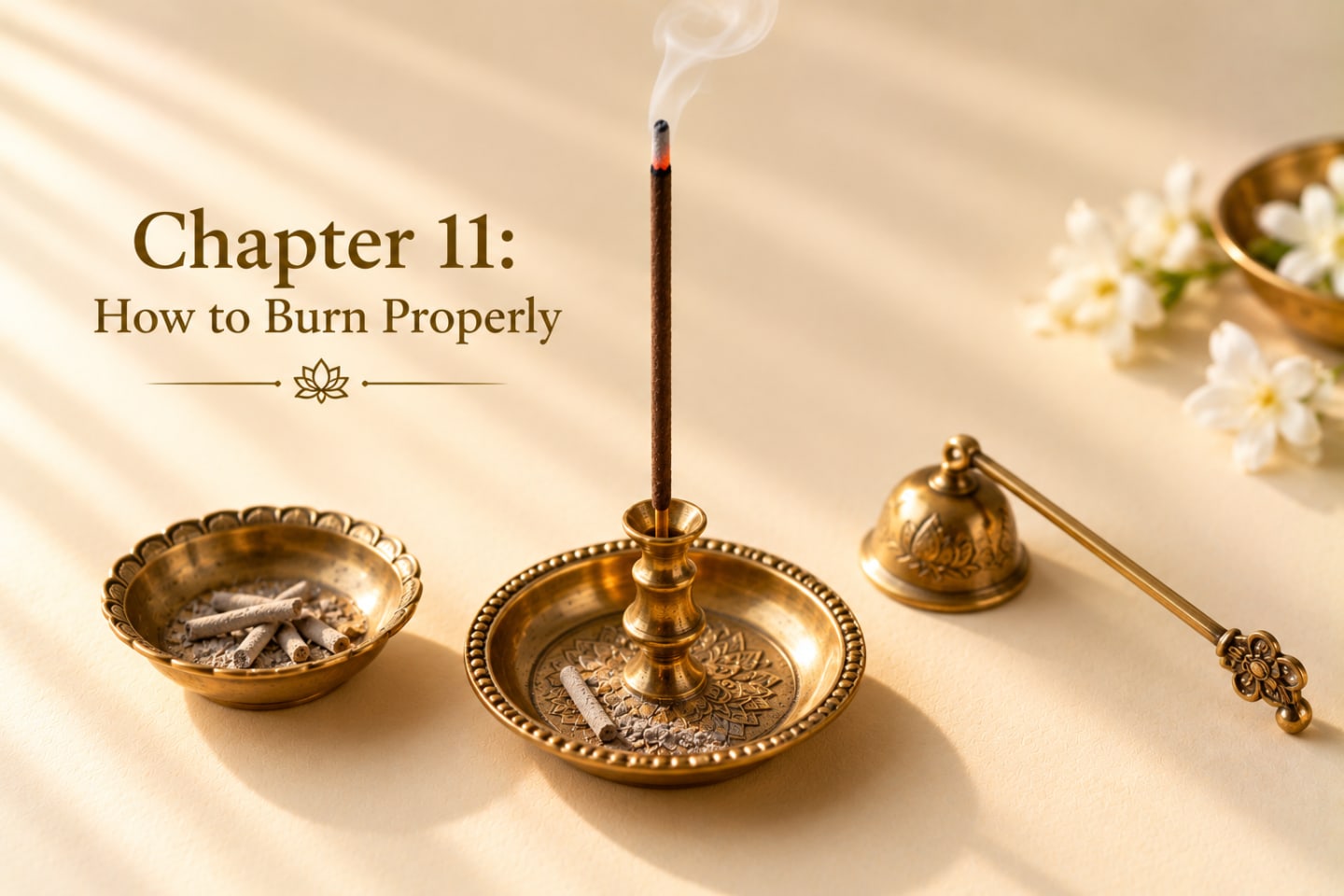
Proper incense burning follows specific rules: place the holder on the right side of the deity, light the tip and fan out the flame (never blow), catch ash in a plate, use odd numbers of sticks (1, 3, 5). Never let ash fall on the floor. Dispose of cold ash in flowing water or under a tree, never in household waste.
Published · Updated · Chaitanya Global Research Team
Most Indian households do three or four things wrong every day without knowing it. The wrong hand-orientation for lighting. The wrong holder. Ash brushed onto the floor. A diya blown out. An incense stick left burning in an unattended room. A count of four sticks in a row that should have been three.
None of these are catastrophic. All of them are small drifts from the tradition — the kind of drift that a household of the 1970s would never have made, because the elders were present and the practice was continuous, and the kind of drift that a household of 2026 has almost normalised because the elders are not always present and the practice is transmitted through habit rather than instruction.
This chapter is the elder's field manual. Not as scolding. As restoration.
Direction — which way to face when lighting
Every ritual lighting has a directional orientation. The tradition assigned these matches to the movement of the sun and the household's seasonal experience of dawn, midday, and dusk.
Facing East for morning aarti. The rising sun is the direction of new beginning, of clarity, of the day's start. Lighting the morning agarbatti while facing east aligns the household with the sun's arc. In most Indian mandirs the front of the shrine already faces east or northeast; the household member lights facing this direction naturally.
Facing North for evening ritual. The direction of Kuber (wealth) and of the pole star (permanence). Evening deepak, sambrani, and evening loban are lit with the household member facing north. In practice this usually means standing at the western side of the mandir and facing the shrine — the direction of orientation is toward the deity, which in a properly-oriented household aligns naturally with north.
Never facing South. South is the direction of Yama (the god of death) in the Vedic directional map. The tradition avoids lighting sacred materials while facing south. This is one of the rules that most modern households have forgotten and violate daily.
West as neutral. West is the direction of the setting sun and of ancestral remembrance. Not preferred for daily lighting, but not forbidden either. Shraddha and ancestral rituals often orient westward.
In apartments where the mandir cannot be ideally placed (the layout does not allow the deity to face east), the household orientation adjusts to face the deity's direction of gaze rather than a compass east. The principle is toward the divine, not toward the compass.
Holders — what you place the burning material in
The tradition has specific answers for what to burn each form in.
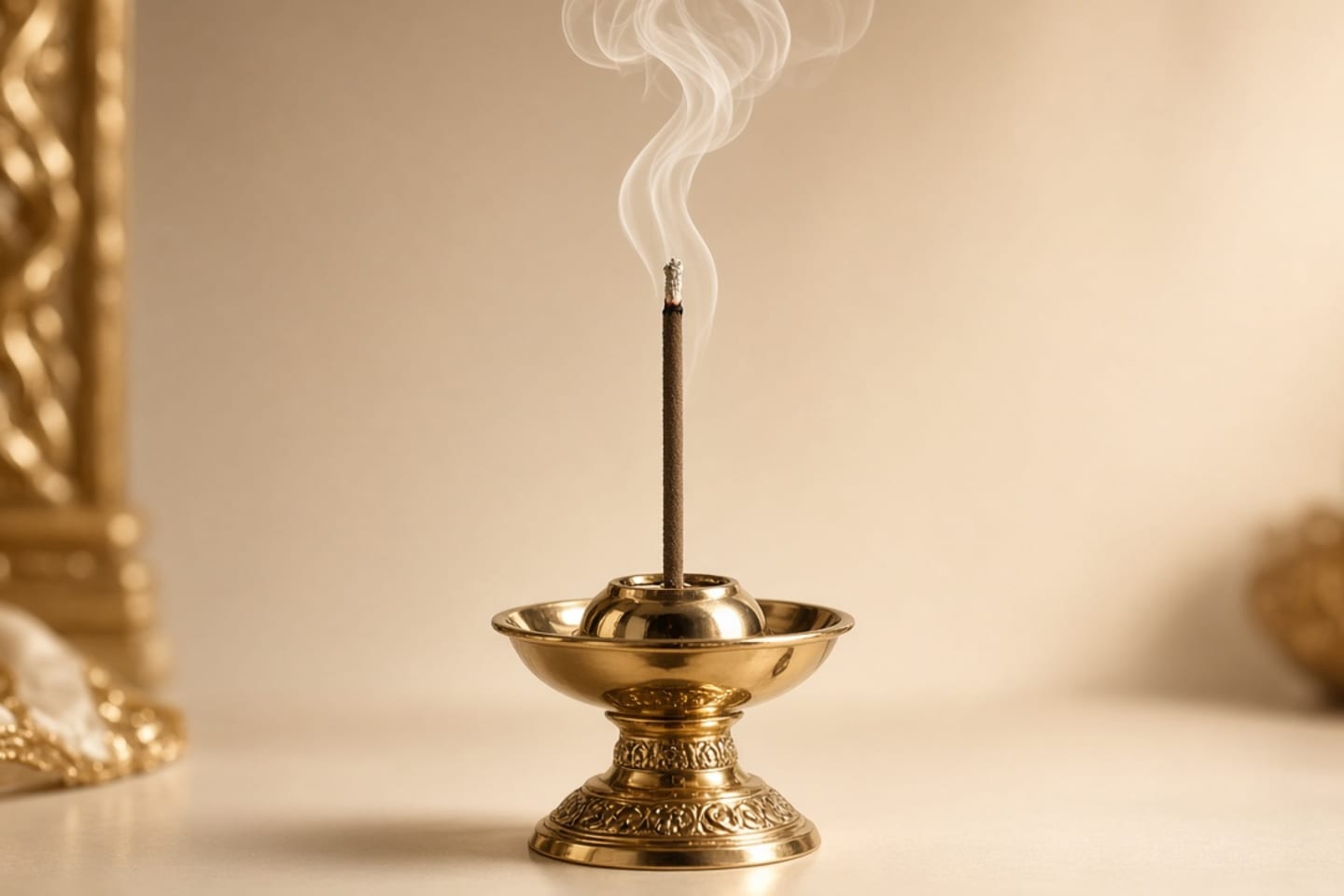
Agarbatti goes into a proper agarbatti stand — a small brass or wooden holder with an ash tray at the base. The stand should be tall enough to catch ash cleanly and stable enough not to tip. Improvised holders (a small bowl of rice, a lump of clay, a coin balanced on a shelf) are what desperation looks like, not what the tradition asks for. Cost of a proper agarbatti stand: ₹150-500. There is no excuse.
Dhoop cones go on a small brass plate with a shallow rim. The rim contains the ash and prevents the cone's flame from touching surrounding surfaces. Dhoop sticks need a proper holder (like agarbatti) since they cannot stand upright on their own.
Loban goes on a lit charcoal disc inside a thick-walled brass or clay lobandani. Never in glass, never in thin ceramic, never in a metal dish thin enough to conduct heat to the surface below. The dish must hold heat without cracking and without scorching the surface it sits on.
Sambrani goes in the proper brass sambrani cup with a perforated lid, held by its long handle. The cup itself heats up considerably during use; the handle stays cool if the cup is well-made.
Camphor goes on a small brass camphor plate (arti-daan) — a shallow round dish with a raised rim. The plate is often integrated into the puja tray as one of its central elements.
What never works. A saucer from the kitchen. A shoe. A folded piece of newspaper. Direct floor. A ceramic dish thin enough to crack. Any surface with residues of oil or food. These are all common improvisations and all wrong — most break the material continuity of the ritual (a food-touched surface is not ritually clean) and some are physically dangerous.
Ash discipline
Ash is not waste. In the tradition, ash from proper burning is vibhuti — sacred residue that carries something of the burned material's fragrance and something of the ritual's intention.
Never brush ash aside mid-burn. The natural instinct when a growing ash column threatens to fall is to knock it into a bin. The tradition says: let it fall into the holder. The holder is designed for this. Brushing ash aside disturbs the burn and treats the residue as garbage.
Never let ash fall on the floor. If the holder is too small to contain the growing ash column, the household needs a larger holder — not a floor-cleaning routine. Ash on the floor is a common household-shame indicator.
Disposal is a ritual step, not a chore. When the material has completely burned and the ash has cooled (allow at least an hour for charcoal-based burns), the ash is disposed of by one of three methods:
- Into flowing water — a river, a stream, a running tap into a garden drain. The water carries the ash to the earth.
- Under a tulsi plant or another sacred tree — the ash returns to the earth via the plant's root system.
- In the household garden — dispersed among plants, the ash mineralises the soil.
The tradition never puts ritual ash into the household trash. Doing so is one of the small dishonours that accumulates without notice.
Number — the auspicious counts
Rituals in the Indian tradition use specific numbers of offerings, mantras, and lit materials. The auspicious counts are: 1, 3, 5, 7, 11, 21, 51, 108, 1008.
The single agarbatti in front of the mandir. Three sticks for a slightly more elaborate morning aarti. Five for a formal daily worship. Eleven for a moderate festival puja. Twenty-one for a serious ritual. One hundred and eight for a mala-count japa or a serious havan offering.
Four is avoided. The tradition treats four as inauspicious in ritual counting — a rough North Indian and Vedic parallel to how East Asian cultures treat four in daily life. If a household finds itself with exactly four sticks about to be lit, the practice is to add a fifth or remove one.
Even numbers other than certain specific ones are avoided. Two, six, eight are generally not preferred. The tradition's ritual counts skew heavily toward odd numbers, particularly odd numbers with symbolic weight (3 for the trinity, 5 for the elements, 7 for the days of the week, 11 as prime, 21 as 3×7, 108 as the sacred number).
The exception is camphor — where any count of 1 or 2 crystals is acceptable because the ritual is about completion, not number. And loban — where the count refers to lumps placed on the coal over a session, and 1 is standard.
Timing — attention as prerequisite
The tradition holds that ritual lighting requires attention — not perfection, but focused attention. Lighting an agarbatti mid-conversation with someone else on the phone is a small breach of the ritual's integrity. The stick is lit but the intention has not been placed with it.
The one-minute practice. Before lighting any sacred material, pause for sixty seconds. The household member takes one breath, forms the intention of the moment (whatever it is — morning gratitude, evening close, a specific request, a specific mourning), and only then reaches for the match. This is the difference between lighting an incense stick and making an offering.
The rule extends downward from formal to informal. A festival aarti obviously requires attention. A daily morning agarbatti also requires attention, even if shorter. Only the household member who is truly rushed (running out the door, in transit, distracted) should skip the pause — and in that case the tradition would say: skip the lighting itself, not the pause.
The never-rules
Six things the tradition holds as absolute prohibitions in household smoke ritual:
1. Never blow out a diya with your mouth. The breath is considered ritually polluting to the flame. Use a hand-fan, a wick-snuffer, or wait for it to burn out. In some households the practice is to gently pinch the wick with damp fingers or to invert a small brass cover over the flame.
2. Never step over incense ash or a burning diya. The rising smoke or heat is symbolically the offering; stepping over it is a small dishonour. Route yourself around, not over.
3. Never combine loban and sambrani on the same charcoal. The two are compositionally distinct — loban is raw resin, sambrani is compound powder — and the tradition holds that mixing them muddles both. Use fresh charcoal for each.
4. Never leave a lit charcoal-based burn unattended. The charcoal disc glows for 30-40 minutes after the loban or sambrani has finished. During this time it can damage surfaces or cause fires. Keep it in view or extinguish it deliberately with a small water-drop.
5. Never light with the left hand alone. The right hand is the ritual hand in most Indian traditions. Lighting a sacred material with the left hand alone is a small breach — either use the right hand, or use both hands (right holds the match, left cups the flame from the wind).
6. Never light in a state of ritual impurity. After the bath is the normal time. After using the toilet, after eating meat, before the daily bath, in a state of active mourning (first ten days after a death in the family for the immediate mourners) — these are moments where the household member steps back from the ritual and lets another member perform it if needed, rather than performing it themselves.
“A single tradition. A thousand ways to get it slightly wrong. The elder's field manual is not scolding. It is restoration.”

For the household that will only remember five things from this chapter, these five, laminated and stuck above the mandir:
1. FACE THE RIGHT DIRECTION. East for morning. North for evening. Never south.
2. USE A PROPER HOLDER. Brass stand for agarbatti. Brass plate for dhoop. Thick brass or clay dish for loban charcoal. Not a saucer, not the floor, not improvisation.
3. LET THE ASH FALL INTO THE HOLDER. Never brushed aside. Never on the floor. Cold ash goes to flowing water or under a tulsi. Never into the trash.
4. USE AUSPICIOUS COUNTS. One, three, five, seven, eleven, twenty-one, one hundred and eight. Never four.
5. PAUSE BEFORE YOU LIGHT. Sixty seconds. Form the intention. Then the match. This is the difference between lighting incense and making an offering.
Print this. Cut it out. Keep it near the mandir. Every household member — including children old enough to help with the aarti — should know these five.

Published by the house of Chaitanya · www.chaitanya.global
Kits & products from this chapter
Available wholesale, or under your own label.

