Javadhu — The Temple Perfume
In the Tamil temple tradition there is a fragrance so old that its name is not in most dictionaries.

Javadhu is an ancient Tamil temple perfume compound — a blend of sandalwood, agar, saffron, musk, and spices, hand-compounded in temple kitchens using formulas passed from priest to priest over centuries. It is applied as a paste, worn as a body powder, and burned as a dhoop offering.
Published · Updated · Chaitanya Global Research Team
In the Tamil temple tradition there is a fragrance so old that its name is not in most dictionaries. It is applied on the body of the deity. It is worn on the body of the devotee. It is burned as offering. It is Javadhu.
The Chola bronzes have been bathed in this fragrance for a thousand years. The Meenakshi Amman temple in Madurai still uses it. The Ranganathaswamy temple in Srirangam still uses it. It is one of the most ancient continuous perfumery traditions on earth — sandalwood, agar, saffron, musk, spice, compounded by hand in temple kitchens using formulas passed from priest to priest, largely undocumented in printed literature.
Nobody outside South India knows the word. The Chaitanya Grantha has chosen to publish it.
The compound
Javadhu is not a single ingredient. It is a compound — a blend of five to seven precious materials, ground together into a fine golden-brown powder that can be applied as paste, worn as scent, or burned as offering.
The core of the compound is remarkably consistent across the Tamil temple tradition:
Sandalwood (Santalum album, ideally Mysore-grade) — the base. Warm, creamy, temple-woody. Provides the compound's foundation and its long persistence. Usually 40-50% of the blend.
Agarwood (also called oud, agar, akil in Tamil) — the resinous heart. Deep, smoky, honey-dark. This is the material that gives javadhu its distinctive complex character. Usually 15-25%.
Saffron (kesar, kumkumapoo in Tamil) — the accent note. Warm, hay-golden, slightly medicinal. A small amount goes a long way. Usually 2-5%.
Musk (traditionally kasturi, though modern temple compounds substitute plant-based musk to comply with wildlife protection laws) — the animal-warm note that gives javadhu its sensual, worn-on-the-body quality. Usually 5-10%.
Camphor (bhimseni grade) — small amount for its cooling brightness against the warm base. Usually 2-5%.
Spice base — clove, nutmeg, cinnamon, sometimes cardamom — for the warm dry finish. Usually 5-10%.
Rose or jasmine — occasional floral note. Some houses include, some don't. Usually 5%.
Each temple has its own formula. The Meenakshi Amman javadhu is different from the Nataraja temple javadhu. The Kanchipuram javadhu is different from the Srirangam javadhu. The formulas are guarded, passed within priesthood families, adjusted seasonally. What is consistent is the structure — a sandalwood base, an agar heart, a spice-and-musk warmth, a saffron accent. Everything else is a variation on that theme.
The three forms
Javadhu is used in three distinct ways within Tamil temple and household tradition.
As paste — for anointment. The powder is mixed with a small amount of water, rose water, or occasionally sandalwood oil into a smooth paste. The paste is applied to the deity — smeared on the forehead of the murti, on the chest, on the arms — during the morning temple worship (abhishekam). The paste is renewed daily. Over centuries, the layered application builds up on the bronze — this is why the Chola bronzes now hold a faint residual scent of javadhu that never fully leaves. A metal object bathed in javadhu paste for a thousand years is a different object than a metal object that was not.
As powder — worn on the body. In the Tamil household tradition, javadhu powder is applied to the throat, the wrists, the base of the neck, occasionally the hair — much like Western perfume, but as a dry powder rather than a liquid spray. The fragrance persists for 6-12 hours on the skin and warms further as the body warms. This is a form of perfumery uncommon outside South India — most cultures apply fragrance as liquid; the Tamil tradition applies it as powder. The result is a subtler, longer-lasting, more skin-integrated fragrance.
As dhoop — for offering. The powder is rolled into a slender dhoop stick using a small amount of binder (traditionally halmaddi, sometimes ghee), then dried. The finished javadhu dhoop is burned as the ceremonial offering during major temple pujas and household rituals. The burning smoke carries the same complex structure as the paste — sandalwood base, agar heart, saffron and musk warmth — into the air.
Three forms. Same compound. Different moments.
The temples that use it
Javadhu is not universal to all Indian temples. It is specifically a Tamil South Indian tradition, though it has spread to Karnataka and Kerala over the centuries. The temples where javadhu use is documented and continuous include:
- Meenakshi Amman Temple, Madurai — one of the oldest continuous javadhu traditions, applied to the goddess daily
- Ranganathaswamy Temple, Srirangam — the Vaishnava tradition uses javadhu as morning offering
- Nataraja Temple, Chidambaram — javadhu paste is applied to the Nataraja bronze
- Meenakshi and Sundareswarar shrines, Madurai — different formulas for each deity
- Kanchipuram Ekambareswarar Temple — the Shaiva tradition has its own javadhu formula
- Srirangam and Alwar tirunagari — the Vaishnava perumal temples use it
- Palani Murugan Temple — the hill temple has its own variant
Each temple's javadhu is slightly different. Each priesthood family holds its formula. Each has been continuous for centuries.

The publishing decision
Why is Chaitanya opening this tradition to a national audience?
Because it deserves to be known. Because the tradition is under quiet threat — as fewer priesthood families continue and as cheap synthetic "javadhu-scented" products flood the market, the actual compound is being diluted by imitation. Publishing the tradition — the ingredients, the structure, the temples, the three uses — creates a national understanding of what javadhu actually is, and by extension what javadhu is not. A shopper who has read this chapter cannot be fooled by a synthetic knock-off.
And because Chaitanya believes that publishing a tradition is a form of preservation. The Chola bronzes have been bathed in javadhu for a thousand years. The next thousand years should not lose the recipe.
“Javadhu is not perfume. It is prayer worn on the body, and offered in the fire.”
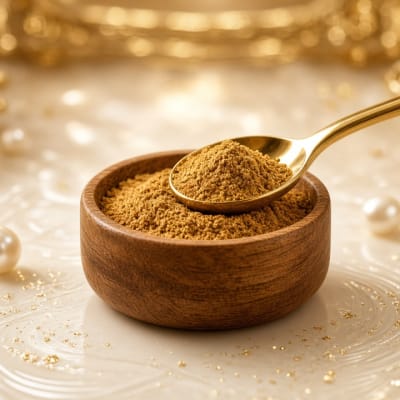
For the household new to javadhu:
AS PASTE — for the mandir murti. Mix half a teaspoon of javadhu powder with a few drops of rose water. Apply to the forehead of the deity during morning worship. Reapply weekly. Over months, a subtle fragrance develops in the mandir room itself.
AS POWDER — worn on the body. Apply a small pinch to the base of the throat and the wrists after bathing, before dressing. Do not apply on synthetic clothing (the fragrance clings to fabric better than skin but stains synthetics). The scent will warm through the day.
AS DHOOP — offering at special pujas. Light one javadhu dhoop stick at the beginning of any significant household puja — Ganesh Chaturthi, Lakshmi Puja, family occasions. One stick per session. The compound's complexity carries the ceremonial weight of the moment.
Chaitanya sources its javadhu from a temple-supply house in Madurai that has been producing the compound for four generations. This is what your purchase supports.
Published by the house of Chaitanya · www.chaitanya.global
Kits & products from this chapter
Available wholesale, or under your own label.


