The Resinous — Sacred Amber, Earthy Resinous
Two resin traditions. One warm as golden honey; one dark as cathedral incense. Both are what fragrance sounds like when it stops being decorative and starts being sacred.
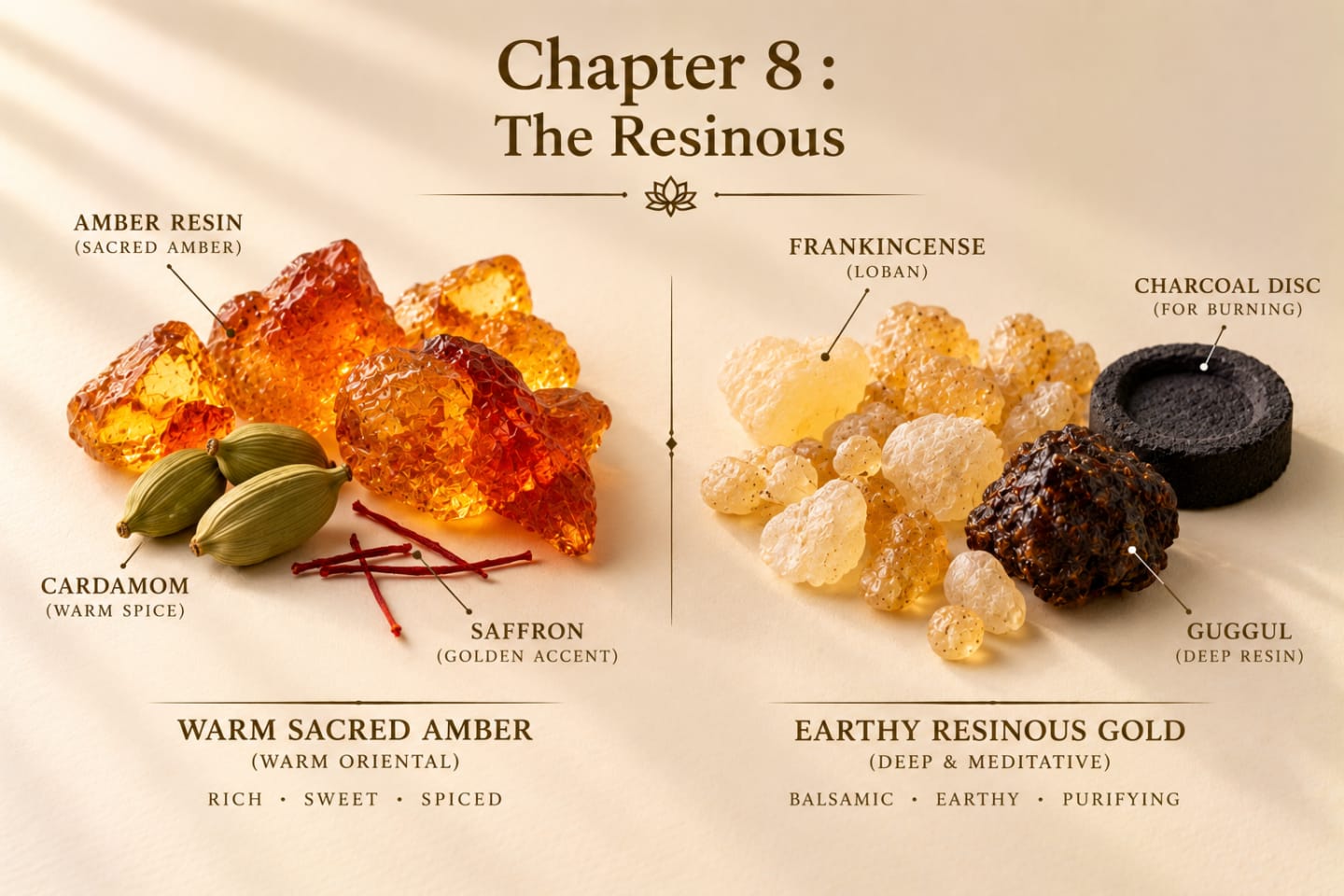
Sacred Amber is a warm, golden fragrance family associated with Vaishnavite tradition (Vishnu, Krishna, Ram). It combines tulsi, kesar (saffron), chandan, kewda, and warm amber resin. Indian sacred amber is temple-warm, built on real botanical ingredients — distinct from Western amber perfumery.
Published · Updated · Chaitanya Global Research Team
Resins are the oldest fragrance materials in continuous human use. Frankincense (loban) has been burned continuously in India for over three thousand years. Amber (the fossilised tree resin variant, and the compound amber accord that Indian tradition builds) has been valued in Egyptian, Vedic and Mesopotamian ritual continuously since. Where florals are the celebration and woods are the daily contemplation, resins are the weight of the fragrance library — the family the household reaches for when the moment carries theological gravity.
The Indian tradition catalogues two resinous families. Sacred Amber is the warm register — golden honey resin with temple-associated sweetness. Earthy Resinous is the deep register — dark frankincense-and-guggul, cathedral-grade, the fragrance of grief and cleansing and shraddha.
Both are resin. Neither is the same thing.
Sacred Amber
Character. Warm golden resin, temple-honey. Sacred Amber is the fragrance a proper morning temple offering carries — sweet without being cloying, warm without being sharp, resinous without the darkness of loban. It is the fragrance the household reaches for when the moment wants weight without gravity — a serious morning aarti, a formal daily worship, a festival evening where warmth is the register.
The pyramid.
- Top: a soft warm spice (cinnamon, cardamom) or a light saffron accent
- Heart: amber resin (or amber accord), sandalwood
- Base: aged sandalwood, benzoin, a whisper of vanilla or tonka bean
The materials. Amber is an unusual word in perfumery — it refers to two related but distinct things.
The first is fossilised amber — the hardened tree resin, tens of millions of years old, found on Baltic coastlines and in Dominican Republic mines. Fossil amber is prized as jewellery but has almost no fragrance when unburned. When gently heated it releases a faint pine-vanilla warmth, but as a perfumery material it is minor.
The second — the one Indian perfumery actually means when it says amber — is an amber accord. This is a compound of resins, waxes, and warm base materials assembled to reproduce the "amber" fragrance character. Classical amber accord recipes include labdanum (a sticky resin from the cistus shrub), benzoin (the sweet vanilla resin), vanilla, tonka bean, and often small amounts of animalic notes (musk, historically ambergris). The resulting compound smells warm, golden, sweet-resinous — the recognisable "amber" perfume category.
Indian tradition adds two variations to this classical amber accord: saffron for the golden accent, and sandalwood for the temple base. The finished Sacred Amber is warmer and more temple-associated than a Western amber perfume; it reads as devotional rather than merely warm.
The ritual moment. Morning aarti in serious devotional households. Weekly full moon (purnima) worship. Festival evenings that require warmth but not the seriousness of loban. Wedding-morning fragrance for the groom. Any moment where the household wants a warm resinous character without the deep gravity of Earthy Resinous.
Chaitanya SKUs in this family. Amber Signature agarbatti, Amber Heritage dhoop, Kesar Amber attar (Kashmiri saffron + amber accord), Sacred Amber compound.
Pairs with: Warm Woody (extends the amber into deeper sandalwood territory), Warm Oriental (amber is a core component; the pairing is natural), Rose Rich Floral (rose-amber is one of the most classical Indian layered fragrances — Ruh Gulab plus amber accord).

Earthy Resinous
Character. Deep, dark, cathedral-grade. This is the fragrance of raw frankincense on charcoal — dense, immediate, unmistakable, carrying the weight the tradition assigns it to grief and cleansing and serious ritual. Where Sacred Amber is warm honey, Earthy Resinous is dark stone. Both are resin. The tradition uses them for opposite emotional registers.
The pyramid.
- Top: the sharp resinous first-minute of frankincense — briefly pine-citrus, then deep
- Heart: frankincense (loban) itself — dominant, unmistakable, carrying the composition
- Base: benzoin, guggul, aged sandalwood
The materials. The primary is frankincense — the resin from Boswellia trees, extensively opened in Volume 1 Chapter 5. In fragrance form (as opposed to burned-on-charcoal loban), frankincense is the anchor of the Earthy Resinous family. The specific grade matters here as much as it does in Volume 1: Grade A hojari frankincense gives the family a bright citrus-forward character; Grade B Omani gives it a warmer balsamic weight; Grade C Indian gives it heavier smokier character.
Supporting notes almost always include:
- Guggul — the sharp, medicinal Indian resin from Commiphora wightii, which adds the "cathedral" quality — the sense of a space being cleansed, not merely perfumed
- Benzoin — a smaller amount of the sweet-vanilla resin for warmth, preventing the composition from being purely austere
- Sandalwood — as the base, integrating the resinous weight
Some compositions also include:
- Myrrh — a related resin (from Commiphora myrrha) with a bitter-medicinal character, adding depth
- Amber accord — a small quantity, softening the darkness with warmth
The resulting fragrance is what an ancient temple actually smells like — the classical Sufi shrine, the Vaishnava temple during a shraddha week, the household home during a period of mourning.
The ritual moment. Grief and mourning periods in the family. Annual shraddha (remembrance of departed family). House cleansing (grihapravesh, post-illness). Serious personal prayer or petition. Full moon (purnima) evening if the household observes it seriously. Any moment where the household wants fragrance that carries theological weight rather than social warmth.
Chaitanya SKUs in this family. Loban Signature agarbatti (frankincense-forward), Guggul Earthy dhoop, Frankincense Heritage loban resin (Grade A and Grade B available), Cathedral Resin compound.
Pairs with: Warm Woody (the sandalwood base creates natural continuity), Smoky Oud (deepens the composition into oud-forward gravity — one of the most powerful classical Indian ritual pairings), Camphoraceous (adds a cool counter-note that lifts the darkness slightly).
“Amber is what fragrance sounds like when the household is celebrating something warm. Loban is what fragrance sounds like when the household is honouring something serious. The two together give the household its full range of ritual gravity.”

Both categories centre on resin. Both persist for hours. Both carry the fragrance weight the tradition uses for serious moments. But they are not the same, and the household that treats them interchangeably will use the wrong fragrance for the wrong moment.
AMBER — warm register. The fragrance says: this moment is celebratory and formal. Golden, honey-sweet, temple-associated but not grave. Use for: morning worship, formal daily contexts, festival evenings, wedding morning. Emotional register: warmth, welcome, generosity.
FRANKINCENSE / LOBAN — deep register. The fragrance says: this moment carries weight. Dense, dark, cathedral-grade, unmistakably serious. Use for: shraddha, grief, cleansing, personal prayer for serious matter, moments of transition. Emotional register: gravity, presence, weight.
The test: if you would light a lamp for the moment, use Amber. If you would sit in silence for the moment, use Frankincense.
The mandir that keeps both — one 30g pack of quality amber compound, one 50g pack of Grade B loban — has fragrance-material coverage for essentially every serious ritual moment the year will bring. Total investment: ~₹1,500. Duration: 4-6 months of use at a serious household's cadence.

Published by the house of Chaitanya · www.chaitanya.global
Kits & products from this chapter
Available wholesale, or under your own label.


