What a Mala Is (and what it is not)
A mala is not a necklace. It is not jewellery. It is a counting instrument that happens to be worn on the body — and understanding the difference is where this volume begins.

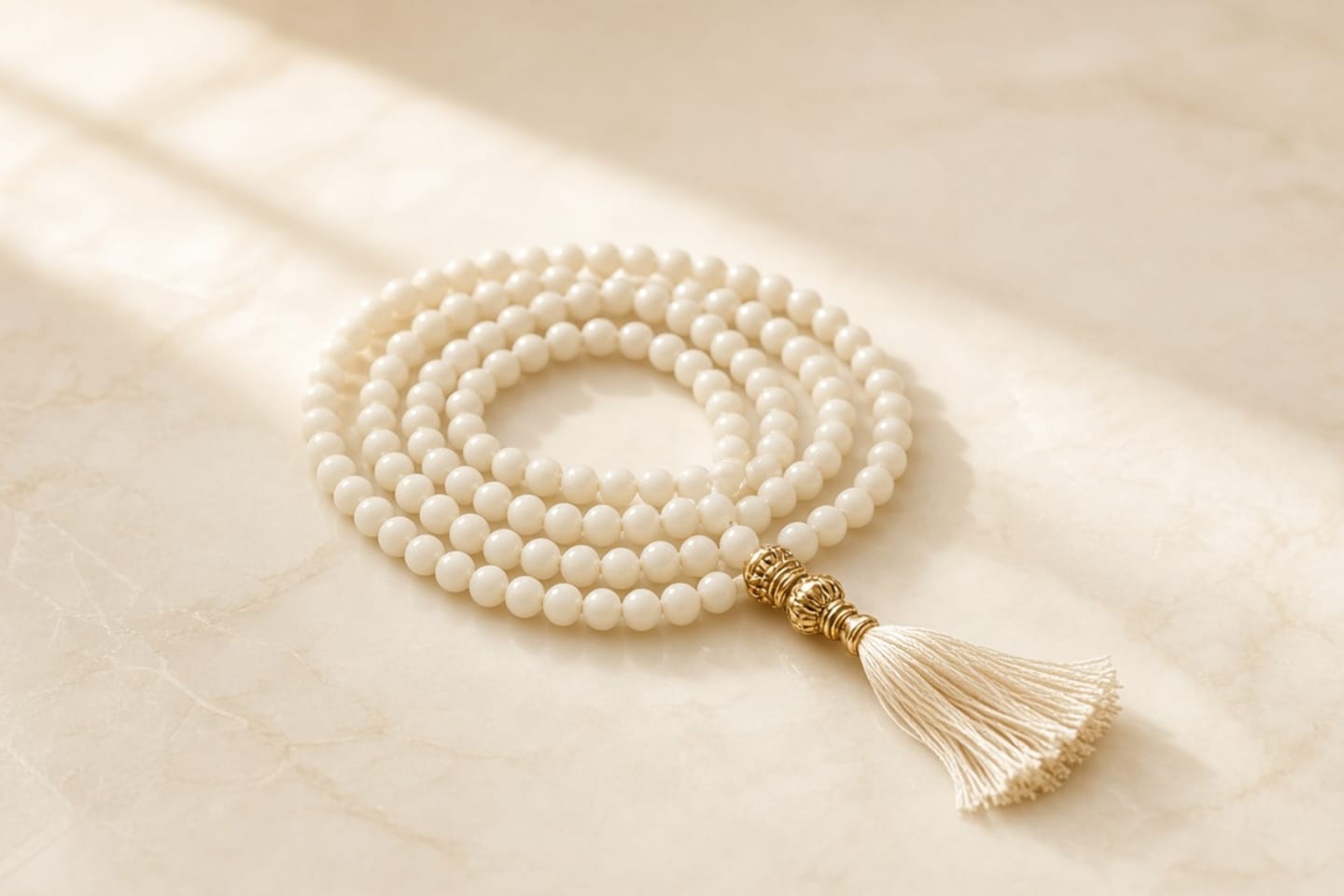
A japa mala is a string of 108 beads plus one guru bead, used as a counting instrument for mantra recitation. The practitioner moves one bead per mantra repetition. The mala is held in the right hand, draped over the middle finger, moved with the thumb. The index finger never touches the beads.
Published · Updated · Chaitanya Global Research Team
Walk through any Indian jewellery store and you will see strings of beads. Some will be sold as fashion malas. Some as devotional malas. Some as rudraksha for style. The vocabulary has collapsed. In the classical Indian tradition, a mala (माला) is a very specific object with a very specific purpose — and the modern retail sector has spent thirty years quietly flattening that distinction into "beaded necklace with a spiritual look".
This grantha begins by restoring the distinction. Everything that follows in the next eleven chapters — rudraksha, tulsi, sphatik, chandan, kamal-gatta, vaijayanti, coral, moti, silver, thread, wearing rules, sourcing chains, the choice of your first mala — depends on getting this opening chapter's vocabulary right. If you know what a mala actually is, everything else in the volume slots into place.
What the word means
Mala (माला) is Sanskrit for garland — literally a string of things woven together in sequence. In classical usage the word covered any strung ornament: a garland of flowers around the deity's neck (pushpa-mala), a garland of names in a hymn (nama-mala), a garland of beads in the hand (japa-mala). The bead-mala inherits its name from this larger family and carries the family logic — a sequence, a string, a count.
The most important word here is count. A mala is fundamentally a counting instrument. Its purpose is to help the mind track how many times a mantra has been recited, a breath has been observed, or a name has been repeated. Every other function a mala performs — worn on the body, kept in a puja tray, given as inheritance — is secondary to this primary counting purpose. Modern retail has inverted the priority; the tradition never did.
The four kinds of mala
Indian tradition recognises four distinct kinds of mala, each with its own purpose. Confusion between them is at the root of most modern misuse.
1. Japa-mala (जपमाला) — the counting instrument. This is the mala in its purest form. Held in the hand, or wrapped around the fingers, or draped over the right hand's thumb-and-middle-finger, it is used to count mantra recitations. The classical count is 108 beads plus a bindu or sumeru (the guru bead) that marks the start and end of a round. A japa-mala is not primarily worn — it is used.
2. Kantha-mala (कण्ठमाला) — the throat mala. Worn at the neck as a devotional identifier. A Vaishnava wears a tulsi kantha-mala to signal their tradition. A Shaiva wears a rudraksha kantha-mala. This is the mala's ceremonial-identity function — like a wedding ring in the Western tradition, it says I belong to this practice.
3. Anga-mala (अङ्गमाला) — the body mala. Worn on the wrist, the ankle, or across the chest. This is the mala as a continuous fragrance and touch presence on the body — chandan for cooling, rudraksha for grounding, tulsi for Vaishnava identity through the day. It is worn during work, sleep, travel; it is the mala the body lives with.
4. Pushpa-mala (पुष्पमाला) — the flower garland. Not a bead-mala at all, but included here for vocabulary completeness. This is the fresh-flower garland offered to the deity in the mandir. It is the original meaning of the word mala — everything else is downstream.
The rest of this grantha concerns the first three. Where the modern reader says simply "mala", the tradition asks — which kind? Japa for counting? Kantha for identity? Anga for continuous body presence? The answer shapes which material you choose, which bead count, which stringing style, and where on the body you wear it.
What a mala is not
Three things a mala is fundamentally not — and where the modern misunderstanding lives.
A mala is not jewellery. A jewellery piece is designed for visual effect — proportion, colour, sparkle, arrangement for the eye. A mala is designed for function — the bead size fits the fingers, the string tension is right for smooth counting, the bead count is exact for the mantra. When the mala is worn on the body it may look ornamental to an observer; but its structure was engineered for the hand, not for the eye. The modern "fashion rudraksha" — worn purely for aesthetic — is not a mala. It is a rudraksha-shaped ornament that happens to have some beads on a string.
A mala is not a talisman. A talisman is a charged object worn to protect from something specific. Some Indian traditions do treat certain malas (particularly certain rudraksha mukhis) with mildly talismanic reasoning — protective, grounding, planetarily corrective — but this is a secondary function. The mala's primary role is meditative practice. The tradition never asked a mala to substitute for medicine, for wealth-generation, or for individual astrological correction. When the modern retail sector sells a rudraksha with claims like for career growth or for marriage prospects, it is stretching a secondary tradition beyond what the classical texts support.
A mala is not a fashion accessory. This is perhaps the most damaging modern confusion. When Western wellness culture began wearing malas in the 2010s as accessories to yoga-and-mindfulness aesthetics, the retail sector fed the trend — selling coloured beaded strings with tassels as "108-bead meditation malas" without any regard for the classical bead materials, without proper stringing, without the guru bead, without any of the counting-instrument functionality. These are decorative products. They are not, in the classical sense, malas.

What makes a proper mala
Six characteristics distinguish a proper mala from a decorative substitute:
1. Correct bead count. 108 beads for the japa-mala. Smaller counts (54, 27, 21) for wrist-worn variants — but each is a divisor of 108 for a reason (see Chapter 2). Fashion pieces frequently use round-number counts (100, 20, 50) that have no ritual meaning.
2. Proper bead material. Rudraksha, tulsi, chandan, sphatik, kamal-gatta, vaijayanti, moti, coral, turquoise — the classical materials the tradition recognises. Coloured wood, dyed synthetic beads, or plastic-with-metallic-coating do not qualify, no matter how they are labelled.
3. A guru bead (bindu / sumeru). The 109th bead marking the mala's start and end. In japa the practitioner does not cross this bead — reaching it, they reverse direction. Fashion pieces routinely omit or misuse the guru bead.
4. Correct stringing thread. Traditional cotton, silk, or occasionally silver thread. The thread should be replaceable — the mala is a lifetime object; the thread is a wear part.
5. Consecration or blessing. Classically the mala should be consecrated by a priest or elder practitioner before first use — through the prana-pratishtha or similar ritual. Modern practice varies; but the tradition has always distinguished a mala that has been touched by the appropriate ritual from one that has not.
6. A specific practice attached. A mala is bought to be used. The practitioner takes a mantra, a name, or a breath-practice and walks it around the mala repeatedly. A mala with no attached practice — bought purely to sit in a drawer or on the body without ever being counted — is a mala the tradition does not recognise. The mala is a tool. Tools want to be used.
“A mala is a counting instrument that happens to be worn on the body. Understanding this reverses the modern retail vocabulary — and everything in this grantha depends on the reversal.”

The mala as a counting-instrument for prayer has an unusually clean origin story. It appears in Buddhist texts by the second century BCE — a japa-mala of 108 beads for reciting the Buddha's name. It moves west with the spread of Buddhism, appearing in Central Asian, Chinese and Japanese Buddhist traditions in the following centuries. It moves further west into the Christian rosary tradition (the word bead in English comes from Anglo-Saxon bede, meaning prayer — the object was named after the practice, not the material).
In the Hindu tradition the mala appears earlier — arguably as ancient as the Rig Vedic period, when the Rishis used knotted grass or knotted thread to count mantra recitations before the bead-mala emerged. The rudraksha mala is documented in the Devi Bhagavata Purana and Shiva Purana. The tulsi mala emerges in the Vaishnava tradition around the same period, becoming the identifying wearable of the bhakti movement's Vishnu devotees.
The mala is, therefore, one of the oldest surviving continuous practice-objects in human religious life. The specific bead in your hand carries the direct memory of a two-thousand-year-old counting ritual.
Published by the house of Chaitanya · www.chaitanya.global
Kits & products from this chapter
Available wholesale, or under your own label.

