Yantras — The Geometric Sacred
A pattern of triangles, lotus petals, and squares etched on copper. The tradition treats it not as diagram but as compacted deity. This chapter opens why — and how a yantra actually works.

A yantra is a geometric diagram that compresses a deity's attributes into a visual form — not decorative art but a meditation and worship instrument. Seven principal household yantras: Shree Yantra (Lakshmi), Gayatri (Saraswati), Hanuman (protection), Navagraha (planetary balance), Vastu (home harmony), Kuber (wealth), and Kaal Sarp (dosha neutralisation).
Published · Updated · Chaitanya Global Research Team
Every serious Indian mandir contains at least one. A small metal plate — copper or brass or occasionally silver, occasionally set on a wooden or silver base — approximately 8-20cm across, etched with a geometric pattern of triangles, lotus petals, and enclosing squares. It sits at the back of the mandir, sometimes ignored by casual visitors, sometimes prominent at the front. This is a yantra (यन्त्र) — the classical Indian geometric sacred diagram — and it is one of the most powerful and most misunderstood objects in the tradition.
The yantra is not a decorative pattern. It is not a talisman. It is not a symbol standing for something else. In the classical understanding, a properly-consecrated yantra is the deity — the specific geometry of the pattern is understood as the deity's own compacted form, and the yantra is treated with the same devotional attention as a murti of the deity.
This chapter opens the yantra properly — what it is, how it is constructed, which yantras appear in Indian household tradition, how to identify a genuine one, and how the tradition uses it.
What a yantra is
The word. Yantra (यन्त्र) is Sanskrit for instrument or device — with the specific classical meaning of a device for holding or containing something. The yantra is understood as a device that contains the deity's presence — geometrically encoded, compressed into a specific pattern.
The classical form. A yantra is a geometric composition typically consisting of:
- An outer square (bhupura) — the physical boundary, understood as the earth or the material world
- Four gates (dwara) — small openings on each side of the square, representing the four cardinal directions
- Concentric circles — representing the concentric energy fields the yantra generates
- Lotus petal rings (1, 8, 12, 16, or more petals) — representing specific deity attributes
- Interlocking triangles — the central sacred geometry
- A central bindu (point) — the concentrated deity-presence at the exact geometric center
Each element of this composition carries specific tantric meaning. The precise geometry is not decorative; it is a compact encoding of the deity's classical attributes.
Materials. Traditional yantras are:
- Copper — the classical material. Etched with lines that are then filled with fine gold or silver leaf, or left as etched copper. Copper's electrical conductivity is understood as amplifying the yantra's energetic function.
- Brass — the affordable alternative.
- Silver — for premium yantras, particularly for Lakshmi and Kubera (wealth-related) yantras.
- Sphatik (clear crystal) — cut into pyramids or set with etched geometry, for meditation-focused yantras.
- Gold — reserved for temple and very serious ceremonial yantras.
- Bhojpatra (birch bark) — traditional inscribing surface for tantric yantras used in specific practice.
- Paper (modern) — printed yantras, used as a lower-cost daily option; treated with less classical formality than metal.
The seven principal household yantras
The Indian tradition names dozens of specific yantras. For household mandir use, seven are dominant:
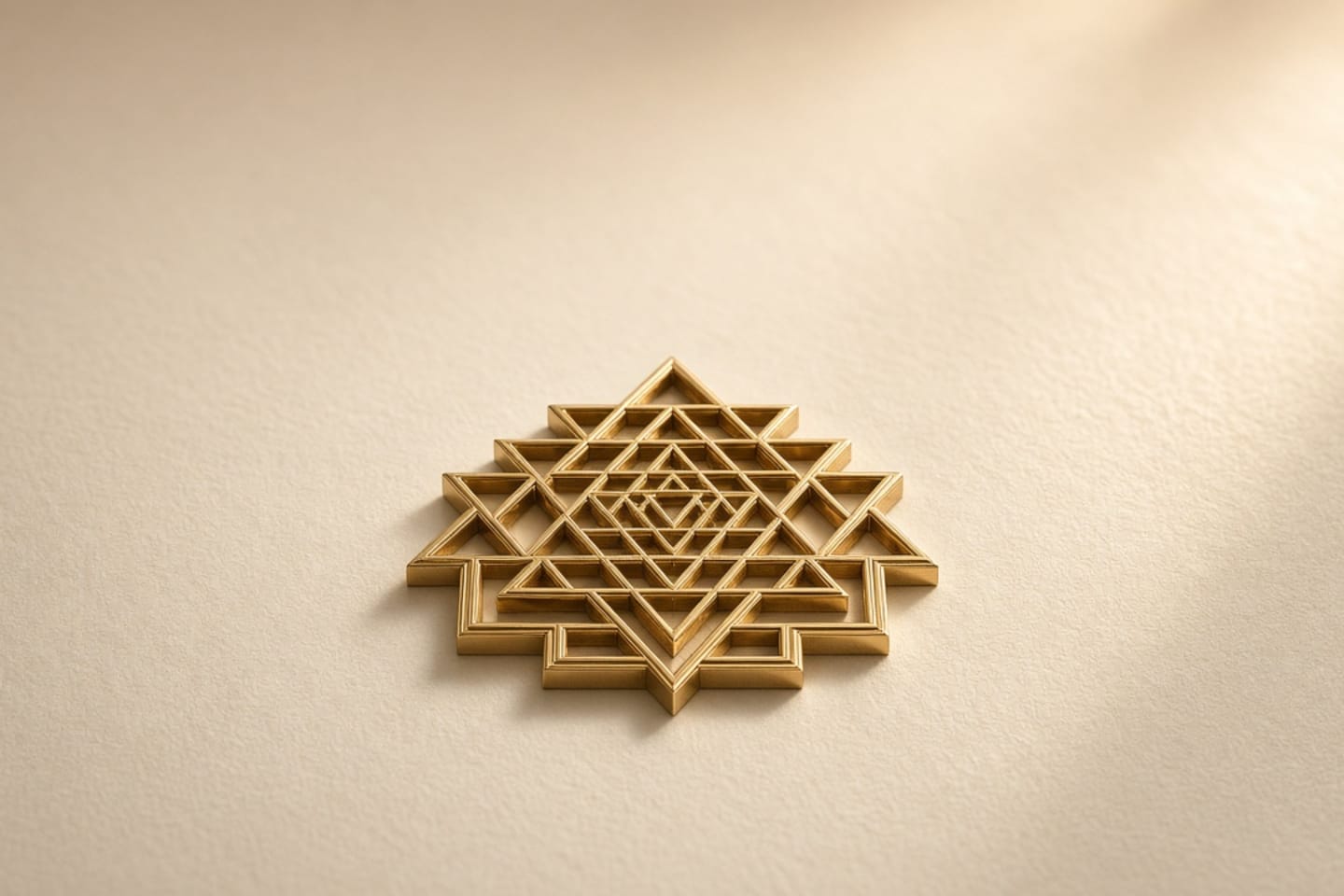
1. Sri Yantra (श्री यन्त्र) — the Devi yantra. The most complex and most celebrated of all yantras. Nine interlocking triangles (five downward-pointing, representing Shakti; four upward-pointing, representing Shiva) forming 43 smaller triangles enclosed within lotus petal rings and the outer square. Central bindu represents Devi (specifically Lalita Tripura Sundari in Sri Vidya tradition). Used for Devi practice, meditation, and general auspiciousness. The classical form is copper with fine etching.
2. Ganesh Yantra (गणेश यन्त्र) — the Ganesha yantra. Simpler than Sri Yantra. A central triangle with the mantra Om Gan Ganapataye Namah inscribed, enclosed within an eight-petaled lotus and the outer square. Used for Ganesha practice, particularly during Ganesh Chaturthi.
3. Mahalakshmi Yantra (महालक्ष्मी यन्त्र) — the Lakshmi yantra. Central bindu with Shri mantra, enclosed within specific triangular geometry, eight petals, and the square. Used for Lakshmi practice, Friday Lakshmi puja, and Diwali.
4. Kuber Yantra (कुबेर यन्त्र) — the Kubera (lord of wealth) yantra. Nine-cell grid (like a Sudoku 3×3) with specific numbers whose rows, columns, and diagonals sum to 72. Used for prosperity practice, particularly in business households. The nine-cell magic-square geometry is distinctive.
5. Navagraha Yantra (नवग्रह यन्त्र) — the nine-planet yantra. Nine-cell grid with each cell representing one of the nine classical planets (Sun, Moon, Mars, Mercury, Jupiter, Venus, Saturn, Rahu, Ketu). Used for planetary practice; particularly at times of specific astrological transitions.
6. Vastu Yantra (वास्तु यन्त्र) — the space/architecture yantra. Nine-cell grid representing the Vastu Purusha (the classical spiritual grid of built space). Placed at the mandir or at the household's entry point during grihapravesh. Considered essential for new-home consecration.
7. Maha Mrityunjaya Yantra (महा मृत्युञ्जय यन्त्र) — the Shiva-conquering-death yantra. Central bindu with the Maha Mrityunjaya mantra, enclosed within specific geometry. Used for Shiva practice and for protection during illness.
Beyond these seven, dozens of specialised yantras exist for specific tantric practices, specific deities, and specific ritual outcomes.
How a yantra is consecrated
The yantra, like the murti, is considered inert until consecrated. The consecration ritual (prana-pratishtha) transforms the etched pattern into a living presence.
Preparation. The yantra is placed on a small cloth-lined tray. Fresh water is prepared. Chandan paste, kumkum, akshata are set beside. Fresh flowers (specific to the deity — red for Devi, white for Shiva, yellow for Vishnu-Lakshmi) are arranged.
Snana (bathing). The yantra is briefly bathed in a small measure of water, followed by a mini-panchamrit (milk, curd, ghee, honey, misri), then pure water again.
Anointment. Chandan paste is applied to the yantra's central bindu and along its geometric structure.
Offering. Flowers, akshata (unbroken rice), fresh tulsi or bilva leaves depending on tradition are offered.
Mantra activation. The specific deity mantra corresponding to the yantra is chanted 108 times (one full mala count). During this chanting, the practitioner's attention is held at the yantra's central bindu.
Final aarti. A small aarti is performed to the newly-consecrated yantra with a diya and light incense.
The yantra is now understood as awakened. It is placed in the household mandir at its designated position and becomes part of the daily worship.
How the tradition uses a yantra
Beyond initial consecration, the yantra plays specific roles in ongoing household practice:
Daily devotional attention. A brief moment of the daily aarti is directed toward the yantra — a small offering of akshata, a light touch of the finger to the central bindu, a moment of visual attention to the geometry.
Meditative focus (tratak). Practitioners of specific meditation traditions use the yantra as a visual focal point. The classical tratak practice involves sustained soft-gazing at the central bindu of the Sri Yantra for progressive periods (starting at 30 seconds, building to several minutes). The tradition understands this as a specific meditative practice that stabilises attention.
Specific festival attention. Ganesh Yantra receives particular attention during Ganesh Chaturthi. Mahalakshmi Yantra during Diwali. Navagraha Yantra during eclipses and specific astrological transitions. The household mandir's collection allows for tradition-specific festival practice.
Placement in specific home locations. Not all yantras belong on the mandir. The Vastu Yantra traditionally sits at the household entry threshold. The Kuber Yantra may sit in the household business or storage area. Some households place small Sri Yantra plaques in the master bedroom for continuous Devi-presence.

How to identify a genuine yantra
Yantras are heavily counterfeited in the modern market — mass-produced brass plates with mechanical etching, marketed as consecrated when they are not.
Genuine markers:
- Hand-etched or carefully machine-etched with clean geometric precision. Mass-produced stamped patterns often have visible flaws in the geometry (asymmetric triangles, uneven petal spacing).
- Traditional material — real copper or brass with metal weight. Aluminium or thin-stamped metal is a warning.
- Documentation of consecration — reputable suppliers provide a small paper certificate confirming the yantra has been prana-pratishtha-consecrated by a temple priest or qualified practitioner.
- Traditional geometry — the classical proportions are exact. A Sri Yantra with visibly wrong triangle counts or incorrect proportions is not a genuine Sri Yantra.
Chaitanya's yantra sourcing. Chaitanya sources copper yantras through a Varanasi-based supplier lineage with three-generation expertise in traditional etching. Each yantra is:
- Hand-etched or precision machine-etched with classical proportions
- Consecrated by a Varanasi temple priest before shipment
- Delivered with a small paper certificate naming the consecrating priest and date
We stock the seven principal household yantras. Rare tantric yantras are made on order.
“A yantra is not a picture of a deity. It is the deity in geometry. The tradition treats the copper plate on the mandir as continuous with the presence at the temple sanctum — the geometry has not moved; only the material carrier has.”

For readers interested in the classical structure — the Sri Yantra's geometry is worth reading properly, because it is one of the most sophisticated sacred geometries in the world's contemplative traditions.
Outer square (bhupura). The material world.
Sixteen-petaled lotus. The sixteen desires (kama) transcended in Devi practice.
Eight-petaled lotus. The eight-fold path of yogic realisation.
Fourteen-triangle ring (chaturdasha). The fourteen aspects of Devi's manifest reality.
Ten outer triangles (bahirdasara). The ten primary powers of Devi.
Ten inner triangles (antardasara). The ten inner Devi forms.
Eight-triangle ring (ashtakona). The eight Devi forms guarding the inner sanctum.
Central triangle (trikona). The trinity of consciousness.
Central bindu. Devi herself — Lalita Tripura Sundari, the primordial consciousness.
The nine major triangular constructions (five downward, four upward) form 43 smaller triangles when properly composed. This is not decorative complexity; it is a mathematical compression of the Devi tradition's full metaphysics into a single figure. Serious practice with the Sri Yantra involves progressive understanding of these layers over years.
For the beginning household practitioner, the Sri Yantra as consecrated presence in the mandir is sufficient. The deeper study belongs to a lifetime of Devi practice.
Published by the house of Chaitanya · www.chaitanya.global
Kits & products from this chapter
Available wholesale, or under your own label.


