How Chaitanya Sources Its Malas
A mala is only as good as the chain that put it on your wrist. This chapter opens the chain — supplier by supplier, region by region, honestly named.
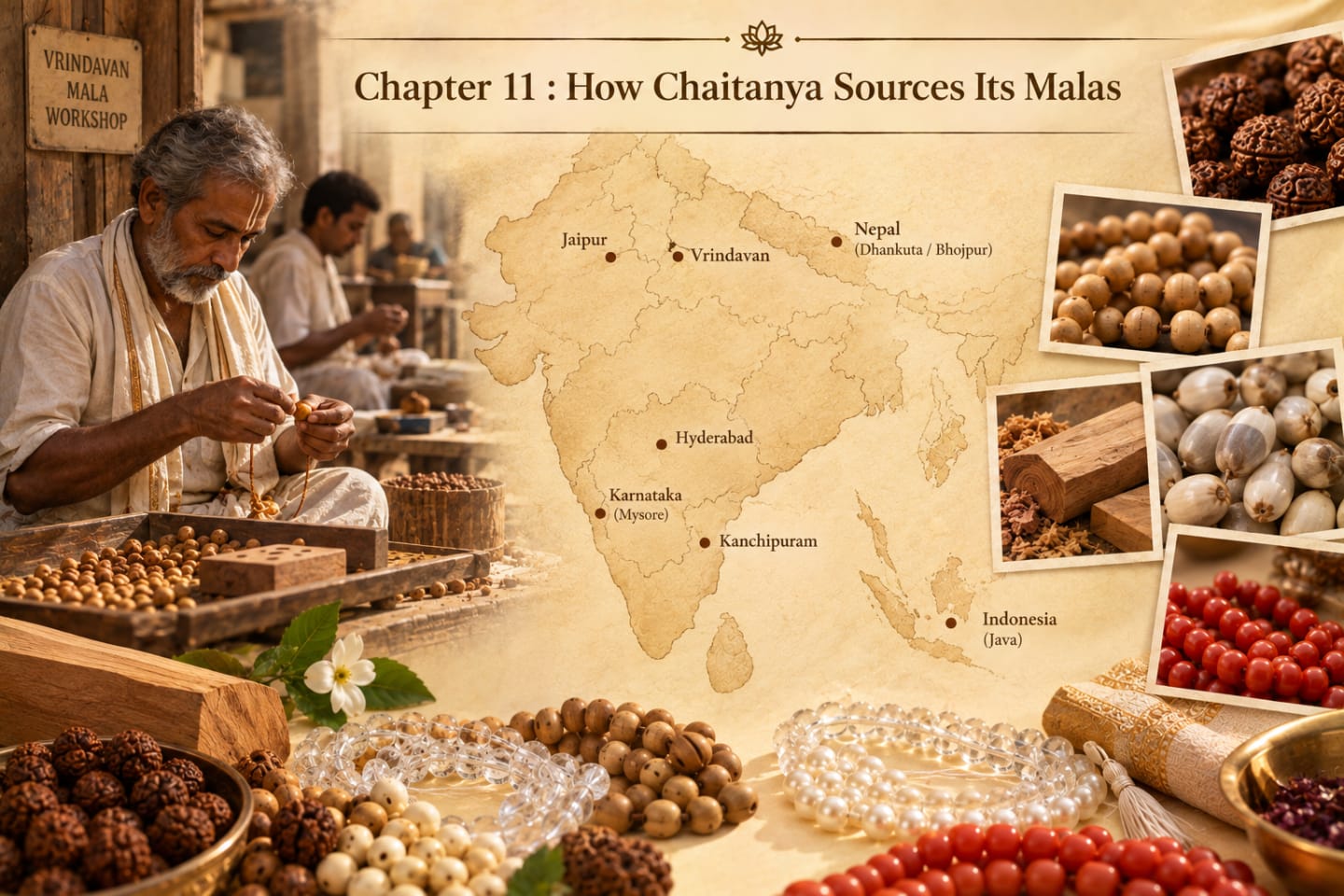
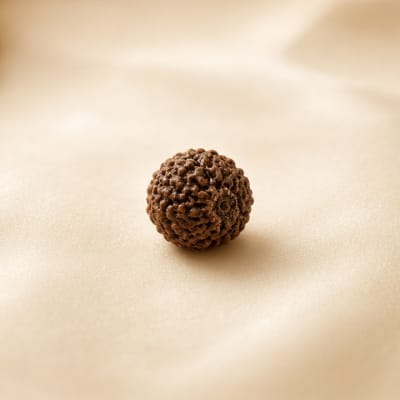
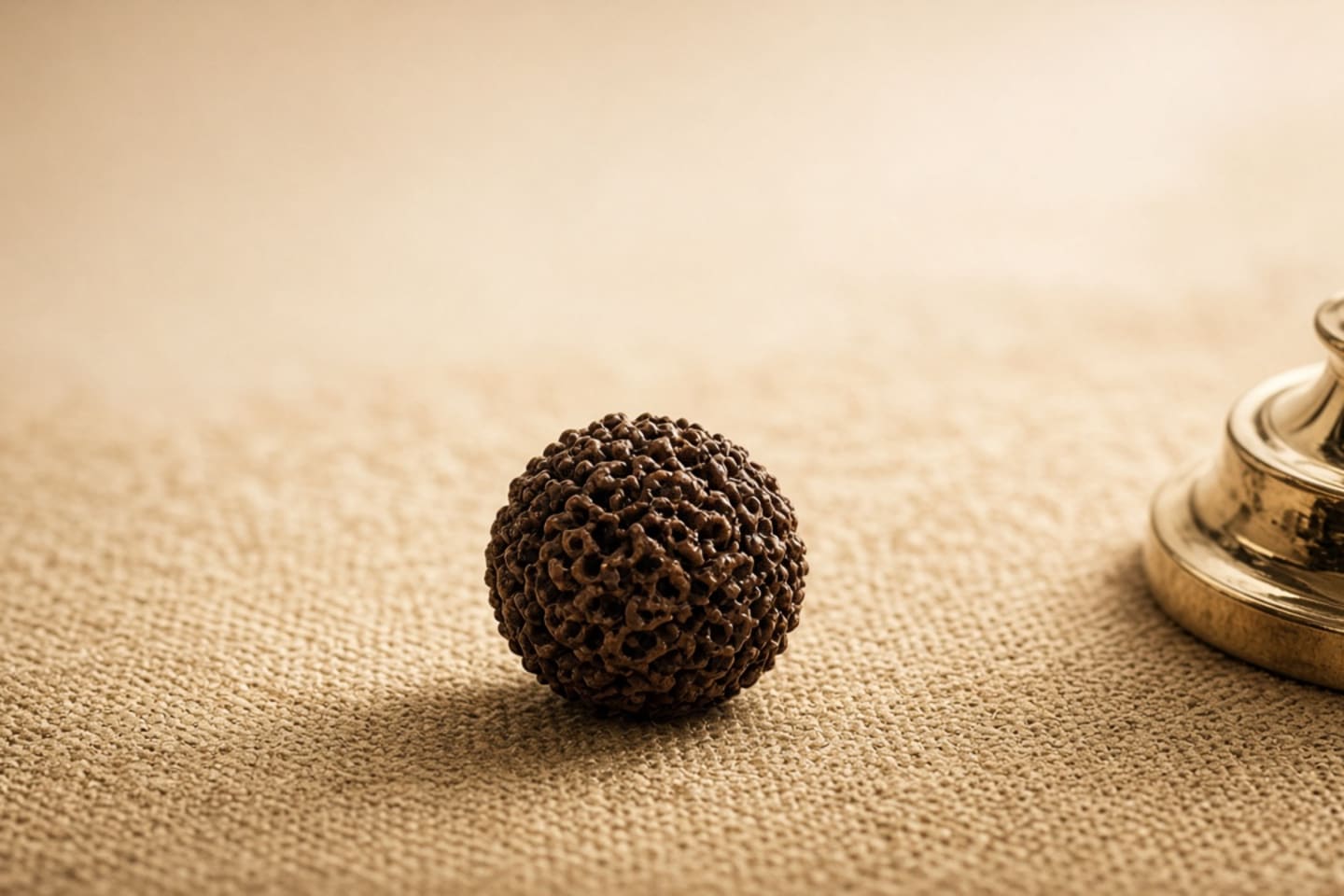
Authentic rudraksha comes from Nepal (larger beads, deeper mukhis, premium) and Indonesia/Java (smaller, more affordable). Nepal 5-mukhi beads range from 10-50 rupees per bead wholesale. Rare 1-mukhi can cost 50,000 to 5,00,000 rupees depending on origin and certification. Buy only from sellers who provide X-ray certification for high-mukhi beads.
Published · Updated · Chaitanya Global Research Team
Every previous chapter of this volume has spoken about materials — rudraksha, tulsi, chandan, sphatik, kamal-gatta, vaijayanti, moti, coral, silver, cotton, silk. This chapter opens the chain — where each material comes from, who has been supplying it, and how a serious mala house sources honestly at every tier.
Volumes 2 and 3 each closed with sourcing chapters. Volume 4's chain is different again — deeper into forest and mountain sourcing, more directly tied to specific botanical or geological origins, and with a counterfeit exposure higher than any other Grantha volume so far. The bead market is where the largest fakes in the Indian sacred trade live. This chapter makes Chaitanya's sourcing visible so that customers can decide with information rather than trust alone.
Nepal — the rudraksha capital
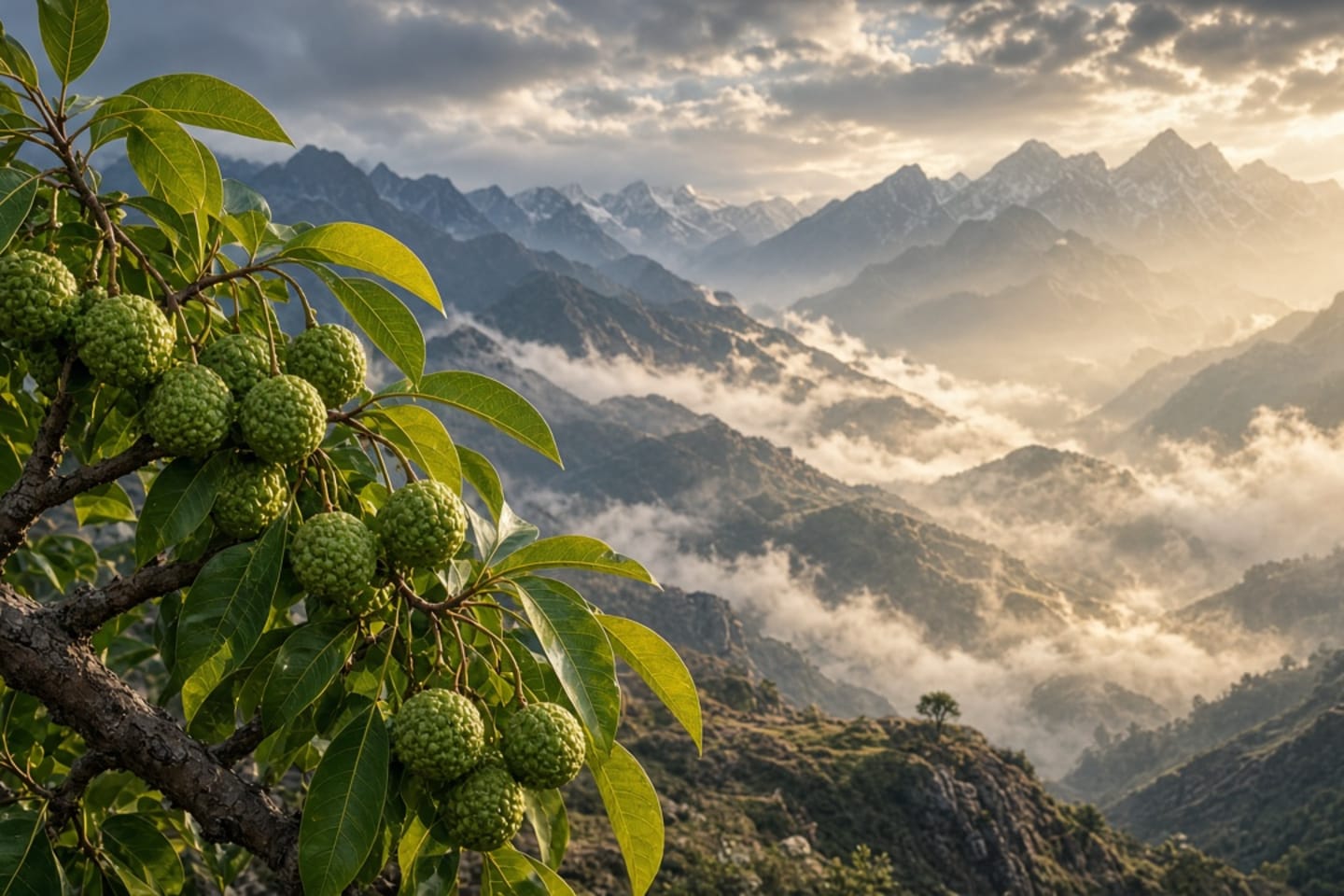
The place. The Nepal Himalayan foothills, particularly the eastern districts of Dhankuta, Bhojpur, Sankhuwasabha, Ilam, and Terhathum, have been the classical source of ritual-grade rudraksha for at least a thousand years. The altitude (800-2000m), the soil composition, and the specific micro-climates of these districts produce the compact, high-density, clearly-mukhi-marked rudraksha the tradition prizes. Indonesian rudraksha (from Java) is more affordable and more common; Nepali rudraksha is the classical gold standard.
Chaitanya's Nepal relationship. Chaitanya sources rudraksha through a supplier lineage in eastern Nepal whose family has been in the rudraksha trade for four generations. The relationship covers:
- Five-mukhi (the workhorse, ~85% of our rudraksha volume)
- Six-mukhi through eleven-mukhi (specific orders, X-ray verified)
- Compound-mala components (rudraksha for rudraksha+chandan and rudraksha+sphatik combinations)
What we do not source. Fourteen-mukhi and above. The counterfeit exposure and the specialised authentication requirements exceed what our supply chain can reliably deliver. Customers seeking rare high-mukhi beads are directed to specialised dealers with dedicated X-ray facilities and multi-generation collector expertise — such purchases are properly made from named-collector houses, not from a general mala house like ours.
Documentation. Every Nepal-sourced rudraksha above five-mukhi comes with paper documentation naming the district and supplier. X-ray scans are provided for eight-mukhi and above. Any Chaitanya rudraksha can be independently verified; Chaitanya facilitates third-party testing where useful.
Indonesia — the commercial rudraksha chain
Indonesian (Java) rudraksha is a legitimate secondary source. Smaller beads, lighter density, similarly-defined mukhi lines — the classical tradition treats Java rudraksha as fully valid for household practice, just less prized than Nepali. Prices are typically 30-50% of Nepali equivalents.
Chaitanya's Indonesian chain. For our Signature-tier five-mukhi mala (the affordable everyday rudraksha), we source through a Bali-based export supplier working with harvesters in central Java. Honestly-named as Indonesian-sourced; not marketed as Nepali.
Vrindavan — the tulsi capital
The place. Vrindavan and Mathura in Uttar Pradesh — the classical land of Krishna's childhood — have been the centre of tulsi cultivation and tulsi-mala production for at least seven centuries. The Vaishnava sampradaya's continuous presence has kept the tradition alive; hundreds of small workshops in and around Vrindavan produce tulsi mala for temple use, initiation, and household devotees.
Chaitanya's Vrindavan relationship. Chaitanya sources tulsi mala through a Vrindavan workshop lineage in continuous operation for over three generations. The workshop:
- Cultivates tulsi on dedicated tulsi-vans (plantations) on the outskirts of Vrindavan
- Hand-turns beads on traditional small lathes
- Strings on natural cotton in classical Vaishnava patterns
- Supplies both plain 108-bead japa mala and 3-strand kantha mala
Cross-linkage to Volume 3. The same Vrindavan-area sources supply tulsi seeds and tulsi plants covered in Volume 3 Chapter 6.
Rameshwaram and Kanchipuram — the South Indian mala centres
Rameshwaram (Tamil Nadu, on the tip of the peninsula) — classical Vaishnava pilgrimage site; source of shell malas and traditional South Indian tulsi mala.
Kanchipuram — the classical Shaiva temple city; centre of traditional stringing and mala assembly workshops. Kanchipuram supply is particularly important for compound malas and for the metal-cap work sometimes seen on premium rudraksha.
Chaitanya's South Indian relationships. Chaitanya sources through a Kanchipuram-based stringing workshop for compound mala assembly (rudraksha+chandan, tulsi+chandan, sphatik with metal cappings). Traditional Kanchipuram silver work — the fine silver-wire cages and pendant work — is produced through this same workshop.
Karnataka / Mysore — the chandan chain
Full sourcing detail is in Volume 3 Chapter 4 and Chapter 11. For chandan mala specifically:
- Royal tier: licensed genuine Mysore Santalum album, hand-turned at Bengaluru workshops.
- Heritage tier: certified Australian Santalum spicatum, hand-turned at the same workshops.
- Signature tier: honestly-sourced smaller Australian sandalwood, machine-turned.
The turning and stringing is done at a single Karnataka workshop network. Same supplier chain for chandan paste raw material (Vol 3) and chandan mala beads (this volume).
The crystal and stone chains — sphatik, moti, coral
Sphatik (rock crystal). Chaitanya sources sphatik through a Rajasthan-based lapidary workshop (Jaipur is India's classical gem-cutting capital). Ritual-grade clear quartz beads cut, drilled, polished. We do not stock or verify Kailash-origin sphatik; standard Himalayan-region and general Indian sourced sphatik only.
Moti (pearl). Sourced through a Hyderabad-based pearl supplier (Hyderabad is India's classical pearl-processing centre, historically working with Persian Gulf and modern freshwater sources). We stock a small range of pearl mala; large orders require lead time for pearl matching.
Coral (praval / munga). Sourced through an Italian coral supplier with sustainable-harvest certification, distributed via a Jaipur re-processor. Coral is one of our smallest-volume mala categories; we stock modestly and prioritise honest sourcing over volume.
The kamal-gatta and vaijayanti chains
Kamal-gatta. Sourced through Bengal (Sunderbans lotus-water region) via a supplier who works directly with local lotus-flower harvesters. Seasonal supply; kamal-gatta mala is often out-of-stock during off-season and returns before Diwali.
Vaijayanti. Sourced through the Vrindavan tulsi supplier's adjacent network — vaijayanti grows in similar agroecosystems and shares supply logistics.
The metal and thread chain
Silver work. Sourced through the Kanchipuram workshop for South Indian pattern work; through a Jaipur silver supplier for North Indian and Rajasthani-style metal work. 92.5 sterling standard.
Copper. Small quantities sourced through the Karnataka workshop network alongside chandan mala production.
Gold. Not stocked in standard inventory. Custom orders only, via a certified Jaipur jeweller.
Thread. Traditional cotton and silk sourced through a Coimbatore textile mill that produces natural-fibre thread for temple garland and mala workshops across South India. Traditional saffron, yellow, undyed cream, and red are stocked; other colours produced on order.
Chaitanya's honest disclosures
Three things we tell customers explicitly rather than obscuring:
1. Not every mala is documented at every tier. Our Signature tier (the affordable everyday range) is honestly-sourced but does not carry the paper documentation our Heritage and Royal tiers do. A customer buying a Signature five-mukhi Indonesian mala is buying a genuine but commercial-grade product; the price reflects that.
2. Supply variability is real. Kashmir saffron, first-flush wild honey, genuine large-mukhi rudraksha — all these are supply-constrained. Chaitanya sometimes runs out of specific mala grades for weeks or months. The alternative (silently substituting cheaper materials) is not what we do.
3. Authentication has limits. No test short of destructive sectioning is fully definitive for a single rudraksha. Our X-ray verification and supplier documentation provide strong but not absolute confidence. A customer with reason to demand absolute certainty on a single high-value bead should factor in the cost of third-party gemological verification (which we support and can facilitate).
What Chaitanya sourcing gives the customer
Three concrete outcomes of sourcing this way:
Material honesty. A Chaitanya five-mukhi Nepal rudraksha is not the same product as a ₹350 rudraksha at a marketplace listing, and the difference is entirely material — real, verifiable Nepal-district sourcing versus commercial-grade or fake beads. Tier names reflect tier reality.
Supplier relationships. If a customer asks where their tulsi mala was made, the answer is a specific Vrindavan workshop in continuous operation for three generations, whose name we can share with the customer on request. This is what a serious mala house should be able to provide.
Independent verification. Every mala can be independently verified. Chaitanya facilitates gemological testing where useful. This is what a house confident in its sourcing offers.
“A mala is downstream of sourcing. The bead against your wrist tomorrow morning is only as good as the chain that put it there. This is Chaitanya's chain, made visible.”
Use these to evaluate any mala supplier — Chaitanya included.
1. Where is your rudraksha from — Nepal or Indonesia? Both are legitimate; the answer should be honest and, for higher-tier claims, documented. A house that hedges is a house whose rudraksha you should not rely on.
2. Can you show X-ray verification for beads above five-mukhi? For six-mukhi and above, X-ray verification is standard-practice among serious suppliers. Absence is a warning sign.
3. Is your tulsi mala hand-turned or machine-produced? Both exist; the answer should be honest. Hand-turned Vrindavan or Puri tulsi commands a premium for good reason.
4. Is your chandan mala genuine sandalwood or scented wood substitute? Genuine Mysore or Australian sandalwood should be named with certification. Below ₹800-1,000 for a full mala, the material is almost certainly substitute.
5. Is your sphatik natural quartz or glass? Natural quartz can be verified with the temperature test (Chapter 7 sidebar). Suppliers should be able to describe origin (Rajasthan, Himachal, general Indian) and quality grade (optical, ritual, standard).
6. What thread is used, and how is the mala knotted? Cotton or silk with at least every-27-bead knotting is proper. Synthetic thread with only guru-bead knotting is mass-market.
7. What is your return / authentication policy? A house confident in its sourcing offers returns and supports independent verification. A house that refuses is a house whose sourcing you should not trust.
A house that answers all seven honestly with documentation is a house you can buy from with confidence. A house that gives vague answers or refuses specifics is a house whose malas are likely below the tier the price suggests.
Published by the house of Chaitanya · www.chaitanya.global
Kits & products from this chapter
Available wholesale, or under your own label.

