The Meal Blessing — Annapurna Tradition
Food is not fuel. In the classical Indian tradition, food is Annapurna's own material presence, offered by the household to itself as continuous small sacrament. This chapter opens the meal blessing.

The Hindu meal blessing (Annapurna tradition) treats food as sacred — anna (grain) is Brahman itself. Before eating: set aside naivedya, sprinkle water around the plate, recite a brief prayer. The Gita verse "Brahmarpanam Brahma Havir" is the most common blessing. Eating in silence for the first minutes is prescribed.
Published · Updated · Chaitanya Global Research Team
Every household eats. Three or four times a day, in most cases. Modern households conduct this activity through a specific pattern: prepare food, plate food, eat food, clean up. The tradition offered a different pattern - and one that most classical Indian households maintained continuously until the last two generations: before eating, briefly acknowledge the food as sacred and offer a small blessing.
This chapter opens the classical meal blessing tradition. The Annapurna framework (food as divine feminine presence), the specific practice, the modern accommodation, and why the practice matters even in reduced form.
Why food is sacred in classical tradition
The classical understanding. Food, in the Indian tradition, is not a consumer good. It is the physical manifestation of Annapurna (अन्नपूर्णा) - literally "she who is full of food" - a specific classical form of the Divine Feminine understood as the deity who provides all food to all beings. Every meal the household eats is understood as receiving Annapurna's continuing generosity.
Multiple layered meanings:
Food as prasad. The classical practice of briefly offering food to the deity before consumption transforms the food into prasad - blessed food. This is not mere symbol; the tradition treats the offered food as ritually distinct from unoffered food.
Food as continuation of Annapurna's presence. Every meal is a small continuous participation in Annapurna's cosmic function of sustaining all beings.
Food as offering to the body's Agni. The classical tradition also treats the act of eating as an offering into the body's own internal fire (jatharagni). The body is understood as containing a small fire (the digestive process) that is a manifestation of Agni himself (see Vol 6 Ch 1). Eating is offering to this internal Agni.
Food as household hospitality. The classical understanding: the food the household prepares belongs first to guests (atithi devo bhava - the guest is divinity), then to household members, then to the household animals (leftover offerings), then finally to nothing wasted. The classical hierarchy of eating.
The classical meal blessing
The classical practice before eating:
1. Preparation for the meal.
- Hands and face washed
- Fresh clothing (not required change, but clean)
- Seated at the family meal location (traditionally on the floor with a low table; modern practice at conventional table acceptable)
2. Brief acknowledgement of the food.
- Look at the food briefly before beginning
- Silent internal acknowledgement that this is Annapurna's presence
- Small gesture (touching the plate briefly with respect, or hands in namaskaram)
3. Small offering to the deity.
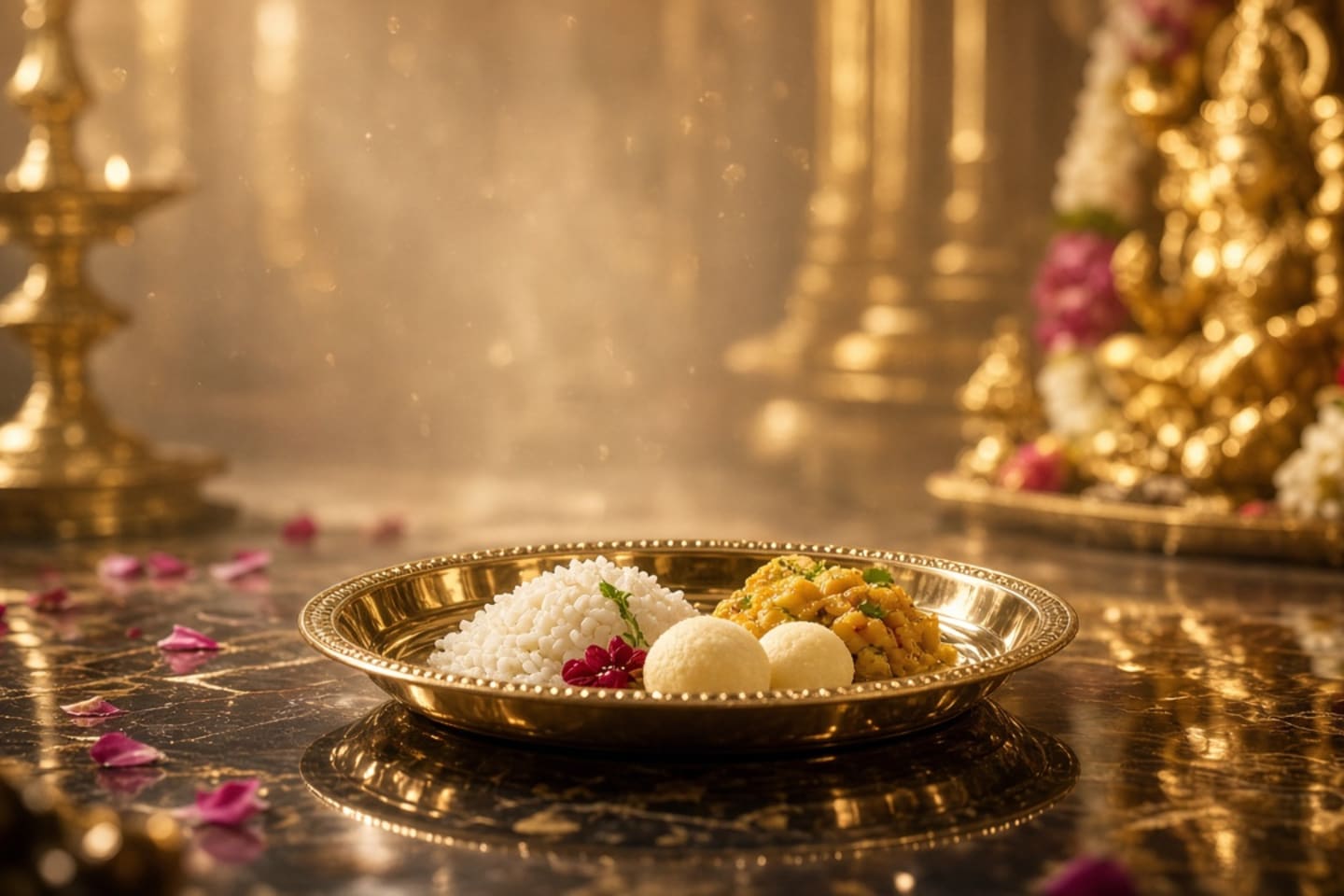
- Traditional practice: a small portion of food (a bite-sized quantity) placed briefly in a small brass container beside the plate as offering
- This is offered mentally to the household deity
- After a moment, the offering can be returned to the plate (having become prasad) or set aside for later plant/animal feeding
4. The classical meal-blessing mantra.
Multiple traditional options - the household selects based on tradition:
Universal option: Brahmarpanam brahma havir brahmagnau brahmana hutam Brahmaiva tena gantavyam brahma karma samadhina (Bhagavad Gita 4.24)
"The offering is Brahman, the offering-substance is Brahman, offered by Brahman into the fire of Brahman - by concentration on Brahman-action, one reaches Brahman."
Vaishnava tradition option: Om Namo Bhagavate Vasudevaya (three times before eating)
Shaiva tradition option: Om Namah Shivaya (three times before eating)
Devi/Shakta tradition option: Om Aim Hreem Kleem Chamundayai Vichche or Annapurna mantra
Family-tradition mantra. Every household may have its own inherited meal-blessing verse; classical practice honours these.
5. Silent moment.
- Brief moment of internal presence before beginning to eat
- Acknowledgement of gratitude
6. Begin eating.
Duration: 30 seconds to 2 minutes depending on elaboration.
The classical eating practice
Beyond the blessing itself, classical tradition holds specific practices during the meal:
1. Silence during eating. Classical tradition asks for silence during meals - not conversation. The reasoning: eating is a devotional act; conversation scatters the attention. Modern practice largely relaxes this rule; families eat with conversation. But even modern practice maintains: the meal begins in silence (during the blessing and first few bites) even if conversation follows.
2. Right hand only for eating (in traditional practice). The left hand is considered ritually improper for direct food contact in classical tradition. This is a South Asian cultural norm maintained widely; modern practice varies but the classical preference persists.
3. Small portions, chewed slowly. Classical Ayurveda held that food should be eaten with attention - chewed thoroughly, not rushed, with intervals. Modern practice often abandons this; the tradition remembers it.
4. Gratitude at the end. The classical practice: brief acknowledgement of the meal completing, thanks to the food, brief clean-up done as ritual not chore.
The meal as household-daily-ritual
The classical understanding: the meal is the household's most-repeated daily ritual moment. More frequent than aarti (typically once daily), more frequent than mantra recitation (variable), more frequent than any other devotional practice. Three to four meals per day, 365 days per year, across the household's entire duration = 1000+ meal moments annually.
If the household transforms even brief meal-blessing into consistent practice, this represents 1000+ small devotional moments woven through the year. This is the classical rhythm that daily practice provides that occasional practice cannot.
Modern reality and reduced practice
Most modern households have foreshortened meal blessing to: mumbled quick prayer or none at all. The classical tradition's honest observation: this is significant devotional loss for the household.
Minimum viable modern meal blessing (10 seconds):
- Brief pause before beginning
- Silent internal acknowledgement: "This food is a gift"
- Brief silent gratitude
- Begin eating
Even this minimum re-establishes the classical rhythm. Better than nothing.
Realistic modern practice (30 seconds):
- Brief pause
- Silent mantra (chosen from tradition-appropriate options above)
- Brief silent gratitude
- Begin eating
Full classical practice (2 minutes):
- Preparation for the meal
- Look at food, acknowledge as Annapurna's presence
- Small offering to deity (physical setting-aside)
- Full mantra recitation
- Silent moment
- Begin eating in silence
Households can select their tier based on capacity and honest realism. What matters: consistent practice at whatever tier the household chooses.
The children's meal blessing tradition
Small children learning meal blessing: The classical Indian household teaches meal blessing to children from earliest age through observation. Children watching parents pause before eating internalise the practice without formal instruction. This is how the tradition transmits.
Modern practical guidance:
- Include children in the meal blessing from earliest possible age
- Explain briefly, in age-appropriate language, why we pause before eating
- Traditional practice: teach specific small mantras for children (short verses appropriate to age)
- The Sikh tradition includes a specific children's meal-prayer tradition (jai jai jai jai kar); other traditions have parallel age-appropriate practices
Children who grow up watching parents conduct meal blessing carry the practice for life, even into their own adult households after leaving parental home.
What consistent meal blessing brings to the household
Households that maintain meal blessing consistently across years report specific qualities:
Slower, more mindful eating. The brief pause before eating naturally slows the meal. Mindful eating is a classical Ayurvedic teaching that meal blessing enforces.
Better family gathering culture. Households that maintain family meals with blessing tend to prioritise family meal gathering. This is not tradition claim; it is documented in family sociology research.
Continuity of tradition across generations. Children learn the practice through observation. Grandchildren inherit similarly. The rhythm continues across generations without explicit teaching.
Small daily presence of Annapurna. In classical understanding, each meal blessing invokes and honours Annapurna. Multiple times per day. The household in which Annapurna is regularly acknowledged is understood in classical tradition as an Annapurna-blessed household.

The specific North-South Indian variation
North Indian household tradition: Meal blessing usually brief, focused on family unity. Common practice: family holds hands briefly before beginning meal (secular adaptation of classical practice), then brief silent prayer.
South Indian household tradition: More formal meal blessing tradition maintained. Full mantra recitation more common. Traditional South Indian household eats on floor with banana leaves; the meal blessing here is more elaborate.
Kerala Vaishnava tradition: Includes specific Vishnu-focused meal offerings; traditional temple-adjacent practice extends into household.
Bengali tradition: Distinct meal blessing tradition with Bengali mantras and specific meal-related deities honoured.
Every regional tradition maintains some form of meal blessing. The specific practice varies but the classical framework - food as Annapurna, meal as sacred moment - is universal.
“The meal is the household's daily-repeated ritual moment. More frequent than aarti. More continuous than any other practice. And it has been quietly abandoned by many modern households. Restoring even brief meal blessing - 10 seconds of pause before eating - restores one of the classical tradition's most reliable daily devotional structures.”

Annapurna is understood in classical tradition as a specific form of Devi. Her classical iconography: a beautiful goddess seated on a lotus, holding a ladle in one hand and a bowl of rice in the other. She is worshipped as the deity who provides food to all beings.
Annapurna's classical presence in India:
- Kashi (Varanasi): The classical Annapurna Devi temple is in Kashi. The story: Kashi was struck by famine and Annapurna appeared, feeding all who came. Even Shiva himself is said to have received food from her hands at Kashi.
- South India: Multiple Annapurna temples, particularly in Tamil Nadu and Kerala
- Household: Every kitchen in India where food is prepared is considered a small Annapurna zone in classical understanding
Physical food as Annapurna's material presence: The classical understanding: every grain of rice, every vegetable, every fruit that reaches the household is Annapurna's continuing generosity. The household that acknowledges this at every meal is holding the classical Annapurna tradition.
Meal preparation as Annapurna practice: Traditional Indian household meal preparation was itself devotional practice - the person preparing food (traditionally the household matriarch) understood herself as Annapurna's small manifestation. Modern practice largely lost this framing, but classical Ayurvedic traditions still emphasise that food should be prepared with attention and devotional intention.
Annapurna is not a distant temple deity. She is present, in classical tradition, in every meal the household eats. The blessing acknowledges her.
Published by the house of Chaitanya · www.chaitanya.global
Kits & products from this chapter
Available wholesale, or under your own label.
