What the Festival Calendar Is
The Hindu year is not the year the modern household plans by. This chapter opens the classical calendar - the lunar rhythm, the twelve months, the specific festivals each carries, and how the classical calendar sits alongside the Gregorian one.
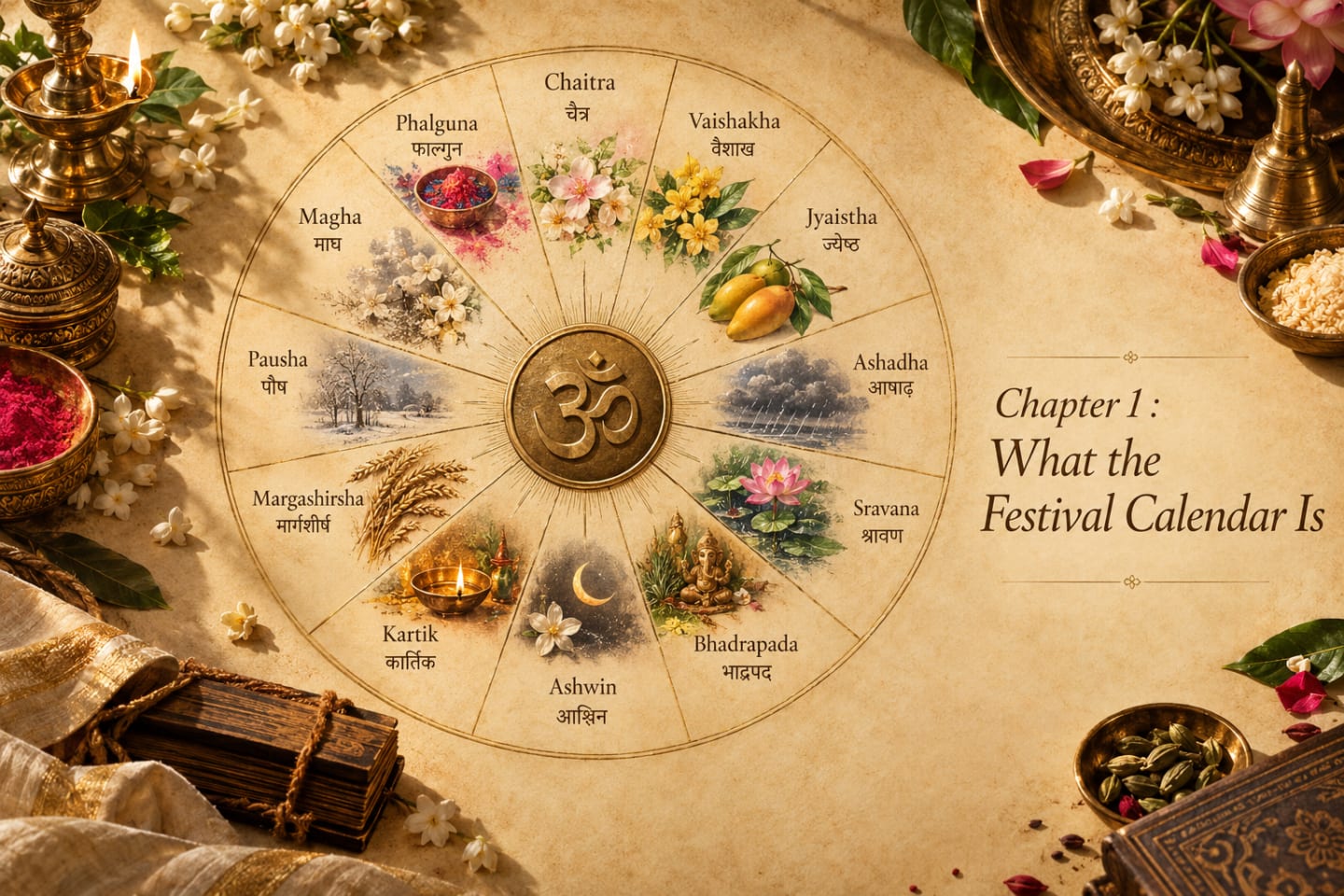
The Hindu calendar is lunisolar — months follow the Moon (29.5-day cycles), while the year adjusts to the Sun. The 12 lunar months from Chaitra to Phalguna each have a bright half (Shukla Paksha, waxing) and dark half (Krishna Paksha, waning). An intercalary month (Adhik Maas) is added roughly every 3 years for alignment.
Published · Updated · Chaitanya Global Research Team
Every modern household in India plans by two calendars simultaneously. The Gregorian calendar (January through December) organises work, school, national holidays, and everyday life. The classical Hindu lunar calendar (Chaitra through Phalguna) organises festivals, samskaras, ritual observances, and the household's devotional year. Most modern households know when Diwali arrives without knowing which Hindu month it falls in. They know Holi is in spring without knowing it marks the end of Phalguna. They observe Navratri without knowing Chaitra Navratri and Ashwin Navratri are two different observances.
This chapter opens the classical calendar as complete framework. Not to memorise but to understand - so that when the household approaches specific festivals in the ten chapters ahead, the wider rhythm is visible.
The classical Hindu calendar
The lunar structure. The classical Hindu calendar (panchang) is a luni-solar system - based on the moon's phases but adjusted to keep pace with the solar year. Each month is one lunar cycle (~29.5 days). Twelve months = ~354 days. To reconcile with the ~365-day solar year, an additional adhika masa (extra month) is inserted approximately every 2.5 years.
The twelve months. In classical order beginning with the spring month:
| # | Month | Roughly Corresponds To |
|---|---|---|
| 1 | Chaitra | March-April |
| 2 | Vaishakha | April-May |
| 3 | Jyaistha | May-June |
| 4 | Ashadha | June-July |
| 5 | Sravana | July-August |
| 6 | Bhadrapada | August-September |
| 7 | Ashwin | September-October |
| 8 | Kartik | October-November |
| 9 | Margashirsha | November-December |
| 10 | Pausha | December-January |
| 11 | Magha | January-February |
| 12 | Phalguna | February-March |
Each month is divided into two fortnights:
- Shukla paksha (bright fortnight) — new moon to full moon
- Krishna paksha (dark fortnight) — full moon to new moon
The specific date within a month is given as paksha + tithi (fortnight + lunar day). Example: "Bhadrapada Shukla Chaturthi" = 4th day of the bright fortnight of Bhadrapada = Ganesh Chaturthi.
Why the calendar matters
The tradition is tied to lunar timing, not solar. Every major festival, samskara, and specific observance is calibrated to a specific lunar day. Diwali is Amavasya (new moon) of Kartik - the specific new moon that falls in October-November. Maha Shivratri is Krishna Chaturdashi of Magha - the specific 14th dark-fortnight day in January-February. Missing the lunar timing means missing the classical observance.
Modern practical implication. Because the classical festivals fall on lunar-specific dates, they shift by 10-11 days each Gregorian year. Diwali may be November 3 one year and October 24 the next. This is why household calendars require year-specific panchang consultation.
Regional calendar variations. India uses multiple regional variants of the classical calendar:
- Vikram Samvat (Northern India) - lunar
- Shalivahana Shaka (Southern India) - solar-lunar
- Bengali calendar - modified lunar
- Tamil calendar - solar
- Malayalam Kollam calendar - solar
The Chaitanya Grantha uses the mainstream Vikram Samvat system throughout; regional variants noted where significant.
The four seasonal groupings
The twelve months naturally group into four seasonal-ritual clusters:
Spring (Chaitra-Vaishakha, March-May): Chaitra marks the classical new year. Chaitra Navratri, Ram Navami, Hanuman Jayanti, Akshaya Tritiya. Rebirth register.
Summer & early monsoon (Jyaistha-Ashadha-Sravana, May-August): Beginning of Chaturmas (four sacred months). Guru Purnima, Sawan Somvar, Nag Panchami, Raksha Bandhan, Janmashtami. Fasting and study register.
Late monsoon & autumn (Bhadrapada-Ashwin-Kartik, August-November): The peak festival zone. Ganesh Chaturthi, Onam, Navratri, Dussehra, Diwali, Karva Chauth, Bhai Dooj. Household abundance register.
Winter (Margashirsha-Pausha-Magha-Phalguna, November-March): Transitions and completions. Vaikuntha Ekadashi, Makar Sankranti, Vasant Panchami, Maha Shivratri, Holi. Purification and preparation register.
Festival types
Not all festivals are equal. Classical tradition distinguishes types:
Yatra (pilgrimage festivals): Some festivals traditionally involve pilgrimage - Kumbh Mela (every 12 years at specific sites), Chardham Yatra (annual for many), specific temple festivals.
Vrata (vowed fast festivals): Household-scale observance centred on fasting practice - Ekadashi, Sixteen Somvar, Karva Chauth, Nirjala Ekadashi.
Puja (worship festivals): Household-scale observance centred on formal puja practice - Ganesh Chaturthi, Navratri, Diwali Lakshmi Puja, Krishna Janmashtami.
Ceremonial festivals: Larger-scale observance involving community gathering - Dussehra, Holi, Onam, Pongal.
Samskara-adjacent festivals: Life-cycle-linked festivals - Rakhi (sibling bond), Bhai Dooj (sibling bond), Karva Chauth (marital bond), specific naming and initiation days.
Different households prioritise different types. Vaishnava households may prioritise Vrata (Ekadashi observance) more than Puja festivals; Shakta households may prioritise Puja (Navratri) more than Vrata; general households observe major Puja festivals with less Vrata practice.
What the household actually needs to know
For the household approaching festival observance in a realistic modern practice:
1. Know the major eight. Even minimal household observance should include: Ganesh Chaturthi, Navratri, Diwali, Karva Chauth, Makar Sankranti, Maha Shivratri, Holi, and Janmashtami or Ram Navami depending on tradition. These are the eight most-widely-observed.
2. Know the household tradition emphasis. Shaiva households add Maha Shivratri emphasis, Sawan Somvar intensification. Vaishnava households add Janmashtami emphasis, Ekadashi observance, Vaikuntha Ekadashi. Shakta households add both Navratris intensified, Kali Puja on Diwali night, Durga Puja for Bengali tradition.
3. Know the seasonal fuel and fragrance shifts. The thirteen fragrance families (Vol 2) map directly onto the festival calendar — warm families (Sacred Amber, Warm Woody) dominate the winter festival months, while cool families (Fresh Green, Fresh Marine) serve the summer. The four forms of Indian smoke (Vol 1) shift too: dhoop for festival aarti, agarbatti for daily, loban for the grief-adjacent observances. Chaturmas (July-October) intensifies practice. Winter (November-February) shifts to warmer fragrance and mustard oil in North Indian evening. Summer (March-June) shifts to cooler fragrance and coconut oil in South Indian.
4. Get annual panchang consultation. Because festivals shift dates yearly, an annual panchang (astrological almanac) helps household plan the year.
5. Plan festival kits 3-4 weeks in advance. Vol 7's festival kits are assembled 3-4 weeks ahead of each festival. Households planning the year proactively can buy ahead for the whole festival calendar.
The Chaitanya festival range
Festival kits for every major observance. Made in Signature, Heritage and Royal grades and supplied wholesale or under your own label to grocery chains, importers and distributors.
Regional customisation. Each regional tradition has its specific festival calendar. Chaitanya's festival kits are made in regional variants to match.
What this volume opens
Chapters 2 through 10 open the twelve months by season, festival-by-festival:
Ch 2: Chaitra & Vaishakha - Spring/New Year festivals Ch 3: Jyaistha & Ashadha - Early monsoon Ch 4: Sravana - The Sawan month Ch 5: Bhadrapada - Ganesh & Krishna month Ch 6: Ashwin - Navratri & Dussehra Ch 7: Kartik - Diwali month Ch 8: Margashirsha & Pausha - Winter transitions Ch 9: Magha - Shivratri month Ch 10: Phalguna - Holi month Ch 11: How Chaitanya supports festival observance Ch 12: Choosing your festival calendar
By the end of this volume, the household has a complete reference to the ritual year - which festivals to observe, when they fall, what each requires, how each connects to the household's tradition, and how to plan festival practice across the full 12 months.
“The Hindu year is not the year the modern household plans by. It is the year the tradition has held continuously for two thousand years - lunar rhythm, twelve months, specific festivals each with specific classical observance. The household approaching this calendar with attention holds not one year but 2000 years of continuous ritual practice.”
Published by the house of Chaitanya · www.chaitanya.global
Kits & products from this chapter
Available wholesale, or under your own label.

