Magha — Shivratri Month
Winter still holds. But Sarasvati Puja opens the education month. Ratha Saptami honours the sun. And Maha Shivratri - the year's most-observed Shiva festival - arrives on the darkest night of Magha. This chapter opens the calendar's final winter month.
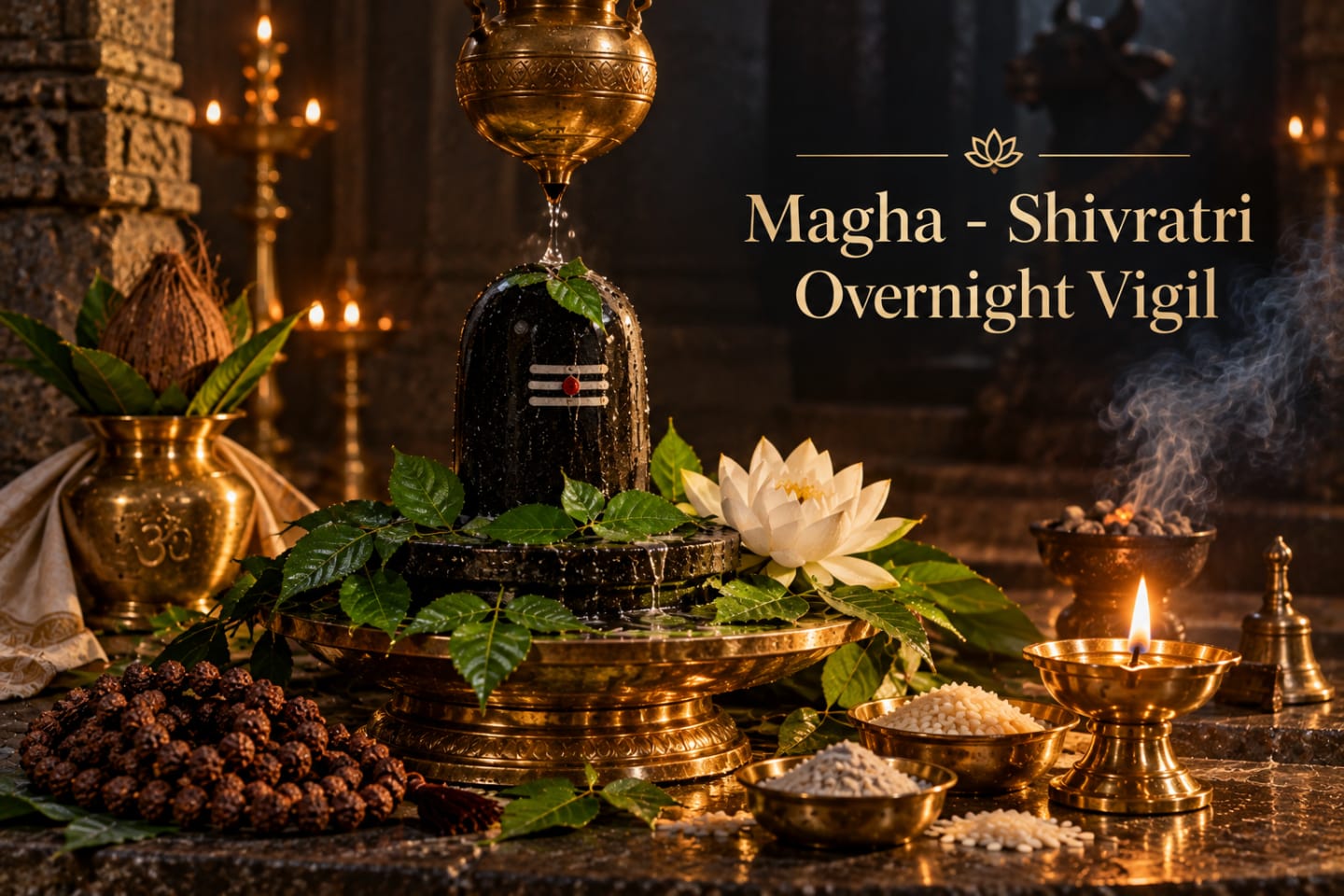
Maha Shivratri (Magha Krishna Chaturdashi, February-March) is an overnight vigil: daylong fast, shivling abhishek with milk and water, bilva leaf offerings, and staying awake through four 3-hour watches with puja at each. The overnight jagaran distinguishes Shivratri from all other festivals.
Published · Updated · Chaitanya Global Research Team
The eleventh lunar month Magha (January-February) sits in classical winter. The festival density remains lower than autumn's peak but the month contains one of the year's most-widely-observed festivals: Maha Shivratri - the Great Night of Shiva. Beyond Shivratri, Magha includes Vasant Panchami (Sarasvati Puja - honouring the goddess of knowledge), Ratha Saptami (sun chariot festival), and multiple regional observances.
Where Sravana was Shiva's month across four Mondays, Magha concentrates Shiva-focused practice in a single overnight vigil. This chapter opens the month.
Magha Shukla Panchami — Vasant Panchami / Sarasvati Puja
Timing. 5th day of bright fortnight of Magha (roughly late January or early February).
Classical significance. Vasant means "spring." Traditional day when winter classically begins yielding to spring. Also Sarasvati Puja - honouring Sarasvati, the goddess of knowledge, learning, arts, and music.
Household observance:
- Traditional yellow clothing (yellow associated with Sarasvati)
- Small Sarasvati murti or picture arranged in mandir with yellow silk drape
- Yellow flowers (mustard flowers particularly - classical seasonal blooming)
- Traditional prasad (yellow rice, saffron-tinted sweets)
- Books, musical instruments, art materials placed briefly at mandir as blessing
- Traditional student practice: children's first-writing ceremony (akshar-arambh) - young children (typically age 2-4) traditionally begin their formal writing with Sarasvati's blessing on this day
Classical understanding: The classical connection between spring's arrival and knowledge's blossoming - the tradition holds that as the natural world renews, the household's engagement with learning and creative practice similarly renews.
Regional variants:
North India: Universal observance. Yellow-clothing tradition maintained. Community celebrations in academic institutions.
Bengal (Saraswati Puja - most elaborate): One of Bengal's most-observed festivals. Community pandal celebrations. Extensive traditional preparation. Bengali households universally observe. Students visit their educational institutions for Saraswati blessing.
Punjab: Basant tradition - kite-flying celebrations parallel to Sarasvati Puja. Yellow clothing extensive.
South India: Different regional emphasis - some traditions observe Sarasvati Puja at different dates in their calendars (particularly Vijayadashami time).
Kerala: Different regional emphasis.
Modern practical practice:
Basic observance (30 min): Yellow clothing, small Sarasvati puja at mandir, brief acknowledgement of learning and books.
Extended observance (2-3 hours): Full Sarasvati puja with elaborate arrangement, community connection where possible, children's first-writing ceremony if age-appropriate, extended prayer for learning practice.
Serious traditional observance (half-day): Full traditional practice with Sarasvati-focused mantra recitation, extensive puja, community gathering, traditional prasad preparation.
Kit reference: Small Sarasvati-focused extension of daily kit - yellow silk cloth, yellow flowers, traditional yellow prasad ingredients.
Magha Shukla Saptami — Ratha Saptami / Surya Jayanti
Timing. 7th day of bright fortnight of Magha.
Classical significance. Sun's classical birth day. Also traditionally understood as the day Surya begins his classical chariot journey with the seven horses representing the seven days of the week. Marks the sun's classical energy increasing.
Household observance:
- Pre-dawn ritual bath - traditional bathing with specific classical mantras
- Sunrise water offering (arghya) to Surya with extended traditional practice
- Extended morning aarti with sun-focus
- Traditional prasad
- Small copper container of water offered to sun during arghya
Classical significance: After winter solstice's Uttarayana beginning at Makar Sankranti (Chapter 8), Ratha Saptami marks the specific classical day when the sun's chariot journey formally begins for the year - a specific solar-tradition observance.
Regional variants:
- South India (particularly Tamil Nadu, Karnataka): More elaborate observance. Community celebrations at Surya temples. Extended practice.
- North India: Modest observance in most households.
- Andhra Pradesh: Ratha Saptami particularly emphasised.
Modern practical practice: Even brief pre-dawn sun-focused practice with water offering restores classical framework.
Kit reference: Small copper container for sun offering, traditional Surya-focused samagri.
Magha Purnima — Magh Purnima
Timing. Full moon of Magha.
Classical significance. Multiple traditions attribute significance to this day:
- Traditional bathing at holy sites (Sangam / Triveni Sangam / Ganga particularly auspicious)
- Buddha Jayanti in some Buddhist traditions
- Traditional observance days at multiple pilgrimage sites
Household observance:
- Traditional bathing (with gangajal if travel not possible)
- Extended morning aarti
- Charitable giving traditional
- Community celebrations at pilgrimage sites
Regional variants:
- North India (Ganga-adjacent): Serious pilgrimage observance
- Kumbh Mela years: During Kumbh Mela at Prayag (Allahabad) or specific pilgrimage sites, Magh Purnima becomes major celebration day
- General households: Modest observance
Magha Krishna Chaturdashi — Maha Shivratri
Timing. 14th day of dark fortnight of Magha - the darkest night of the winter month (roughly late February or early March).
Classical significance. Maha Shivratri - "the Great Night of Shiva." One of the year's most-widely-observed festivals across all Shaiva traditions.
Classical narratives (multiple layered):
- The night Shiva married Parvati in classical tradition
- The night of Shiva's cosmic Tandava dance - his classical destruction-creation dance
- The night Shiva emerged from the classical lingam form
- The night of Shiva's classical marriage of Ardhanarishvara form
Household observance:
Preparation (day-of):
- Complete household cleaning
- Fresh flowers extensively (bilva leaves particularly, white flowers)
- Bhimseni camphor stock verified
- A2 cow ghee stock for extended akhand
- Panchamukhi diya prepared
Pre-sunset observance:
- Sankalpa for the overnight vigil
- Traditional pre-sunset bath
- Extended evening puja
Sunset to midnight (first prahar):
- Shivling abhishekam with water and milk
- Bilva leaves offering (108 or 1008 leaves for serious observance)
- Bhajan and mantra recitation - Shiva Chalisa, Rudra Ashtakam, Maha Mrityunjaya
- Community gathering at Shiva temples if accessible
Midnight (second prahar):
- The peak observance moment
- Continued abhishekam
- Extended aarti at midnight
- Traditional practice: staying awake through the entire night
Post-midnight (third and fourth prahar):
- Continuing bhajan, meditation, japa
- Some households read Shiva Purana or specific Shiva-tradition texts
- Continuing bilva leaves offering
Dawn:
- Final abhishekam
- Traditional pre-dawn bath
- Fast breaking with panchamrit
- Brief morning aarti
- Family gathering meal
Regional variants (substantial):
North India: Universal observance. Community celebrations at Shiva temples. Elaborate pandal celebrations in some regions. Ganga bathing tradition for those near the river.
South India: Serious traditional observance. Temple visits central. Traditional Tamil, Malayalam, Kannada practice.
Maharashtra: Serious observance. Extended fasting tradition.
Bengal: Modest household observance; less elaborate than North Indian.
Kashmir: Traditional Kashmiri Pandit Shivratri with specific regional practices.
Nepal (Pashupatinath): Major celebration at Pashupatinath temple - one of the most spectacular Shivratri celebrations globally.
Modern practical practice:
Basic observance (evening only): Extended evening aarti with Shiva focus. Bilva leaves offering. Milk abhishekam if household has shivling. No overnight vigil.
Standard observance (evening + midnight): Sunset preparation. Midnight vigil observance. Return to sleep after midnight aarti. Morning acknowledgement.
Serious observance (full overnight): Complete overnight vigil. Continuous practice through four prahars. Dawn conclusion.
Kit reference: Extension of Daily Kit + Shiva-specific materials. Additional bilva leaves (108 or 1008 for serious observance), extra ghee for extended burning, panchamukhi diya, bhimseni camphor extra stock.
Other Magha observances
Magha Krishna Chaturthi - Sankashti Chaturthi: Monthly Ganesh fast day.
Bhishma Ashtami (Magha Shukla Ashtami): Commemorates Bhishma's classical departure from body during Uttarayana. Traditional tarpana observance.
Magha Krishna Ekadashi - Vijaya Ekadashi: Vaishnava fast observance.
Regional festivals:
- Thaipusam (Tamil tradition): Falls in Tamil month Thai (Magha equivalent). Major Kartikeya-focused festival particularly in Tamil Nadu, Malaysia, Singapore.
The month's practical rhythm
Week 1: Magha begins. Winter cold continues.
Week 2: Vasant Panchami / Sarasvati Puja (5th bright). Beginning of classical spring transition.
Week 3: Ratha Saptami (7th bright). Magh Purnima (full moon).
Week 4: Approaching Maha Shivratri preparation.
End of month: Maha Shivratri (14th dark). The overnight vigil.
Month character: Sarasvati and Shiva-focused. Sarasvati Puja opens the spring transition. Ratha Saptami marks the sun's classical journey beginning. Maha Shivratri closes the month with the overnight vigil. Winter's final month before Phalguna's Holi.
What Chaitanya makes for Magha
Everything below is made in Signature, Heritage and Royal grades and supplied wholesale or under your own label to grocery chains, importers and distributors.
Sarasvati Puja Kit. Yellow silk cloth, yellow flower supply, traditional yellow prasad ingredients, Sarasvati murti or picture for household presence, children's first-writing ceremony materials.
Ratha Saptami materials. Small copper container for sun offering, traditional Surya-focused samagri.
Magha Purnima materials. Extra gangajal for those observing pilgrimage-adjacent practice from home.
Maha Shivratri Kit. Full three-tier kit at Signature / Heritage / Royal. Includes bilva leaves (108 or 1008 count), extra A2 cow ghee for extended akhand, panchamukhi diya, extra bhimseni camphor stock, milk supply, extended Shiva materials.
Regional customisation. Kashmiri Pandit, Bengali, Nepalese variants all supported through custom orders.
“Magha is winter's final full month. Vasant Panchami opens the classical spring transition with Sarasvati Puja. Ratha Saptami honours the sun's chariot journey beginning. Magh Purnima invites classical bathing pilgrimage. And Maha Shivratri closes the month with the overnight vigil - the year's most-observed Shiva festival concentrated in one intense night. Winter yields. Spring approaches.”

The classical Maha Shivratri overnight vigil is structured across four prahars (three-hour watches). Worth understanding the classical structure:
The classical framework: The night from sunset (~6 PM) to dawn (~6 AM) is divided into four three-hour watches. Each prahar has specific classical observance.
First prahar (6 PM - 9 PM):
- Sunset preparation completed
- Initial evening aarti with Shiva focus
- Traditional milk abhishekam of shivling
- Bhajan and mantra recitation begins
- Family gathers
- Community temple visit if participating
Second prahar (9 PM - 12 AM):
- Continuing evening practice
- Increased bilva leaves offering
- Extended mantra recitation
- Rudra Ashtakam, Maha Mrityunjaya
- Traditional Shiva Purana reading in some households
- Extended aarti at midnight (peak moment)
Third prahar (12 AM - 3 AM):
- Continuing overnight vigil
- Extended japa practice on rudraksha mala
- Some households read specific Shiva-tradition texts
- Continuing bilva leaves offering
- Traditional silent meditation periods
Fourth prahar (3 AM - 6 AM):
- Approaching dawn preparation
- Extended pre-dawn practice
- Traditional final abhishekam preparation
- Continuing bhajan practice
Dawn (~6 AM):
- Final abhishekam and aarti
- Traditional pre-dawn ritual bath
- Fast breaking with panchamrit
- Family gathering meal
The four-prahar structure's classical significance:
Each prahar represents a specific aspect of Shiva's classical presence. The overnight vigil is understood as continuous devotional attention across all four aspects.
Modern practical accommodation:
Full four-prahar vigil is demanding. Modern households often observe modified practice: - Two prahars (6 PM to midnight): Extended evening observance, midnight aarti, then rest - First and fourth prahars: Evening observance, sleep, pre-dawn awakening for dawn observance - Rotating vigil: Family members observe different prahars, ensuring continuous presence without individual burnout
The tradition understands household reality. Modified observance is acceptable modern accommodation. What matters classically: the intention to observe Shivratri properly, however the four-prahar structure is adapted to household capacity.
Chaitanya support: For customers ordering the Maha Shivratri Kit, guidance on the four-prahar structure included. Households can plan practical observance accommodating their specific capacity while maintaining the classical framework.

Published by the house of Chaitanya · www.chaitanya.global
Kits & products from this chapter
Available wholesale, or under your own label.