Ashwin — Navratri + Dussehra Month
Nine nights of Devi. Nine forms across nine specific colours. Continuous akhand flame for the duration. On the tenth day, Devi's victory over Mahishasura celebrated as Dussehra. Ashwin is the Devi's own month.

Ashwin (September-October) is Navratri month — nine nights celebrating nine Devi forms. Home observance: akhand deepak (9-day flame), daily colour offerings, 9-day fast, barley-seed planting (Jyoti Kalash), and kanya puja on day 8 or 9. Vijayadashami/Dussehra (day 10) marks Rama's victory over Ravana.
Published · Updated · Chaitanya Global Research Team
Festival guides: date, samagri checklist and vidhi for Dhanteras 2026 (6 Nov)
Where Sravana was Shiva's month and Bhadrapada was Ganesha and Krishna's month, Ashwin (September-October) is unambiguously Devi's month. The autumn Navratri - nine nights of specific Devi-form worship, continuous akhand deepak, elaborate household observance - anchors the month. On the tenth day, Dussehra (Vijayadashami) commemorates Devi's classical victory over the demon Mahishasura.
For Shakta households, Ashwin is the year's peak devotional zone. For Bengali households, the Ashwin Navratri period is celebrated as Durga Puja - the most elaborate community festival in Bengali tradition.
This chapter opens the month.
Ashwin Shukla Pratipada through Navami — Ashwin Navratri
Timing. Nine nights beginning first day of bright fortnight of Ashwin (roughly late September or early October). Also called Sharad Navratri because it falls in sharad (autumn) season.
Classical significance. The primary Navratri of the year (see Vol 7 Ch 4 for complete kit and full ritual sequence). Chaitra Navratri exists but Ashwin Navratri is universally more elaborately observed.
The nine forms (Navadurga) with classical colours:
| Night | Devi Form | Classical Colour | Signature Offering |
|---|---|---|---|
| 1 | Shailaputri | Grey | White flowers, ghee |
| 2 | Brahmacharini | Orange | Sugar, tulsi |
| 3 | Chandraghanta | White | Kheer, panchamrit |
| 4 | Kushmanda | Red | Malpua, coconut |
| 5 | Skandamata | Blue | Bananas, saffron |
| 6 | Katyayani | Yellow | Honey, gud |
| 7 | Kalaratri | Green | Jaggery, sesame |
| 8 | Mahagauri | Pink | Coconut, misri |
| 9 | Siddhidatri | Purple | Prasad rice + payasam |
Regional variants (substantial):
Bengali Durga Puja (parallel tradition): The Bengali Durga Puja is technically a shorter but more elaborately-choreographed 5-day tradition (Shashti through Dashami - days 6-10 of Ashwin Navratri period). Community pandal-based celebrations rather than primarily household. Central Durga idol at community pandal with elaborate art and architecture. Specific Bengali offerings - kheer, sondesh, moa (Bengali sweet). This is one of India's most spectacular community festivals.
Gujarati Garba tradition: Navratri centred on nightly Garba (traditional dance) rather than or alongside domestic akhand puja. Household observance includes akhand + kalash + daily puja PLUS community Garba dance every night. Specific Gujarati sweet prasad (mohan-thal, laadu).
South Indian traditions: Bommai Kolu (Tamil Nadu): The doll display tradition. Nine tiers of dolls representing Devi's presence. Household hosts other households for viewing across the nine days.
Ayudha Puja centrality: Day 8-9 tools worship - household work tools, computers, cars, musical instruments anointed and honoured.
Chamundeshwari-focused tradition (Karnataka): Mysore Dasara particularly - one of India's most spectacular royal-heritage festivals.
North Indian traditions:
- Household akhand deepak central
- Community Ramlila performances (10-day theatrical retelling of Ramayana)
- Ram-Ravana effigy tradition culminates on Dussehra
Kit reference: Vol 7 Ch 4 (Navratri Kit) - Signature / Heritage / Royal tiers, each added to the daily kit.
Ashwin Shukla Dashami — Vijayadashami / Dussehra
Timing. 10th day of bright fortnight of Ashwin - immediately following Navratri.
Classical significance. Vijaya means "victory." Dashami means "tenth day." Devi's classical victory over Mahishasura commemorated. Also Rama's classical victory over Ravana celebrated in Northern tradition.
Household observance:
- Final Navratri closing puja
- Kalash respectfully dismantled (water offered to plants, seeds distributed as prasad)
- Akhand deepak respectfully extinguished
- Ayudha puja - tools and instruments of household work anointed with turmeric and offered
- Traditional weapon/tool honouring - traditional practice includes marking household tools with turmeric, keeping them in mandir briefly, and blessing them for the coming year's work
- Community celebrations - Ram-Ravana effigy burning in North India, Chamundeshwari procession in Karnataka, community-scale gatherings
Ayudha Puja significance: The classical understanding treats work tools as extensions of dharmic activity. Blessing them at Dussehra invests them with continued proper use. Modern practical adaptation: computers, phones, cars, professional tools all traditionally receive brief turmeric mark or blessing during Ayudha Puja.
Regional variants (substantial):
North India (Ram-Ravana tradition):
- Elaborate Ram Lila theatrical performances across 10 days culminating in Ravana-effigy burning on Dussehra
- Community-scale effigy burning
- Traditional fair (mela) tradition surrounding the celebrations
Karnataka (Mysore Dasara):
- One of India's most spectacular royal-heritage festivals
- Traditional procession featuring elephants, decorated palace, community celebrations
- Chamundeshwari focus (the specific Devi form of Mysore tradition)
West Bengal (continuation from Durga Puja):
- Vijaya Dashami is the final day of Durga Puja
- Sindur Khela - married women apply sindoor to Devi murti before immersion
- Durga immersion in flowing water
- Bijoya Dashami community celebrations
- Sondesh and traditional Bengali sweets exchanged
Tamil Nadu / Karnataka:
- Continuation of Bommai Kolu display
- Ayudha Puja centrality
- Community celebrations
Modern practical practice:
Household closure (30-60 minutes):
- Brief closing puja to Devi
- Kalash dismantling with respect
- Ayudha puja for household tools
- Family blessing
Extended practice (2-3 hours):
- Extended Devi puja
- Full Ayudha puja
- Community effigy or procession participation
- Family gathering meal
Kit reference: Extension of Navratri Kit (Vol 7 Ch 4) with Ayudha puja materials.
Ashwin Krishna Ekadashi — Rama Ekadashi
Timing. 11th day of dark fortnight of Ashwin.
Classical significance. Vaishnava Ekadashi fast honouring Rama's classical victory over Ravana.
Household observance: Standard Vaishnava Ekadashi practice with Rama focus.
Ashwin Krishna Trayodashi — Dhanteras
Timing. 13th day of dark fortnight of Ashwin. First day of the Diwali five-day sequence.
Note: Dhanteras technically begins the Diwali sequence but Diwali itself falls in Kartik. See Chapter 7 for full Dhanteras and Diwali treatment.
Ashwin Krishna Chaturdashi — Naraka Chaturdashi
Timing. 14th day of dark fortnight of Ashwin. Second day of Diwali sequence.
See Chapter 7 for full treatment.
Ashwin Krishna Amavasya — Diwali proper
Timing. New moon of Ashwin. The peak Diwali night.
See Chapter 7 for full treatment.
Other Ashwin observances
Bengali Mahalaya (end of Pitra Paksha):
- Marks Devi's arrival for Ashwin Navratri
- Traditional Bengali dawn radio broadcast of Mahishasura Mardini
- Beginning of Bengali Durga Puja preparations
Pitra Paksha continues into Ashwin:
- The ancestor fortnight (see Chapter 5) begins in Bhadrapada Krishna paksha but extends into Ashwin's early period
- Concludes with Mahalaya (Bhadrapada Amavasya technically, but Ashwin association)
The month's practical rhythm
Week 1: Ashwin begins. Pitra Paksha concludes with Mahalaya. Devi preparation intensifies for Bengali households.
Week 2: Ashwin Navratri begins Day 1 (Ghata Sthapana). Akhand deepak lit. Colour-coded observance begins.
Week 3: Continuing Navratri Days 2-9. Full nine-day Devi observance.
Week 4: Vijayadashami Day 10 concludes Navratri. Kalash dismantled. Ayudha puja. Community celebrations.
End of month: Transitions into Kartik. Dhanteras arrives (technically Ashwin end but Diwali proper falls in Kartik).
Month character: Devi-centered festival month. For Shakta households, most intense devotional zone of the year. For Bengali households, the most elaborate community festival period. For general households, one of the most significant observances of the calendar.
What Chaitanya makes for Ashwin
Everything below is made in Signature, Heritage and Royal grades and supplied wholesale or under your own label to grocery chains, importers and distributors.
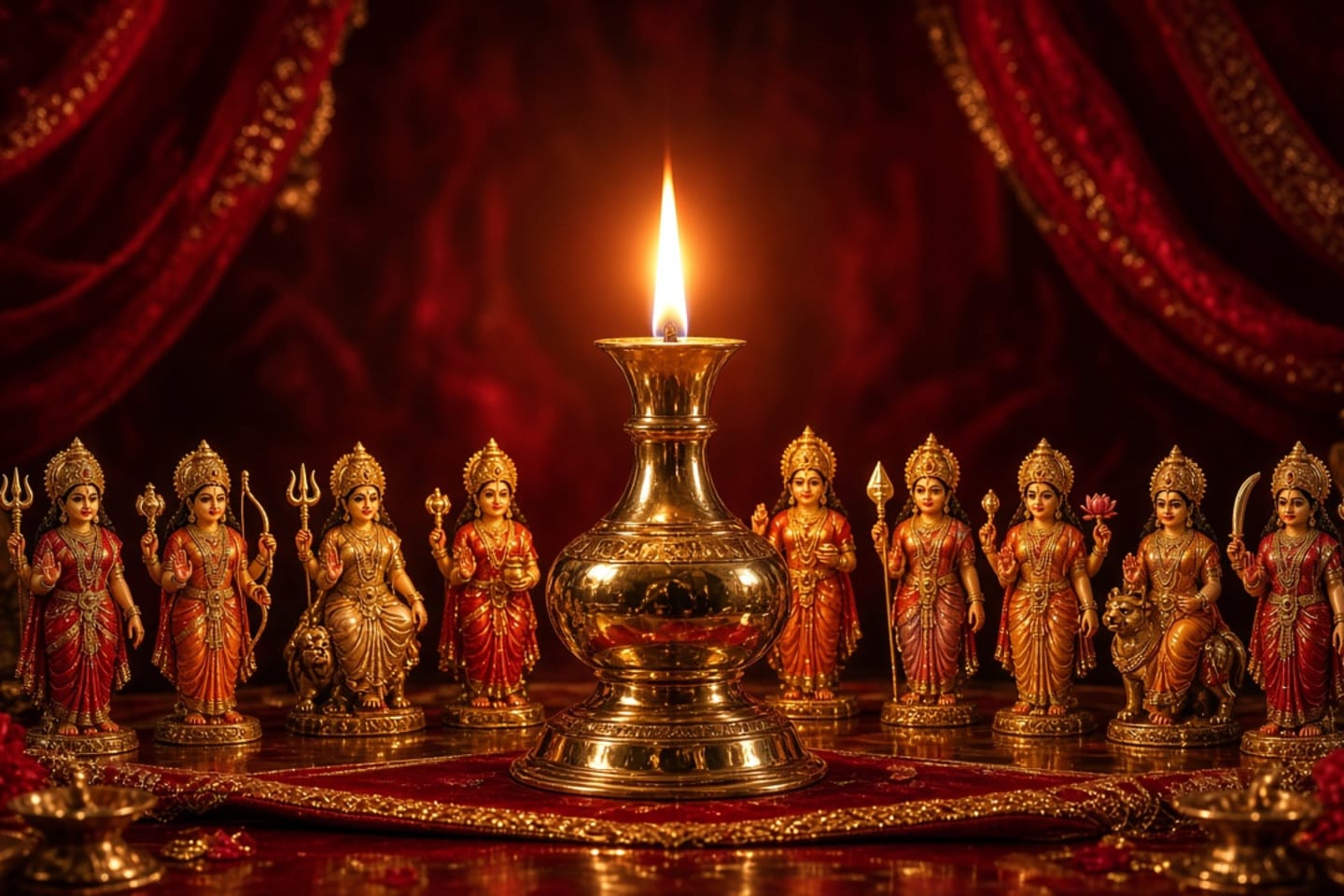
Navratri Kit (Vol 7 Ch 4). Full three-tier kits. Substantial regional customisation - Bengali Durga Puja materials, Gujarati Garba materials (dance-tradition-adjacent), South Indian Bommai Kolu doll displays, Karnataka Chamundeshwari-focused materials.
Akhand deepak infrastructure. Extended discussion in Vol 6 Ch 7 - Chaitanya provides akhand-format diyas, akhand-length wicks, 3-4 litres of A2 ghee, fire safety kits for nine-day observance.
Kanya-puja provisioning. 9 sets of Kanya-puja materials for household observance on Day 8-9.
Devi murti sourcing. Clay Devi murtis for household installation (returning to earth after visarjan) or brass/panchaloha permanent household presence.
Ayudha puja materials. Turmeric-based traditional preparation, small brass containers for tool marking.
Bengali Durga Puja support. For Bengali community households and organisations - kit materials and community pandal supply.
Regional customisation. Every major regional variant supported through custom orders.
“Ashwin is Devi's own month. Nine nights of nine forms across nine colours. Continuous akhand flame for the duration. Vijayadashami's victory celebration. Community-scale Durga Puja in Bengal. Bommai Kolu in Tamil Nadu. Mysore Dasara in Karnataka. Ayudha puja universally. This is the Devi's peak devotional zone - the month the tradition brings to its most elaborate festival practice.”

Mysore Dasara deserves specific opening. One of India's most spectacular festivals with substantial royal-heritage tradition:
Historical context: The Mysore royal family (Wodeyar dynasty, from 14th century) established the classical Mysore Dasara tradition. Even after Indian independence and abolishment of princely states, Mysore Dasara continues as the state festival of Karnataka.
The 10-day celebration:
Days 1-9 (Ashwin Navratri): Traditional Chamundeshwari worship at Chamundi Hills. Palace-based rituals daily. Community celebrations building.
Day 10 (Vijayadashami): The classical elephant procession (Jamboo Savari). Traditional elephants (including Balarama, the golden howdah-bearing elephant) carry the Chamundeshwari idol through Mysore's streets. Historical route through the city. Thousands of visitors attend.
Chamundeshwari: The specific Devi form central to Mysore tradition. Her temple sits on Chamundi Hills overlooking Mysore. Mahishasura's classical narrative places him as ruler of Mysore region; Chamundeshwari as the Devi who defeated him.
Traditional Mysore practices:
- Palace-based traditional rituals continuing across 10 days
- Traditional Mysore Painting art tradition featured
- Traditional Karnataka classical music and dance performances
- Extended community fair adjacent to celebrations
- International visitor draw
Modern Mysore Dasara:
- Continuing as state-level celebration
- Major tourism attraction
- Modern infrastructure supporting traditional celebration
- Live streaming and international coverage
Household connection for Karnataka households: Karnataka households traditionally either travel to Mysore for the celebration, host household observances aligned with Mysore tradition, or maintain small Chamundeshwari focus during the 10 days.
Chaitanya support: For Karnataka households wanting Chamundeshwari focus, specific Karnataka-tradition kit customisation available. Kannada mantra materials, regional prasad ingredients, small Chamundeshwari image supported.
The Mysore Dasara represents one of India's classical royal-festival traditions maintained continuously across centuries and transitioning across political changes without losing tradition-continuity. Worth understanding as example of how classical Indian devotional festivals maintained their character even as political structures around them changed.

Published by the house of Chaitanya · www.chaitanya.global
Kits & products from this chapter
Available wholesale, or under your own label.