The Sweet — Gourmand Floral
This is the fragrance family halmaddi built. One family, its own chapter — because nothing else in Indian perfumery has quite this warmth.
A gourmand fragrance in Indian incense comes from halmaddi resin — the traditional binding agent in masala agarbatti. Halmaddi gives premium Indian incense its distinctive warm sweetness that no synthetic can replicate. This family is unique to Indian incense; it does not exist in Japanese koh or Western perfumery.
Published · Updated · Chaitanya Global Research Team
Every fragrance family in this catalogue has three or four material ingredients doing most of the work. Sweet Gourmand Floral is unusual: it has one material at its centre, and the material itself is not a flower or a wood or a resin in the classical sense. It is halmaddi — the sticky black tree resin from Volume 1 that binds every proper agarbatti — deployed here as a fragrance element in its own right.
Halmaddi smells honey-sweet on its own, even before any other fragrance is added. Combine that with a Southern white floral (champa, tuberose) and a warm-vanilla accent (tonka bean, vanilla itself), and you get a fragrance category that feels like it was invented in an Indian temple courtyard and can be reproduced nowhere else on earth. Because it wasn't invented — it emerged from the specific materials Indian tradition has always had access to.
This chapter opens the sweet family that halmaddi built.
The champa flower — the signature ingredient
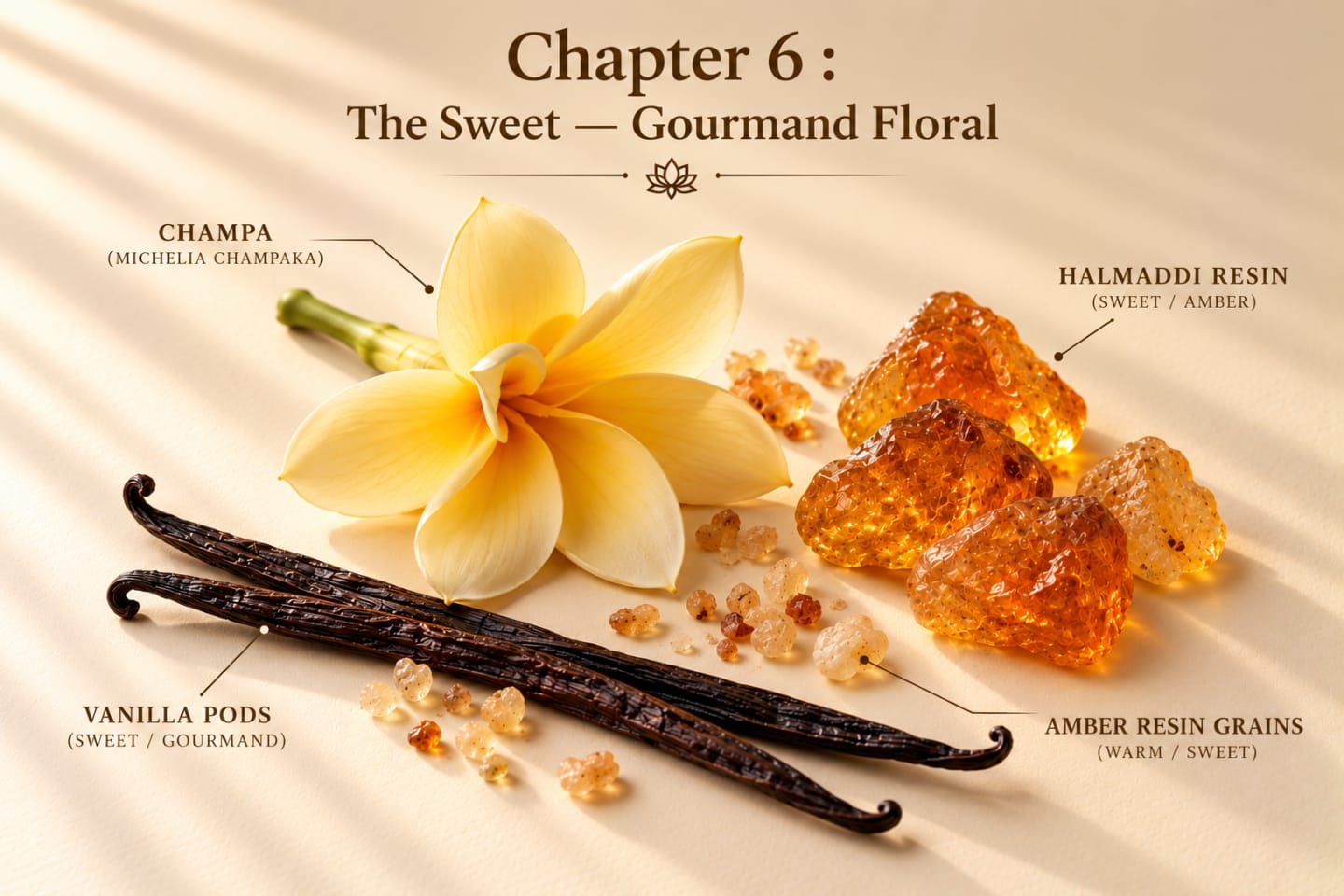
Character. Champa (Michelia champaca) is a small tree native to South Asia, producing creamy-yellow flowers of remarkable fragrance. The petals are oval, overlapping in a soft star, and hold a scent unlike anything in Western floral perfumery — sweeter than jasmine, warmer than tuberose, with a faint fruit-and-tea undertone that carries through every stage of the fragrance.
Champa is one of the classical Indian temple flowers — deeply associated with Vishnu worship, particularly in Karnataka, Kerala and Tamil Nadu where champa trees are planted at temple entrances so devotees can gather flowers to offer. The tree is also called sampige in Kannada, sonchafa in Marathi, champaka in Sanskrit.
In the pyramid. Champa is a heart note — it emerges after the first minute and dominates the middle third of the fragrance's life. In a well-composed Sweet Gourmand Floral, the champa is unmistakably present but layered so that neither it nor the sweetness overwhelms.
The material honesty problem. Real champa oil is expensive and difficult to obtain — the flower yields very little essential oil per kilogram of petals, and the plant is not cultivated at scale outside India. Most modern "champa" fragrances use a synthetic champa accord (a reconstruction of the natural fragrance using a mix of other floral materials). A real champa attar or premium champa agarbatti tastes markedly different — richer, more complex, more three-dimensional — than a synthetic champa.
Halmaddi as sweet-honey base
Character. Volume 1 Chapter 3 introduced halmaddi as the binder that separates good agarbatti from bad. But halmaddi also has its own aromatic character — warm honey-sweetness with faint balsam undertones, a smell that some perfumers describe as "the smell of a good agarbatti even before it's lit". When burned, halmaddi releases a base note that persists for hours after the stick has extinguished — this is the residual sweetness a proper Sweet Gourmand Floral leaves in a room.
In the pyramid. Halmaddi is entirely a base note. It emerges late (as top and heart notes fade) and dominates the fragrance's memory — the "morning after" smell of a room that had a Sweet Gourmand incense burning the night before.
Why this family only exists in India. Halmaddi comes from a specific Indian tree (Ailanthus malabarica) and has never been widely used in Western perfumery. Sweet Gourmand Floral as a category is therefore essentially unique to Indian tradition — Western gourmand perfumery uses vanilla, caramel, tonka, but does not have access to the specific halmaddi honey-warmth that gives the Indian version its signature. This is one of the fragrance families where Indian tradition possesses a material Western perfumery cannot replicate.
The vanilla-amber depth
Beyond champa (heart) and halmaddi (base), a full Sweet Gourmand Floral usually includes two additional accents:
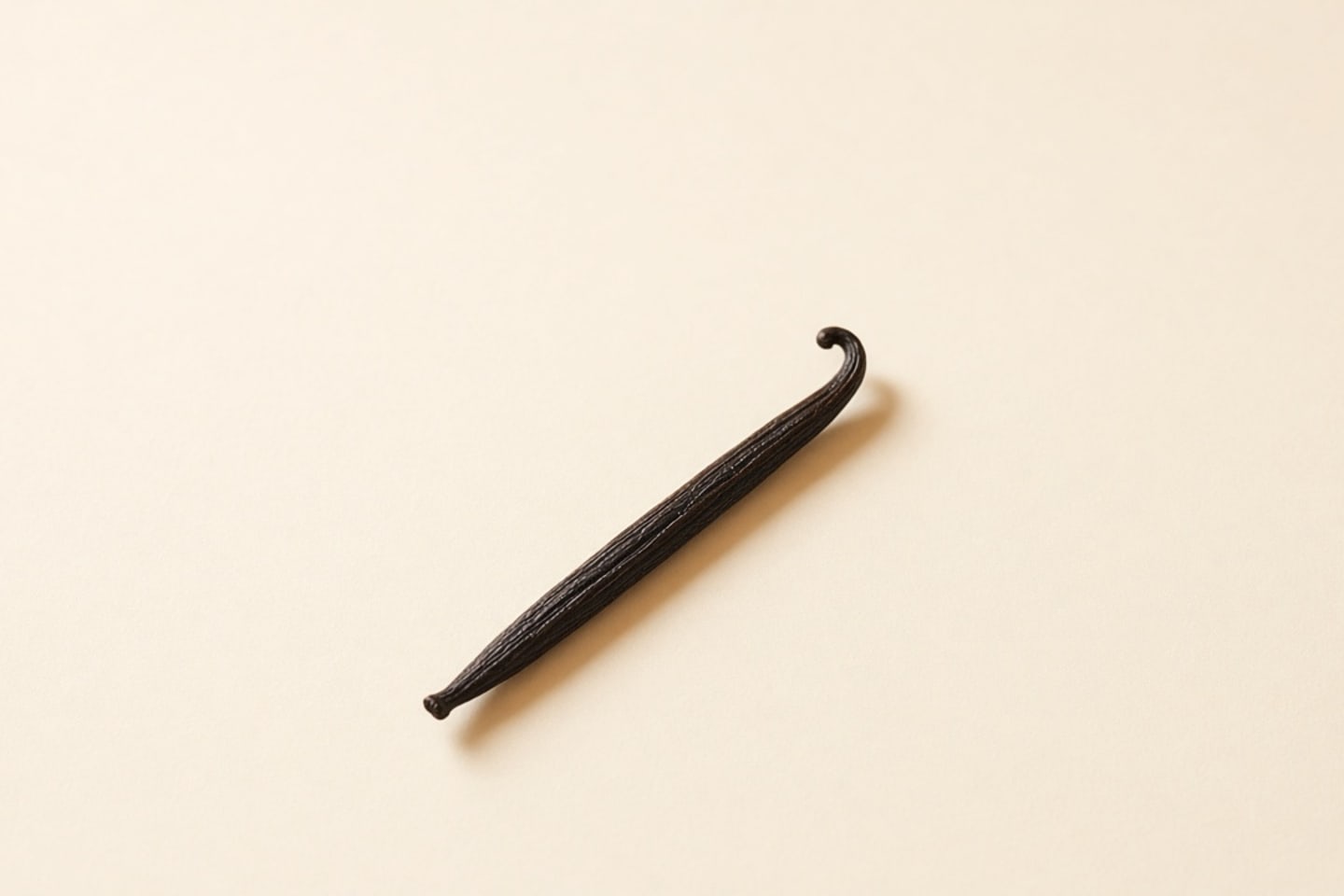
Vanilla. Either genuine vanilla absolute (expensive — real Madagascar or Ugandan vanilla) or a supporting vanilla note from tonka bean. Vanilla layers into the halmaddi base to create the "edible sweetness" register that gives this family its gourmand classification.
Amber. A warm resin base note (see Chapter 8 · Sacred Amber for the full material profile). Amber sits alongside halmaddi at the base, giving the fragrance its temple-honey warmth and extending the base note's persistence.
Together — champa heart, halmaddi base, vanilla accent, amber warmth — the family delivers the sweetest, most edible-adjacent fragrance in the entire Indian catalogue. It is what a South Indian temple courtyard smells like at dusk after a champa-heavy evening puja.
When to reach for this family
Sweet Gourmand Floral is not a daily driver for most households — the sweetness is too rich for daily morning use, and can feel cloying if lit every day. But for specific moments, it is the perfect answer:
South Indian festival evenings. Particularly in Vaishnava traditions where champa is the deity flower. Vaikuntha Ekadashi, Krishna Janmashtami, and any Vishnu-centred festival gain from a Sweet Gourmand fragrance at dusk.
Post-meal / entertaining. Burned as an ambient fragrance after a family meal or when hosting guests — the sweetness signals warmth, hospitality, celebration.
Evening winter contexts. Sweet fragrances feel richer in cool weather; the Sweet Gourmand family shines in October-through-February when the house is closed and cool and the sweetness fills the space slowly.
Weekend / occasional treat. For households that stock multiple fragrance families, Sweet Gourmand is often the "special" family — brought out once a week rather than daily, so its distinctiveness is preserved.
Chaitanya SKUs in this family. Champa Signature agarbatti, Champa Heritage dhoop, Champa Halmaddi masala compound, Champa attar (Kannauj).
Pairs with: Bright White Floral (extends the champa into mogra companion territory), Sacred Amber (deepens the sweet warmth into temple gravity).
“Halmaddi smells like honey even before it's lit. Champa smells like the temple courtyard at dusk. Together, they form a fragrance family that could only have emerged in India — and that Western perfumery, for all its resources, cannot quite reproduce.”
The synthetic imitation of this family is one of the most common frauds in the Indian incense market. A proper Sweet Gourmand Floral costs ₹250-500 as a full agarbatti box; a synthetic sweetened stick costs ₹40-80 and fools most buyers who haven't smelled the real thing.
Three tests to distinguish:
1. The unlit-stick smell. A real Sweet Gourmand has warm honey-woody sweetness in the unlit stick itself (the halmaddi is present in the paste and audible before ignition). A synthetic version smells sharply of chemical vanilla oil — one-note, immediate, no warmth beneath.
2. The middle-burn character. Real Sweet Gourmand evolves through the burn. First 5 minutes: sweet top note (vanilla forward). Minutes 10-25: champa heart becomes distinct. Minutes 25-45: halmaddi honey base settles in the room. Synthetic version: the same sweet fragrance from lit to ash, no evolution.
3. The morning-after test. Burn the fragrance in a closed room overnight. Return the next morning. A real Sweet Gourmand leaves a soft honey-woody warmth in the fabric and air that lingers pleasantly. A synthetic version leaves either nothing (cheap dipping oil evaporates completely) or a lingering chemical sweetness that reads as artificial once it's dislodged from the moment of burning.
Do these three tests once, and no chemical Sweet Gourmand can ever pass as the real family in your household again.
Published by the house of Chaitanya · www.chaitanya.global
Kits & products from this chapter
Available wholesale, or under your own label.