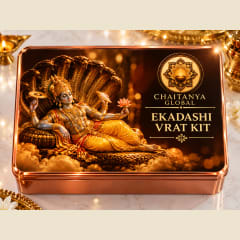
The Havan / Hom Kit
A small brass fire-pit. Specific woods. A compounded blend of thirteen dry ingredients. Ghee poured into flames at specific mantras. This chapter opens the Vedic tradition's most direct offering practice — and the kit that assembles it.

A havan kit requires: a havan kund (copper is premium), samidha (mango or peepal wood), ghee (minimum 250g), havan samagri mixture specific to the deity, camphor for ignition, dry coconut pieces, a large spoon for pouring ghee, and a seat mat. Ganapati havan adds modak and durva; Lakshmi havan adds lotus petals.
Published · Updated · Chaitanya Global Research Team
Every major ceremony in the previous chapters — grihapravesh (Ch 7), wedding (Ch 8), Satyanarayan puja (Ch 6), Navratri elaborate observance (Ch 4), Ganesh Chaturthi major days (Ch 3) — has referenced havan or hom as an included practice. This chapter opens the havan itself — what it is, why the tradition places it at the centre of major rituals, and what specific materials assemble a proper havan kit.
Havan (हवन) and hom (होम) are essentially the same practice with slightly different regional names — the classical Vedic fire ceremony where offerings are placed into a small sacred fire while specific mantras are recited. Vol 1 Chapter 8 opened the philosophy of havan; this chapter opens the kit.
What havan is (in brief)
The classical practice. A small sacred fire is kindled in a specific ceremonial fire-pit (havan-kunda). Specific dry compounded materials (havan dravya) are offered into the fire, alongside ghee poured at specific mantra moments. The fire receives the offerings, transforms them into rising smoke and heat, and — in classical Vedic understanding — carries them to Agni (the fire deity) who is the messenger to specific higher deities being invoked.
Duration. Small household havan: 30-60 minutes. Ganesh Chaturthi or Navratri havan: 1-2 hours. Wedding havan: 3-4 hours across the ceremony. Major samskara havan (grihapravesh, upanayan): 2-3 hours. Yagya-scale community havan (temple or large-scale religious observance): from half a day to multiple days.
Priest-led (typically). Full havan requires knowledge of specific mantra sequences, specific offering-timings, and specific fire-management. Household havan-lite is possible but classical havan is priest-led.
Materials specific. The havan dravya blend is compounded traditionally from thirteen specific ingredients (variants exist), each with classical reasoning for inclusion. See below.
The havan kit inventory
The fire-pit (havan-kunda):
- Small brass havan-kunda — traditional square or round fire-pit, typically 15-30cm across
- Small brass or clay lid for extinguishing when needed
- Small clay havan-kunda variant — traditional in some regions, one-time-use (offered to flowing water after)
- Small brass ladle (jala) for offering ghee to fire
Havan wood (samidha):
- Sandalwood pieces (chandan-lakri) — Royal tier
- Peepal wood pieces (peepal-lakri) — traditional for many havans
- Mango wood pieces — traditional for wedding havan
- Bel (bilva) wood pieces — traditional for Shiva-focused havan
- Palasha wood pieces — traditional for Devi-focused havan
- Wood pre-cut to small 5-10cm pieces suitable for household fire-pit
- Traditional practice specifies dry-aged wood; not fresh green
Havan dravya — the classical thirteen ingredients:
The traditional compounded blend, each with classical role:
- Sesame (til) — offering to Agni
- Rice (akshata) — offering symbolic of household grain
- Barley (yava) — classical Vedic grain
- Sugar or gud (jaggery) — sweet offering
- Camphor (bhimseni) — aromatic + fire-accelerant
- Dried coconut pieces — offering symbolic of complete surrender
- Chandan (sandalwood powder) — fragrance offering
- Guggul (specific dry resin) — cleansing offering (see Vol 1 Ch 5)
- Loban (dry resin) — additional cleansing (Vol 1 Ch 5)
- Dried flowers (rose petals, marigold) — offering symbolic
- Ashwagandha or other dried herbs — classical Ayurvedic addition
- Ghee (added continuously during havan) — the primary continuing offering
- Water (from the panchapatra) — for specific mantras' fire-cooling
Regional variants add or substitute specific items — Bengali havan adds specific Bengali herbs, South Indian havan adds specific dried leaves.
Extra havan materials:
- Small pile of dry mantra-appropriate wood pieces — kept beside the havan-kunda for continuous feeding
- Small brass or copper tongs for arranging burning wood
- Small brass water pot — for post-havan hand-washing and fire-cooling
- Fresh flowers — for placement around the havan-kunda
- Small brass ceremonial ladle (jala) for ghee — specific to havan use
Ghee for havan:
- A2 cow ghee — Royal tier for major havan (wedding, grihapravesh)
- Heritage cow ghee — for household observance
- Traditional cow ghee — for daily minor havan
- Quantity: 500ml minimum for household havan; 1-2 litres for major ceremony; 3-5 litres for wedding
Mantra materials:
- Traditional havan mantra booklet — for the specific mantras being recited
- Small brass reading-stand for the book
- Fresh flowers for the priest's or reciter's ceremonial marking
The classical havan sequence
Preparation (before the ceremony):
- Havan-kunda placed at the ceremonial location (typically on a small chowki or dedicated havan-mat)
- Small fresh flower arrangement around the kunda
- Wood pieces stacked beside
- Havan dravya prepared in a small brass tray
- Ghee prepared in a small brass container
- Small brass ladle (jala) at hand
- Priest positioned at the appropriate ceremonial side
Kindling (Agni-installation):
- Small piece of camphor lit as ignition source
- Small wood pieces kindled from camphor
- Fire established with small flames
- Priest offers Agni-invocation mantras
The offerings:
- Handfuls of havan dravya offered into fire at specific mantras
- Small ladlefuls of ghee poured onto fire at specific "svaha" mantra endings
- Additional wood added as needed to maintain fire
- Fresh flower petals offered periodically
- Specific mantras for each deity being invoked (Ganesha first, then main deity)
Continuous through duration:
- Priest reciting mantras while offering materials into fire
- Family members participating with hand-clasping in reverence
- Fire is fed but not allowed to over-blaze (managed intensity)
Closing:
- Purna-ahuti (complete final offering) — larger handful of dravya + ghee offered at closing mantras
- Fire allowed to burn to natural completion (or respectfully extinguished with sand or lid)
- Small aarti offered to the completed fire zone
- Residual ash blessed and often distributed as small pinches to attendees (traditional havan-ash prasad)
- Havan-kunda cleaned when cool
The three tiers of havan kit
Signature Havan Kit:
- Standard small brass havan-kunda
- Basic wood pieces (mango, peepal)
- Standard havan dravya (Signature tier — all thirteen ingredients at commercial quality)
- 500ml traditional cow ghee
- Basic mantra booklet
- Small brass ladle
Heritage Havan Kit:
- Heritage-quality brass havan-kunda (larger, hand-finished)
- Heritage wood pieces (adding bel and palasha)
- Heritage havan dravya (all thirteen ingredients Heritage grade)
- 1L A2 cow ghee
- Traditional-format mantra book
- Small brass ceremonial tongs
Royal Havan Kit:
- Premium brass or copper havan-kunda (large, ornate)
- Royal wood pieces (including sandalwood chips)
- Royal havan dravya (each ingredient Royal grade)
- 2-3L A2 cow ghee
- Traditional-format printed mantra book
- Complete ceremonial hardware (tongs, ladle set, water pot)
Regional variants of havan
North Indian household havan:
- Standard 13-ingredient dravya
- Mango or peepal wood emphasis
- Cow ghee as fuel
Bengali havan:
- Additional specific Bengali herbs
- Different regional mantras
- Bel wood emphasis for Shiva-adjacent
South Indian havan (Tamil, Malayalam):
- Different regional dry ingredients
- Coconut and specific southern grains emphasis
- Sandalwood specific for premium havans
- Different priest procedure
Ayurvedic havan variants:
- Additional dried medicinal herbs
- Specific mantra emphasis for health-adjacent (though not medical claim)
Tantric havan variants:
- Specific tantric additions
- Different fire-management
- Specific tantric mantras
- Not typical household observance
When havan is used
Standalone havan:
- Griha-Shanti — specific household-purification havan often done annually
- Navagraha shanti — for astrological transit periods
- Rudra havan — for Shaiva households
- Chandi havan — for Shakta households
Havan-as-component within larger ceremony:
- Grihapravesh — havan required
- Wedding — havan is the ceremony's heart (see Ch 8)
- Namkaran (child-naming ceremony) — small havan
- Upanayan (sacred-thread ceremony) — havan required
- Antyeshti (final rites) — havan required
- Satyanarayan puja — optional elaborate havan portion
- Ganesh Chaturthi Day 1 and Day 10 — havan often included
- Navratri Day 8-9 — havan often included
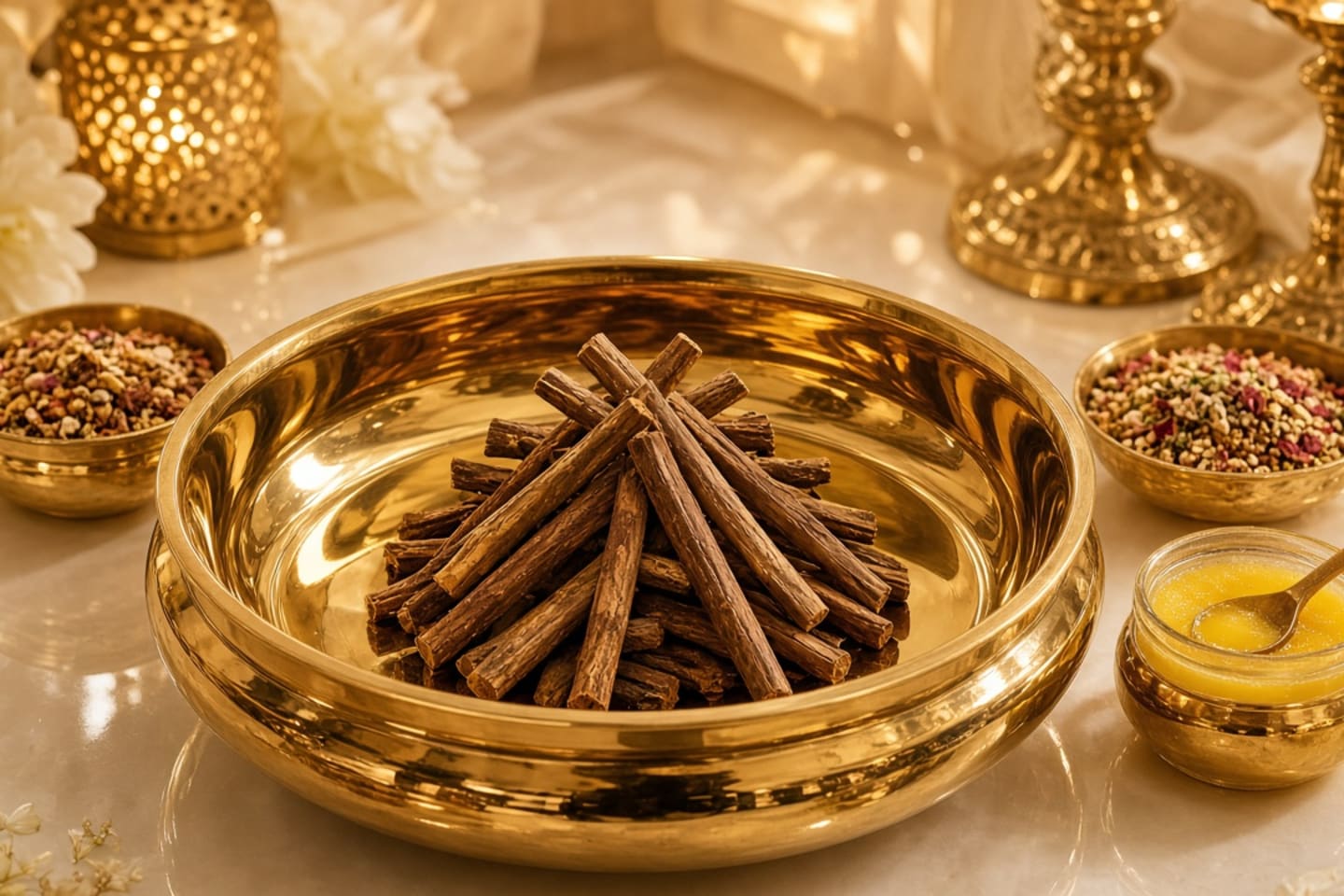
What Chaitanya makes for havan
Everything below is made in Signature, Heritage and Royal grades and supplied wholesale or under your own label to grocery chains, importers and distributors.
Prepared havan kits. Signature, Heritage, Royal tiers as above. Regional variants supported (Bengali, Tamil, Kerala, Ayurvedic).
Fresh dravya preparation. Havan dravya loses potency over time. Chaitanya's dravya is compounded within 4 weeks of shipping for freshness.
Wood sourcing. Specific ceremonial wood pieces sourced from traditional havan-wood suppliers. Wood is dry-aged appropriately for clean combustion.
Havan-kunda supply. Small brass havan-kundas cast at Moradabad; larger ceremonial ones available on order.
Fire-safety guidance. For customers doing home havan, Chaitanya's kit includes fire safety notes (ventilation requirements, sand-bucket recommendation, appropriate location).
“Havan is the tradition's most direct offering practice. Small brass fire-pit. Specific woods. Compounded dravya. Ghee poured at mantra moments. Every major ceremony in the household calendar reaches for it. The kit is the tradition's material inventory for the practice — assembled properly, it enables the household to hold Vedic ritual in continuity with two thousand years of practice.”

The classical havan dravya is a compound of thirteen ingredients — not fourteen, not twelve. The specific number has classical reasoning:
Twelve is the number of solar Adityas (twelve solar deities in classical Vedic tradition). The thirteenth ingredient (ghee) is understood as the offering that unites the other twelve into a single ritual whole — the medium through which the twelve deities' individual functions become integrated into the classical ritual.
Symbolic completeness. Each ingredient represents a specific domain: - Grains (rice, barley) — household sustenance - Sweet (sugar/gud) — devotional pleasure - Resins (guggul, loban) — cleansing - Fragrance (chandan, camphor) — aromatic offering - Flowers — beauty offering - Coconut — surrender offering - Herbs — health-adjacent offering (Ayurvedic) - Ghee — the binding medium
Practical wisdom. Thirteen is few enough to compound reliably at scale (household-level households can maintain the inventory) and many enough to include the classical symbolic domains. Traditional havan-dravya vendors have maintained this specific compounded blend across centuries because it represents a functional balance.
Regional variants add specific ingredients (Bengali might add ~4-5 specific herbs; South Indian might substitute some grains) but the core thirteen structure is maintained. Chaitanya's Signature dravya follows the classical thirteen; Heritage and Royal add regional specifics on request.
The dravya, in short, is not just a mix of dry materials. It is a classical compounded blend with specific reasoning for each ingredient. The household using it is using a two-thousand-year-tested formulation.
Published by the house of Chaitanya · www.chaitanya.global
Kits & products from this chapter
Available wholesale, or under your own label.