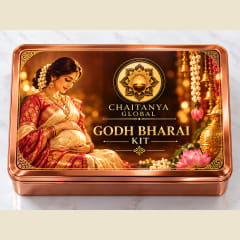
The Samskara Kit — Namkaran, Upanayan, Antyeshti
Sixteen classical rituals mark the passage from birth to death. Each has its own kit. This chapter opens the three the modern household most commonly conducts.
The 16 samskaras (shodasha samskara) are life-stage sacraments from conception to death: Garbhadhana, Pumsavana, Simantonnayana, Jatakarma, Namakarana (naming), Annaprashana (first food), Chudakarana (first haircut), Karnavedha, Vidyarambha (first letters), Upanayana (sacred thread), Samavartana, Vivaha (marriage), and Antyeshti (last rites).
Published · Updated · Chaitanya Global Research Team
Classical Indian tradition holds that the human life is marked by sixteen samskaras (संस्कार) — literally "impressions" or "consecrations" — sixteen specific ritual moments that transform each life-stage into a properly-consecrated passage. Some samskaras happen before birth (garbhadhana, punsavana, simantonnayana — pre-natal consecrations). Some happen in early childhood (jatakarma, namkaran, nishkramana, annaprashan). Some happen through youth (chudakarana, karnavedha, upanayan). Some happen at critical adult transitions (samavartana, vivaha — the wedding). And some happen at life's end (antyeshti).
The wedding (Ch 8) has already been opened as one specific samskara. This chapter opens the three other samskaras the modern household most commonly conducts: namkaran (child-naming ceremony), upanayan (sacred-thread ceremony), and antyeshti (final rites). Each has its specific kit.
Namkaran — the child-naming ceremony
What it is. The eleventh classical samskara. Traditionally conducted on the 11th or 12th day after birth. The formal ceremony where the child's name is officially given, entered into family record, and consecrated through Vedic ritual.
Modern practice. In classical tradition, the naming happens at a specific auspicious moment (muhurta) with priest guidance. In modern practice, some families do abbreviated ceremonies at home; some conduct full traditional ceremonies at temples; some skip the ceremony entirely and name the child through documentary means only. The classical tradition considers the formal ceremony as making the naming "real" in the tradition's sense.
The namkaran kit inventory:
- Small Ganesha and household deity murti installed for the ceremony (may be the family's continuing mandir presence)
- Kalash — small copper or silver, established for the ceremony
- Small brass ceremonial cradle or plate — for the child to be briefly placed in during specific mantras
- Small yellow silk cloth — for wrapping the child briefly
- Small brass container of ghee — for the traditional taste-of-ghee moment
- Small brass container of honey — for the traditional taste-of-honey moment
- Small piece of silver or gold — traditionally touched to the child's tongue
- Small piece of clean silk cloth — for wiping the child during ceremony
- Fresh flowers — jasmine or rose
- Panchamrit ingredients (see Vol 3 Ch 5) — for small ceremonial preparation
- Small brass or clay pot for prasad — kheer or specific naming-ceremony sweet
- Small brass bell — rung at naming moment
- Havan-kunda and havan dravya (small quantity for brief havan portion)
- Ceremonial mauli threads for family members
- Small gifts for attendees — traditional silver coin distribution
The ceremony sequence:
- Family gathering at the household mandir or ceremony location
- Small Ganesha puja + household deity invocation
- Small havan portion (brief)
- The child placed on the family's lap or on a small ceremonial cushion
- Priest recites specific mantras invoking blessings on the child
- Small drop of ghee touched to the child's tongue
- Small drop of honey touched to the child's tongue (traditional "taste of sweetness")
- Small silver piece touched to the child's tongue (traditional "wealth blessing")
- The name announced by the priest and family elder together
- Name repeated three times (some traditions do 11 times)
- Small gift or symbolic material given to the child
- Community meal follows
Three tiers:
- Signature — basic ceremony materials
- Heritage — Heritage tier throughout + silver child-blessing coin
- Royal — Royal tier throughout + silver ceremonial cradle plate
Upanayan — the sacred-thread ceremony
What it is. The ninth classical samskara. Traditionally conducted at ages 8-12 for boys (in classical Brahmin, Kshatriya, and Vaishya traditions). Marks the child's initiation into formal Vedic study and adult ritual responsibility. The child receives the sacred thread (yajnopavita or janeu) — three cotton threads worn diagonally across the torso, replaced periodically throughout life.
Modern practice. Practice varies significantly. Serious traditional families conduct full ceremonies; many modern urban families conduct abbreviated ceremonies; some families defer or skip. Ceremony is traditionally priest-led with astrological muhurta.
Regional and community variance. The classical practice is most strongly maintained in South Indian Brahmin communities (Iyer, Iyengar traditions), in certain North Indian communities, and in specific tantric-lineage families. Practice in other communities is variable.
The upanayan kit inventory:
- Sacred thread (yajnopavita/janeu) — traditionally hand-spun cotton, three threads twisted together, with specific knots and proportions
- Small Ganesha + household deity + Guru murti or image
- Kalash — small silver or copper
- Small kush grass bundle — traditional initiation grass
- Deer-skin or symbolic substitute — traditional in classical practice; often symbolic in modern practice
- Small wooden staff (danda) — traditional student's staff
- Small brass alms bowl (bhiksha-patra) — the child receives symbolic first-alms after initiation
- Havan-kunda + havan dravya — full havan required (see Ch 9)
- A2 cow ghee — 1-2 litres for havan
- Traditional-cotton dhoti — the child's ceremonial clothing
- Small silver or gold ceremonial coin for the child
- Gayatri Mantra text card or booklet — the classical mantra the child begins to recite
- Community meal materials — traditional for the gathering
The ceremony sequence:
- Priest arrives at auspicious muhurta
- Family gathering
- Full Ganesha puja
- Small kalash establishment
- Small havan (Ch 9)
- The child seated in ceremonial posture
- Sacred thread ceremonially placed diagonally across the child's torso by the priest and family elder
- Gayatri Mantra whispered into the child's ear by the priest (first initiation)
- Small alms symbolically offered to the child (bhiksha)
- Child stands and receives symbolic staff (danda)
- Community meal + celebration
Three tiers:
- Signature
- Heritage
- Royal — Royal-tier ceremonial materials
Antyeshti — the final rites
What it is. The sixteenth and final samskara. Conducted upon a person's death. Traditionally involves specific classical rituals of body-honouring, cremation (traditional practice), specific bone-collection and disposal at holy waters, and 12-13 days of specific household ritual practice (shraddha, pind-daan).
This chapter's careful treatment. Antyeshti is grief-adjacent and specific-tradition. This section opens the kit inventory without opening the emotional-tradition dimensions the household experiences. The tradition's honest position: antyeshti is priest-led, involves specific family responsibility, and every household following it does so with grief that no book can address. The materials are practical; the household bears the grief.
The antyeshti kit inventory:
- Kush grass bundle — traditional for many antyeshti practices
- Black til (black sesame) — traditional offering
- White silk or cotton cloth — for body-wrapping (traditional Hindu practice; other traditions vary)
- Small ceremonial fire materials for the cremation ritual (traditional practice)
- Fresh sandalwood pieces — added to the pyre in classical tradition
- Small brass ceremonial containers — for the pind (rice-flour ball) offerings
- Rice flour + til + specific grain mixture — for pind preparation
- A2 cow ghee — for pyre and continuing rituals
- Gangajal — for specific mantras
- Fresh flowers — for body-honouring
- Family ceremonial materials — traditional mourning clothing, specific ritual objects
- 12-13 day continuing puja materials — the shraddha period requires daily specific materials
The classical sequence:
Day of death and immediate:
- Traditional body-honouring practices
- Small kush and til preparations
- Community gathering
Cremation:
- Priest-led classical ritual
- Family responsibility (traditionally the eldest son)
Days 1-13 (shraddha period):
- Daily specific pujas at household mandir
- Daily pind-daan offerings
- Continuous specific practice
- On specific days: larger community observances
Vaishnava-Shraddha (day 13):
- Concluding ritual
- Pind-daan at holy water if accessible
- Community meal
Continuing:
- Monthly shraddha on the death-anniversary tithi (traditional)
- Annual shraddha (varshika-shraddha) at classical death-anniversary
- Ancestor-honouring practices continue through the family's ongoing life
Kits for antyeshti — Chaitanya's position:
Chaitanya provides antyeshti kits at Heritage and Royal tiers. The Signature tier is not maintained because the classical tradition treats antyeshti as requiring particular attention that basic-tier materials do not adequately support.
- Heritage — Heritage-quality materials for full 13-day observance
- Royal — Royal-tier materials + shraddha materials for the observances that follow
Chaitanya also makes shraddha materials as separate kits for households maintaining monthly and annual shraddha observance after the initial 13-day period.
Regional variants (across samskaras)
North Indian:
- Elaborate community gathering for namkaran
- Full ceremonial upanayan traditional for Brahmin families
- Traditional shraddha practices
Bengali:
- Specific Bengali namkaran food and offerings
- Traditional Bengali continuing practices for shraddha
South Indian (Tamil, Malayalam, Telugu):
- Strongest continuing tradition of full ceremonies (particularly upanayan)
- Specific regional mantras and practices
- Traditional shraddha practices
Kerala:
- Distinctive Kerala Ayyappa-tradition additions where household is Ayyappa-devoted
- Specific ceremony variants
Sikh, Jain, other traditions:
- Different classical ceremonies with different materials
- Chaitanya's kits customised on request
What Chaitanya makes for samskaras
Everything below is made in Signature, Heritage and Royal grades and supplied wholesale or under your own label to grocery chains, importers and distributors.
Kit assembly. Signature, Heritage, Royal tiers as documented above. Full customisation to household tradition.
Continuing materials. Kits for what follows each samskara are made too — namkaran-related first-year practices, upanayan-continuing daily practices, monthly shraddha.
Grief-sensitivity for antyeshti. Antyeshti kits are kept ready-assembled, because a family’s need is always immediate.
Ceremonial cloths. Dhoti, silk stoles and mourning cloth supplied alongside the kits.
“Sixteen samskaras across a life. Sixteen ritual moments marking birth to death. Each with its specific classical kit. The household that observes them properly holds the classical tradition of human passage across the years — from first name to final rites, held in the tradition's material inventory.”
Published by the house of Chaitanya · www.chaitanya.global
Kits & products from this chapter
Available wholesale, or under your own label.