The Aarti Set — Thali, Diya, Panchapatra, Udhrani
Every morning aarti uses the same six or seven small brass objects. Each has a specific role, a specific position on the tray, and a specific meaning. This chapter opens the set.

A complete aarti set includes: an aarti thali (plate, typically brass or silver), a ghee diya or camphor holder, a panchapatra with udhrani spoon for sprinkling water, a small bell, compartments for kumkum, haldi, akshata, and chandan, and a flower holder. The thali should be at least 8 inches with raised edges.
Published · Updated · Chaitanya Global Research Team
The universal Indian household ritual — repeated every morning in every home that maintains a mandir — is the daily aarti. And the daily aarti has a specific instrument set: six or seven small brass objects that assemble on a single tray and get used in a specific sequence. Thali. Diya. Ghanta. Panchapatra. Udhrani. Arti-daan. Agarbatti stand. Sometimes a small kumkum-and-akshata katori set beside.
Every serious household has these objects. Every one is a specific brass casting with a specific tradition-role. And every one — despite being deeply familiar as objects on the family shelf — is often used without full awareness of its classical function. This chapter opens each.
The thali — the tray
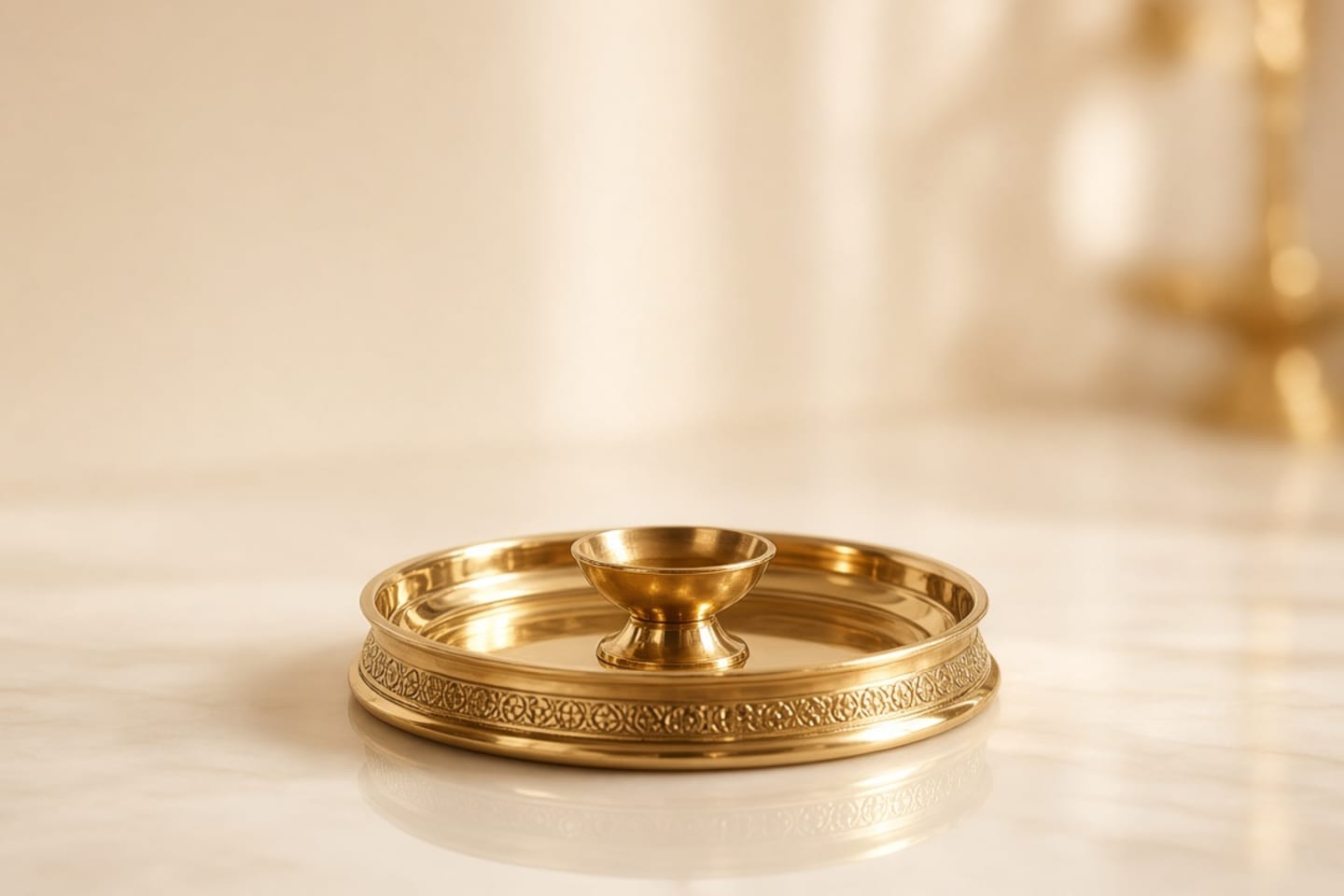
Form. A small round or slightly oval brass tray, ~14-20cm in diameter, with a slightly raised rim (1-2cm) to hold small objects without spillage. Often decorated with an ornamental border or with small tradition-symbols (Om, Swastik) embossed on the base.
Role. The thali is the base — the surface on which the other aarti instruments are arranged. During the aarti, the thali is often held in the left hand or placed on a small stand in front of the deity while the right hand handles the diya or ghanta.
Materials. Traditional brass. Premium versions in silver (for Lakshmi practice) or copper. Chaitanya's household aarti thali standard is brass; Heritage-tier in copper; Royal in silver.
Care. Wipe clean daily. Monthly polish with brass cleaner or traditional tamarind + salt.
The diya — the lamp
Form. A small brass oil lamp, ~4-8cm in diameter and 2-4cm deep, with a shallow bowl (holding oil or ghee) and a small pinched extension at one side (holding the cotton wick that projects out for lighting). Some diyas have multiple wick positions (2, 5, 7, 11) for elaborate ceremonies.
Role. The diya is the aarti instrument. Lit at the beginning of morning aarti, it is the physical flame that is waved before the deity during the aarti ritual (from Sanskrit aa-rati, "toward-brightness" — bringing brightness toward the deity). The diya is what makes an aarti an aarti.
Fuel. Traditional aarti fuel is pure cow ghee — understood as the classical sattvik fuel. Some traditions use sesame oil (til-tel) instead, particularly for evening or specific Shani-day aartis. Coconut oil is used in South Indian traditions. Vegetable/mustard oil is a modern shortcut; traditional practice prefers ghee.
Wick. Traditional cotton wick (batti), hand-rolled from pure cotton. Store-bought pre-rolled wicks are acceptable for daily use; hand-rolled wicks are used for serious ceremonies.
Care. After the aarti concludes, the diya is respectfully extinguished (traditionally by placing a flower petal over the wick, not by blowing — blowing is considered disrespectful). The residual oil is left in place (not poured out); fresh oil is added the next morning. Weekly wipe with soft cloth; monthly cleaning with brass polish.
Volume 6 of the Grantha treats the diya and flame in complete detail — this chapter opens only its role within the aarti set.
The panchapatra — the water vessel
Form. A small round brass or copper pot, ~8-12cm tall with a rounded body and a slightly narrowed neck. Distinct from the kalash by its smaller size and simpler unadorned form. Usually with a decorative rim at the mouth.
Role. The panchapatra holds the water used during aarti — for offering to the deity (sipping-offering with the small udhrani spoon), for sprinkling on the household members, for symbolic pouring during specific ritual moments. The name panchapatra means "five-pot" — traditionally the water in it is understood to contain the five sacred waters (or five sacred elements) symbolically.
Water. Fresh water is added every morning. Some traditions add a drop of gangajal to sanctify the household water. Some traditions add tulsi leaves to the water. The water in the panchapatra should be treated as tirtha — sacred water — not casual drinking water.
Materials. Traditional brass or copper (copper is understood classically as ritually superior for water vessels). Chaitanya's standard is copper for Heritage tier; brass for Signature.
Care. Fresh water every morning. Weekly wipe. Monthly polish. Copper darkens with age — this is desirable and part of the vessel's character.
The udhrani — the offering spoon
Form. A small brass spoon, ~6-10cm total length, with a small round bowl (~2cm diameter) at one end and a decorative handle at the other. The handle often features a small tradition-symbol (Om, lotus, or a small deity form).
Role. The udhrani is used with the panchapatra — for lifting water from the panchapatra and offering it to the deity's feet, to the devotee's palm for sipping (achamana), or for symbolic sprinkling. The udhrani never touches the mouth directly; water is poured from the udhrani into the palm and sipped from the palm.
Traditional usage sequence. During aarti:
- Right hand cups water from the panchapatra using the udhrani.
- Water is poured into the left palm.
- Right hand takes water from left palm and sips (achamana).
- Or water is offered to the deity by pouring from the udhrani.
Materials. Brass standard; silver premium.
Care. Rinse daily. Weekly polish.
The arti-daan — the camphor plate
Form. A small brass plate, ~6-10cm diameter, often with a raised rim to contain the camphor and a handle at one end for holding during aarti. Sometimes shaped as a small tray with a specific ornamental design.
Role. The arti-daan holds bhimseni camphor (see Vol 1) crystals which are lit at the climax of the aarti — creating the intense white flame that momentarily fills the mandir zone with concentrated aromatic camphor smoke. This is the most sensory-intense moment of the daily aarti.
Usage. 2-3 crystals of bhimseni camphor are placed on the arti-daan. The crystals are lit using the diya's flame (a small piece of cotton wick can transfer flame). The lit camphor produces a white intense flame that burns for 15-30 seconds. During this burning, the arti-daan is held in the right hand and moved before the deity in the classical aarti circular pattern.
Materials. Brass standard. Because of the intense heat of burning camphor, the arti-daan must be a solid brass plate; thin plates warp or discolour over time.
Care. After each use, wipe the residual camphor residue with a soft cloth. Weekly polish.
The agarbatti stand
Form. A small brass stand designed to hold one or more agarbatti sticks. The most common form: a small brass base (~5×5cm) with 3-5 small vertical holes into which agarbatti sticks slide. Some stands include a small tray at the base to collect ash.
Role. Holds the agarbatti lit at the beginning of aarti — chosen from the four forms of Indian smoke (Vol 1) and matched to one of the thirteen fragrance families (Vol 2). The agarbatti burns throughout the aarti and often through the household morning routine that follows.
Placement. On the thali or beside the mandir. Ash collects in the tray or on the mandir surface (routinely cleaned).
Materials. Brass standard.
Care. Weekly ash removal. Monthly polish.
The ghanta — the bell
Fully treated in Chapter 4. In the aarti set, the ghanta is present as one of the essential objects — used continuously during the aarti to punctuate the moment.

The complete aarti sequence
With the seven instruments assembled on the thali (or nearby the mandir), the classical morning aarti sequence:
1. Preparation. All instruments arranged. Diya has fresh ghee, fresh cotton wick. Panchapatra has fresh water. Arti-daan is empty. Agarbatti stand is ready with fresh agarbatti.
2. Approach. The household member approaches the mandir barefoot, having briefly rinsed hands. Touches the mandir threshold briefly with respect.
3. Light. Diya is lit first (from a small candle or matchstick). From the diya's flame, the agarbatti is lit. The agarbatti smokes upward.
4. Wave the diya. Holding the diya in the right hand, the household member waves it before the deity in a circular clockwise pattern. The left hand rings the ghanta continuously. Aarti verses may be sung during this movement — Om Jai Jagdish Hare (the universal aarti verse) or tradition-specific verses.
5. Camphor climax. Three crystals of bhimseni camphor are placed on the arti-daan and lit from the diya. The arti-daan replaces the diya in the right hand. The intense camphor flame is waved before the deity for 15-30 seconds while the ghanta rings continuously. This is the peak sacred moment of the daily aarti.
6. Water offering. Water from the panchapatra is offered to the deity using the udhrani — a small quantity poured before the murti.
7. Achamana. A small sip of water from the panchapatra (via udhrani, poured into palm) is taken by the household member — sanctifying the human alongside the deity.
8. Prasad. A small piece of the day's food offering (or a small sweet, or a piece of fruit) is briefly offered to the deity and then eaten by the household members as prasad.
9. Closing. The diya is respectfully extinguished (flower petal, not breath). The household member touches the deity's feet (through hands to forehead), touches the mandir threshold in respect, and departs.
Total time: 5-10 minutes for daily aarti. The classical minimum for a properly-conducted daily household worship.
“Seven small brass instruments. One tray. Five to ten minutes. Two thousand years of Indian tradition compressed into a specific sequence the household repeats every morning of every day of its life.”

The classical Indian household tradition observes three aartis in a day, each with slightly different intensity and instrument set:
Morning aarti (prata-aarti). The most complete, done shortly after sunrise. Full instrument set including the camphor climax. Duration ~5-10 minutes. Considered the most important daily observance.
Noon aarti (madhyanha-aarti). Brief mid-day observance. Often reduced to diya + ghanta + brief mantra. Some households skip this in modern practice. Duration ~2-3 minutes.
Evening aarti (sandhya-aarti). Done around sunset. More elaborate than noon aarti; may include additional camphor or dhoop. Considered particularly important for Vaishnava tradition and for Devi practice. Duration ~5-8 minutes.
Serious devotional households maintain all three; modern household practice typically maintains morning aarti as central, may keep evening aarti, and often skips noon. Each aarti uses the same instrument set — the difference is in duration and specific verses chanted.
Volume 9 of this Grantha (Home Ritual) will treat the daily cycle in detail. This chapter opens the physical inventory the household needs to keep the practice.
Published by the house of Chaitanya · www.chaitanya.global
Kits & products from this chapter
Available wholesale, or under your own label.