Kalash — The Sacred Vessel
A brass pot, filled with water, topped with a coconut, wrapped in a red thread — no object in Indian tradition carries as much auspiciousness in as compact a form.

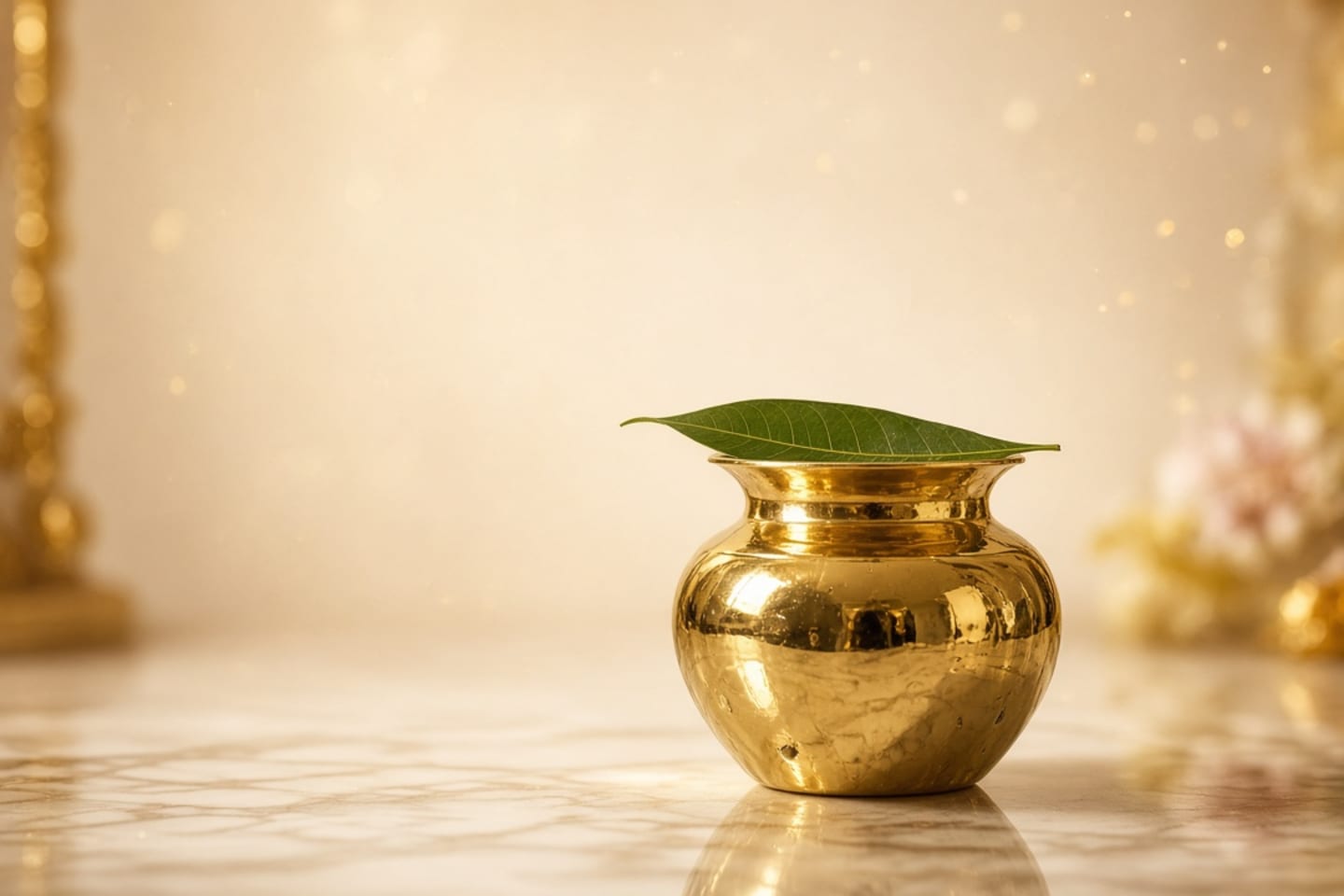
A kalash is a brass, copper, or silver water vessel filled with water, topped with mango leaves and a coconut. It represents the universe: water is the primordial ocean, mango leaves are the tree of life, the coconut is divine consciousness. Placed at the entrance during grihapravesh, at the centre of Satyanarayan puja, and at weddings.
Published · Updated · Chaitanya Global Research Team
Walk into any Indian house on the morning of grihapravesh, wedding, Diwali, Satyanarayan puja, or any major samskara, and you will see one. A round brass or copper pot, roughly 15-25cm tall, filled with water, topped with mango leaves and a whole coconut, wrapped at the neck with a red cotton thread, sometimes adorned with a small tilak of chandan or kumkum. This is the kalash (कलश) — the classical sacred vessel of Indian household tradition. The single most auspiciousness-dense object in the entire Grantha's vocabulary.
Every serious puja begins with the kalash. Every threshold-crossing ceremony (marriage, new home, new business, naming ceremony) invokes the kalash. Every temple sanctum has one at its centre. And every classical Indian iconography of Lakshmi shows her standing on one. The kalash is not merely a pot; it is the physical container of the auspicious itself.
What the kalash is
The word. Kalash (कलश) is Sanskrit for pot or vessel — specifically the round-bodied ritual vessel with a narrower neck. Related words: ghata (घट, another word for pot), kumbha (कुम्भ, a specific class of ritual pot associated with the Kumbh Mela).
The physical form. The classical kalash has a specific shape:
- Round-bellied body — the largest circumference at roughly the vertical midpoint
- Narrower neck — tapering upward from the body
- Slightly flared mouth — for the coconut to sit securely at the top
- Flat base — for stable placement on the pooja tray or altar
- Height typically 15-25cm for household use; larger (30-50cm) for temple use
Materials. Traditional kalash materials, in order of classical hierarchy:
- Copper (tamra) — the classical primary material. Understood as ritually pure and cleansing.
- Brass (pital) — the affordable everyday alternative. Warm-gold, welcoming.
- Silver (chandi) — the premium material for wealth-related and Lakshmi-focused kalashas.
- Gold (svarna) — reserved for temple use and very serious ceremonial contexts.
- Clay (mitti) — traditional for one-time-use kalashas (kalash offered to flowing water after ceremony) and for specific tantric-tradition use.
- Sphatik (rock crystal) — rare and premium, used for meditative and Devi-specific practices.
Chaitanya stocks brass (Signature), copper (Heritage), and silver (Royal) household kalashas.
The complete kalash arrangement
A properly-set kalash is not merely a pot with water. The classical arrangement includes several specific elements, each with its own tradition-meaning:
Water — fills the kalash to approximately three-quarters full. Sometimes gangajal is added (a small measure); sometimes plain water is used.
Coins — a small coin (silver preferred, copper acceptable) is placed inside the water. Some traditions add several coins.
Grains — a small handful of unbroken rice (akshata) or wheat may be added inside.
A tulsi leaf, betel leaf, or specific tradition-plant — depending on the deity focus, a leaf is added inside.
Mango leaves at the mouth — 5, 7, 9, or 11 fresh mango leaves are arranged around the mouth of the kalash so that their stems sit in the water and their leaves fan outward. The tradition specifies odd numbers (5-11) as auspicious.
Coconut at the top — a whole ripe coconut (with brown husk removed, showing the outer shell), placed at the center of the mango-leaf arrangement, its "eye" facing upward. Some traditions specifically use a coconut with the tuft of husk fibers still attached (the jata).
Red thread (mauli) around the neck — sacred red-and-yellow cotton thread wound around the neck of the kalash.
Chandan and kumkum marks — small tilak marks applied to the body of the kalash and to the coconut.
Turmeric-rice paste dabs — small mounds or dabs applied to the base and sides.
When fully assembled, the kalash is a small self-contained ritual arrangement — the pot itself, the water within, the coins and grains inside, the leaves at the mouth, the coconut at the top, the sacred thread around, the marks on the surface. Every element carries meaning.
What the kalash represents
The classical understanding of the kalash — layered across Vedic, Puranic, and household traditions:
The kalash is a symbolic microcosm of the universe. The pot represents earth (its material substance). The water represents the primordial waters from which creation emerged. The coconut represents divine consciousness. The mango leaves represent life-giving vegetation. The red thread represents auspiciousness itself. Together, the arrangement models the complete cosmos in miniature.
The kalash is Lakshmi's classical vessel. Almost every iconography of Lakshmi depicts her with a golden kalash from which prosperity flows. Setting up a kalash in the household mandir is understood as inviting Lakshmi to reside there. This is why the kalash is central to grihapravesh (Lakshmi enters the new home through the kalash) and to Diwali (Lakshmi puja is performed with the kalash at the center).
The kalash is a Devi form. In classical tantric tradition, the fully-set kalash is considered itself a manifest form of Devi — worshipped directly, offered puja to as a deity form during Navratri and specific Devi festivals.
The kalash represents ancestral wisdom. In shraddha (ancestor-honoring) rituals, water from the kalash is offered to the household's departed as continuation of the lineage.
Specific kalash ceremonies
The tradition has specific kalash-centered ceremonies for major life moments and festivals:
Grihapravesh (house-entry). A fresh kalash is set up before the household enters a new home. The kalash is carried across the threshold by the household matriarch. The kalash is then established in the new mandir zone as the founding auspicious presence of the home.
Wedding. Multiple kalashas are used throughout the wedding sequence — for the sagai (engagement), for the mehendi ceremony, for the wedding itself (the four corners of the mandap traditionally have kalashas), and for the vidai (the bride's departure). The kalash carrying is considered particularly auspicious.
Satyanarayan puja. The kalash represents Vishnu (specifically the Satyanarayan form of Vishnu). A full puja is offered to the kalash as though to the deity.
Navratri (nine nights). For each of the nine nights, specific offerings are made to a kalash considered as the manifest Devi. Some households set up a new kalash on the first night and maintain it fresh through all nine.
Diwali. The kalash sits at the center of Lakshmi puja. Coins from the kalash may be kept as auspicious blessing objects for the year ahead.
Grihapravesh anniversary. Some households annually re-establish the kalash at the mandir on the anniversary of grihapravesh, refreshing the auspicious blessing.
Shraddha (ancestor rites). Water from the kalash is offered to departed ancestors in specific pinda-dana rituals.

Care and continuity
Daily kalash (some households maintain). In serious devotional households, a small daily kalash is kept in the mandir with fresh water — refilled every morning as part of daily practice. The mango leaves may not be maintained; simply water + coin + specific tradition-element.
Ceremonial kalashas (transient). Kalashas set up for specific ceremonies are typically maintained for the duration of the ceremony (one day, seven days, nine days) and then respectfully retired. The water from ceremonial kalashas is traditionally offered to a household tulsi plant, to flowing water, or to a peepal tree. The mango leaves are similarly returned to nature. The coconut may be broken and offered as prasad.
Storage of the empty kalash. Between ceremonies, the empty brass or copper kalash is stored dry, cleaned, and stored on the mandir as an object of continuous auspiciousness even when not actively set up.
Cleaning. Copper kalashas develop a natural patina; monthly polishing with traditional tamarind + salt paste restores the shine. Brass kalashas are polished the same way. Silver kalashas require silver-specific polishing.
Retirement. A kalash that becomes damaged (dented beyond repair, cracked, or worn thin) is respectfully retired. Copper and brass are traditionally offered to flowing water. Silver is typically kept and re-crafted.
Inheritance. A well-maintained kalash used continuously through a household's ceremonies for a generation is considered particularly auspicious and is a natural inheritance object.
“The kalash is the auspicious itself in physical form. Fill it with water, top it with the leaves and the coconut, wrap it in the red thread — and the household has, in one compact arrangement, invited every classical understanding of grace into its home.”

Classical tradition distinguishes different kalasha types by ritual purpose:
Poorna Kalash (पूर्ण कलश) — "full kalash", the standard fully-assembled auspicious kalash used for major ceremonies. Everything included: water, coins, grains, leaves, coconut, red thread, marks.
Mangal Kalash (मंगल कलश) — "auspicious kalash", specifically for grihapravesh, wedding, and life-transition moments. Emphasizes fresh coconut, extra red thread wrapping, and turmeric marking.
Jal Kalash (जल कलश) — "water kalash", a simplified kalash with just water and a single leaf, used for daily aarti water and for panchapatra service. This is the household daily version.
Ratna Kalash (रत्न कलश) — "gem kalash", premium ceremonial version where small precious stones (turquoise, coral, small crystals) are added to the water. Used in serious traditional weddings and initiations.
Bhrama Kalash (ब्रह्म कलश) — "Brahman kalash", the highest ceremonial form used in classical temple consecration and in serious tantric practice. Contains specific mantra-consecrated water and specific sacred materials.
Household daily practice uses the Poorna Kalash form for ceremonies and Jal Kalash for daily. The other variants are ceremonial and specialised.
Published by the house of Chaitanya · www.chaitanya.global
Kits & products from this chapter
Available wholesale, or under your own label.