Fragrance Materials in the Samagri Context
Where samagri meets smoke. The fragrance layer of the tray — briefer than Volumes 1 and 2, because it lives inside them.

A havan requires: a havan kund (copper or brick fire pit), samidha (mango or peepal wood), ghee, havan samagri mixture (herbs, resins, seeds — composition varies by deity), camphor for ignition, and dry coconut. Ganapati havan adds modak and durva; Lakshmi havan adds lotus petals and rice.
Published · Updated · Chaitanya Global Research Team
Every properly-arranged samagri tray carries a fragrance layer. A small container of bhimseni camphor for the aarti climax. A packet or pot of dhoop powder for burning as offering. One or more slim agarbatti for the ambient fragrance of the puja. Occasionally, a small vial of attar for anointing the deity's forehead.
These fragrance materials have been opened in depth across Volumes 1 (Sacred Smoke) and 2 (Fragrance). This chapter does not repeat those openings. Instead, it clarifies how each material appears specifically in the samagri context — how it is stored on the tray, how it is used during the daily ritual, and how it interfaces with the other samagri materials (powders, waters, plants, sweets) that surround it.
If you have read Volumes 1 and 2, this chapter is a bridging reference — where fragrance meets samagri on the pooja tray.
Bhimseni camphor — the arti-daan on the tray
Established in. Volume 1 Chapter 9 opened bhimseni camphor as the fifth practice of Indian smoke and gave it a two-page material spread. Volume 1 Chapter 11 (How to Burn Properly) opened the kapoor aarti technique.
Samagri context. On the samagri tray, camphor lives in the arti-daan — a small ornate brass plate (~8cm diameter, shallow, with a raised rim). The plate sits at the top of the tray, near the diya, in a position where the pujari can reach it easily at the aarti climax without disturbing other elements.
Stocking on the tray. Two or three bhimseni crystals (~1 cm each) ready on the arti-daan at the start of each puja. A small covered brass container of additional crystals nearby (sufficient supply for one week of daily use).
Storage. Bhimseni is volatile — it sublimates slowly at room temperature. Store in a tightly-covered small brass or dark glass container to preserve the crystals. A container that has been left open for weeks will lose most of its material to evaporation.
Cost and duration. A 10g container of real bhimseni is enough for ~30-60 puja climaxes (2-3 crystals per aarti). Cost: ₹150-400 depending on grade and source.
Cross-reference. For material sourcing, authenticity testing, and the full bhimseni vs synthetic distinction, see Volume 1 Chapter 9.
Dhoop powder — loose fragrance for the fire
Established in. Volume 1 Chapter 4 opened dhoop as one of the four forms of Indian smoke. Volume 1 Chapter 9 opened the materials that go into dhoop paste.
Samagri context. Beyond the moulded dhoop cones and sticks discussed in Volume 1, the samagri tradition includes dhoop powder — a loose ground fragrance compound (sandalwood powder, halmaddi, guggul, herbs, and fragrance oils) that is sprinkled directly onto hot embers or a hot brass plate to release smoke.
Dhoop powder is more traditional than the moulded stick or cone — it is what South Indian temple worship uses in preference to sticks, and what many serious household devotional traditions still use for the morning offering.
Ritual use.
- After lighting the diya on the samagri tray, the pujari takes a small pinch (~½ teaspoon) of dhoop powder and sprinkles it directly onto a small brass plate that has been briefly warmed over the diya flame.
- The powder immediately releases warm base-heavy smoke — thicker than an agarbatti, more atmospheric than a cone.
- One pinch produces about 5-8 minutes of fragrance. Repeat with a fresh pinch as the ritual proceeds.
Storage on the tray. A small covered brass container (~5cm) of dhoop powder positioned near the diya. Refill from a larger household stock (~50-100g pack) as needed.
Grade differences. Sandalwood-forward dhoop powder is the classical Vaishnava offering. Guggul-forward dhoop is used in Shiva worship and in space-cleansing contexts. Rose or amber dhoop is used in festival contexts. See Volume 2 Chapters 5-8 for the full fragrance-family breakdown.
Agarbatti — the tray's ambient fragrance
Established in. Volume 1 Chapter 3 opened the incense stick's anatomy. Volume 2 opened the 13 fragrance families available in agarbatti form.
Samagri context. Agarbatti on the samagri tray serves a specific role: it provides sustained ambient fragrance through the entire duration of the puja. Where camphor is momentary (60 seconds at the aarti climax) and dhoop powder is medium-duration (5-8 minutes per pinch), agarbatti runs for 20-60 minutes and fills the room continuously.
Ritual use.
- Lit at the start of the puja, placed in a small ornate brass holder (agarbatti stand) positioned at the front of the tray (nearest the pujari), oriented so the smoke rises toward the deity.
- One stick per typical household morning puja is sufficient. Some traditions use three or five sticks for more elaborate rituals.
- The stick continues to burn as the puja proceeds; the ash falls into the stand's built-in ash catch (see Volume 1 Chapter 11 for the proper ash discipline).
Family selection. Match the fragrance family to the deity focus and the moment (see Volume 2 Chapter 10 for the full family × moment map). Common defaults:
- Daily morning aarti → Warm Woody (Mysore sandal) or Sacred Amber
- Krishna puja → Rose Rich Floral or Sweet Gourmand Floral (champa)
- Shiva puja → Earthy Resinous (loban) or Warm Woody
- Devi puja → Bright White Floral (mogra)
- Ganesha puja → Sweet Gourmand Floral
Attar — the anointment layer
Established in. Volume 2 Chapter 1 opened attar as the classical Indian fragrance surface. Volume 2 Chapter 11 opened the Kannauj sourcing chain.
Samagri context. Beyond personal wearing, attar has a specific samagri role: anointing the deity. A single drop of attar (Ruh Gulab for Krishna/Vishnu contexts, sandalwood-heavy for Shiva contexts, mogra or jasmine for Devi contexts) is applied to the forehead of the murti during morning worship, alongside or after the chandan tilak.
Ritual use.
- A small vial (~3ml) of the household's chosen attar sits on the samagri tray or in a small container beside the tray.
- The pujari dips a small applicator wand or fingertip into the attar and applies one drop to the deity's forehead (or, for larger murtis, one drop each to forehead, chest, and shoulders).
- The fragrance persists on the deity's surface for many hours; over months and years, the metal or stone develops a residual fragrance that never fully leaves.
Storage. A small dark glass or ornate silver bottle with a filigreed cap (traditional Indian attar bottle form — see Volume 2 Chapter 1 imagery). Kept out of direct sunlight, in a cool corner of the mandir.
Not every household uses attar on samagri. Applying attar to the deity is an advanced devotional practice, more common in serious devotional households and temple contexts than in casual daily worship. A household new to samagri does not need to include attar in year one; it is a category to add as the practice deepens.
The offering flowers — fragrance-adjacent
Beyond the burned or applied fragrance materials, flowers themselves belong to the samagri tray's fragrance layer. Marigold (deep saffron-orange, universal offering flower), rose (red or pink, for Devi and Krishna), jasmine / mogra (white, for Devi and dawn worship), lotus (when available, for Lakshmi), red hibiscus (particularly for Kali and Devi), champa (yellow-cream, for Krishna and Vishnu).
Fresh flowers on the tray release their own fragrance into the puja space. In the tradition, the offering flower's fragrance is considered as important as any burned fragrance — a rose placed on the deity releases its perfume just as legitimately as a rose agarbatti's smoke would.
Practical note. Flowers must be fresh (never wilted, never with brown edges), whole (not split or broken), and gathered respectfully (never plucked from a plant by pulling; picked with gentle finger pressure). Flowers gathered in the morning before sunrise are the ritually preferred material; flowers bought from a vendor are acceptable but second-best. Flowers should never be smelled by the household before being offered (the fragrance is for the deity first, not the offerer).

Bhimseni camphor and the synthetic tablet
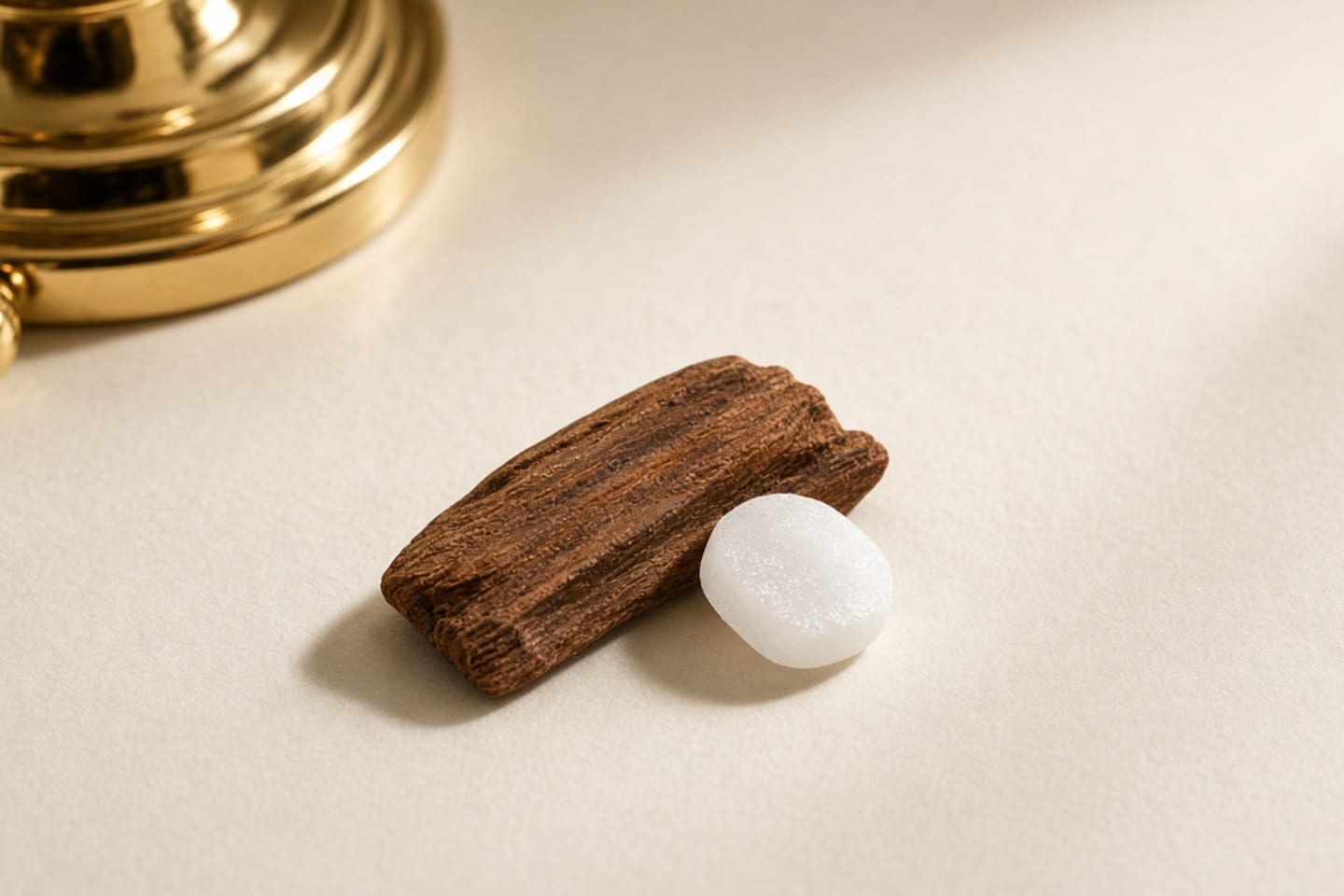
The name. Bhimseni kapoor historically named the prized camphor of Borneo; in today's market it denotes pure, natural camphor, as distinct from the compressed synthetic tablets that fill most grocery shelves. The tradition's preference is clear: the aarti flame is offered with the purest camphor the household can obtain.
How to tell them apart:
- Burn - natural camphor burns cleanly and leaves little or no residue; poor tablets often leave a dark residue
- Fragrance - natural camphor is sharp and clean; synthetic tablets may carry an added perfume
- Storage - both evaporate in open air; camphor should be kept sealed in a tin or jar
Unlit use. Camphor slowly turns from solid to vapour at room temperature. Households have long kept a few crystals in a bowl or a cupboard for their fragrance, without lighting them - a second use of the same material between aartis.
“Where samagri meets smoke — the fragrance layer of the pooja tray. Every household worship carries all four materials (camphor, dhoop, agarbatti, flowers) plus optionally attar. Volume 1 opened the smoke. Volume 2 opened the fragrance. This chapter is where they meet the tray.”
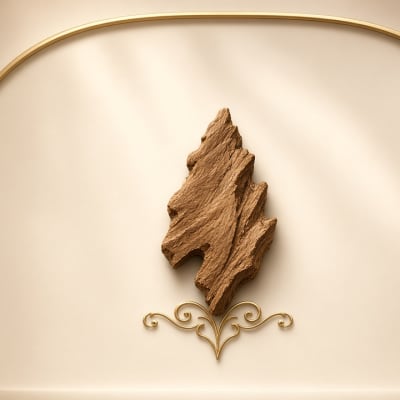
A properly-arranged samagri tray carries the following fragrance-layer items in these positions (see Chapter 2 for the full tray layout):
TOP OF TRAY (near the diya): - Arti-daan with 2-3 bhimseni camphor crystals ready to light - Small covered container of additional bhimseni for restocking
FRONT OF TRAY (nearest the pujari): - Agarbatti stand with one lit incense stick, smoke rising toward the deity - A small stock of unlit agarbatti (~5-7 sticks) beside the stand for the week's use
CENTRE OF TRAY (with the primary offering): - Fresh flowers — the day's chosen offering (marigold, rose, jasmine, or seasonal availability)
BESIDE THE TRAY (on the mandir shelf or floor): - Dhoop powder container (~5cm brass pot) with a small brass spoon - Attar vial (if the household uses attar) with a small applicator wand
Total fragrance-layer investment for a properly-stocked tray:
- Arti-daan: ₹150-300
- Bhimseni camphor (10g): ₹150-400
- Agarbatti stand: ₹150-500
- Agarbatti stock (1 pack): ₹250-600
- Dhoop powder (50g): ₹200-500
- Small attar vial (optional, 3ml): ₹800-2,500
Total: ₹900-4,800 depending on grade. Duration: 3-6 months of daily use.
Published by the house of Chaitanya · www.chaitanya.global
Kits & products from this chapter
Available wholesale, or under your own label.