Phalguna — Holi Month
Spring returns. The classical year closes. Holi arrives - India's most colour-filled festival. Holika Dahan burns the year's negative residue. Phalguna Purnima marks the year's classical closing. This chapter opens the calendar's closing month.
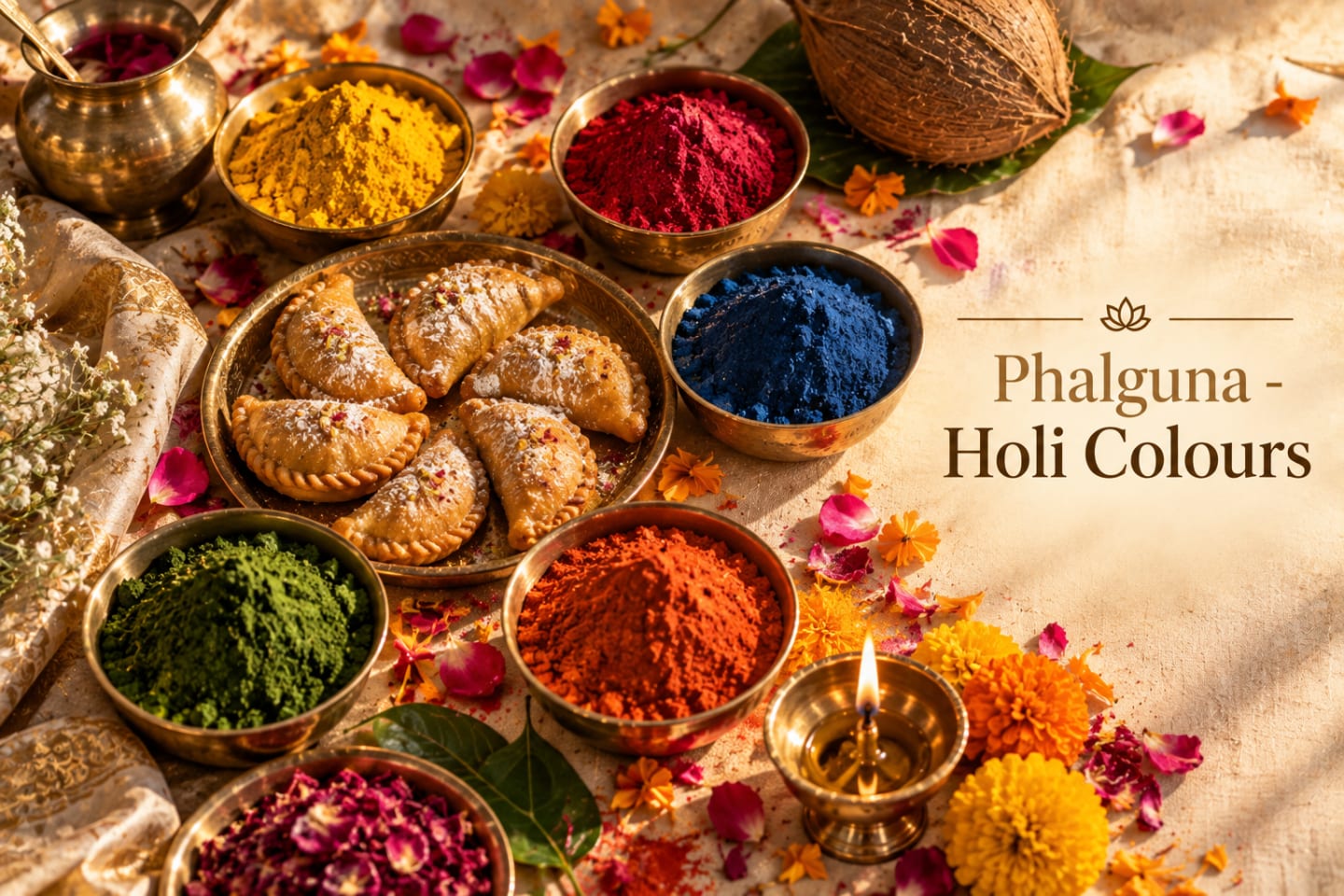
Holi (Phalguna Purnima, March) is the last full moon of the Hindu calendar year. Holika Dahan (bonfire night before colour-Holi) re-enacts the burning of demoness Holika. The next morning is Dhulandi/Rangwali Holi: playing with dry gulal and wet rang. Holi marks the harvest of winter rabi crops and arrival of spring.
Published · Updated · Chaitanya Global Research Team
The twelfth and final lunar month Phalguna (February-March) closes the classical year before Chaitra opens the next. Spring has arrived. Winter has completed. The tradition marks the year's closure with one of India's most-widely-observed festivals: Holi - the festival of colours celebrating the classical burning of Holika (representing negative residue) and the joyful colour-throwing tradition of Krishna's Vrindavan days.
Phalguna is quieter than autumn's peak months but Holi's cultural significance makes the month one of the year's most-celebrated. This chapter opens the month and closes the calendar year.
Phalguna Shukla Ekadashi — Amalaki Ekadashi
Timing. 11th day of bright fortnight of Phalguna.
Classical significance. Amalaki refers to the Indian gooseberry (amla). Traditional Vaishnava Ekadashi observance emphasising amla's classical significance.
Household observance:
- Vaishnava Ekadashi fast
- Traditional amla-based practices - amla consumption, amla offering to deity
- Extended Vishnu-focused morning aarti
Regional variants:
- Vaishnava households: Serious observance
- Ayurvedic-tradition households: Emphasis on amla's classical health properties
- General households: Modest observance
Kit reference: Small extension of Vaishnava Ekadashi kit with amla.
Phalguna Krishna Chaturdashi — Holika Dahan (Choti Holi)
Timing. 14th day of dark fortnight of Phalguna - the day before Holi proper.
Classical significance. Holika Dahan means "burning of Holika." Commemorates the classical narrative of Prahlada's protection and the burning of the demoness Holika. The classical story:
Prahlada, son of the demon king Hiranyakashipu, was devoted to Vishnu against his father's wishes. Hiranyakashipu's sister Holika had a boon that made her immune to fire. Attempting to kill Prahlada, she took him on her lap in a fire. Vishnu's protection reversed the outcome - Holika burned; Prahlada emerged unharmed. The narrative represents good's classical triumph over evil.
Household observance:
Evening ceremony (traditional):
- Community or household bonfire lit at sunset
- Traditional practice: household members walk around the fire three times
- Small quantities of grains, coconut, and specific traditional offerings placed into the fire
- Family gathering around the bonfire
- Traditional songs and community celebration
Modern practical considerations:
- Community bonfires require appropriate outdoor space and fire safety
- Urban high-rise households cannot observe traditional bonfire
- Chaitanya's honest position: symbolic small brass diya observance is acceptable modern accommodation where full bonfire is impractical
Regional variants:
North India (particularly UP, Bihar): Serious community bonfire celebrations. Extensive traditional practices.
Maharashtra: Different traditional forms of Holika Dahan.
South India: Modest observance; less-elaborate than North.
Bengal (Dol Purnima): Different regional tradition - Krishna-focused celebration on Phalguna Purnima parallel to Holi.
Kit reference: Small traditional offering materials for household bonfire observance or symbolic mandir practice.
Phalguna Purnima — Holi Proper (Rangwali Holi)
Timing. Full moon of Phalguna. Day after Holika Dahan.
Classical significance. Multiple layered meanings:
Krishna-Radha classical narrative: The day Krishna traditionally played colours with Radha and the gopis in Vrindavan. Classical Vaishnava tradition treats Holi as one of Krishna's most-celebrated moments.
Spring's arrival celebration: The classical spring festival marking the year's renewal and community joy.
Community-scale celebration: One of India's most-inclusive festivals - crossing caste, community, and religious boundaries.
Household observance:
Morning:
- Traditional colours (gulal) prepared
- Fresh flowers, extensive natural colour materials
- Traditional white clothing preparation (to be coloured through the day)
- Family gathering and community connection
Colour-throwing tradition:
- Family members and neighbours engage in traditional colour-throwing practice
- Traditional coloured water (using natural dyes classically; chemical dyes in modern practice)
- Community celebration extending across neighbourhoods
- Traditional Holi bhajans and songs
Traditional prasad and celebration:
- Bhang thandai - traditional cannabis-infused drink (in specific traditional communities where legal)
- Traditional Holi sweets - gujiya (traditional stuffed sweet), malpua, dahi bhalla
- Extended family gathering meal
- Community feast in traditional villages
Cleanup and evening:
- Traditional bath after colour play
- Fresh clothing
- Family gathering meal in evening
- Modest household mandir practice
Regional variants (substantial):
North India (particularly Braj region - Mathura/Vrindavan): The classical Holi epicentre. Extended celebrations lasting a week (from Vasant Panchami through Holi). Lath Mar Holi (Barsana) - traditional women's celebration where women playfully beat men with sticks. Phoolwali Holi (Vrindavan) - flower-throwing celebration.
Maharashtra: Regional variants with specific Maharashtrian traditions.
Bengal (Dol Purnima): Krishna-Radha focused celebration. Traditional swing (dol) with Krishna murti swung amid coloured throws.
Odisha: Similar Krishna-focused observance.
South India (Kaam Dahan): Modified observance in some regions. Different traditional emphasis.
Kerala (Manjul Kuli): Different regional variant.
Punjabi (Hola Mohalla): Traditional Sikh martial-tradition celebration adjacent to Holi.
Modern practical considerations:
Chemical dye concerns: Modern chemical Holi colours have raised health concerns. Chaitanya's honest position: natural dye alternatives (turmeric-yellow, beetroot-red, henna-green) are traditional and appropriate. Chemical dyes commonly sold should be evaluated carefully.
Cannabis (bhang) traditional consumption: Traditional bhang consumption is community practice in specific traditions (particularly Braj region). Modern legal and health considerations apply; Chaitanya does not stock cannabis-based products.
Water usage concerns: Modern practice has raised water-scarcity considerations. Traditional Holi used moderate water; excessive modern water use has been criticised. Household observance can be maintained with reduced water usage.
Kit reference: Traditional Holi Kit including natural colours, gujiya ingredients, malpua materials, community coordination for extended observance.
Post-Holi Phalguna Observances
Phalguna Krishna Ekadashi — Papmochani Ekadashi: Papmochani means "sin-removing." Vaishnava Ekadashi observance emphasising classical purification tradition.
Regional continuing observances:
- Dol Purnima continuation in Bengali tradition
- Braj region continued celebrations for a week after Holi proper
- Community fair traditions in various regional contexts
Phalguna Amavasya - Year's Classical End
Timing. New moon of Phalguna - the classical year's final day.
Classical significance. The lunar year completes. Chaitra Shukla Pratipada (day after Phalguna Amavasya) will mark the new year (Ugadi).
Household observance:
- Traditional acknowledgement of the year completing
- Reflection on the classical year's practice
- Preparation for the new year approaching
- Ancestor-honouring practice (traditional Amavasya)
- Small closing observance
Modern practical practice: Even brief acknowledgement of the classical year completing prepares the household for Chaitra new year and Ugadi celebrations (see Ch 2).
The month's practical rhythm
Week 1: Phalguna begins. Amalaki Ekadashi mid-week.
Week 2: Approaching Holi preparation.
Week 3: Holika Dahan (14th dark) followed by Holi proper (Purnima). Peak celebration zone.
Week 4: Post-Holi continuing observance in some traditions. Papmochani Ekadashi.
End of month: Phalguna Amavasya - year's classical end. Preparation for Chaitra new year.
Month character: Spring's arrival. Year's closure. Holi's colour-abundance celebrating community joy and Krishna's Vrindavan tradition. Preparation for calendar's classical cycle beginning again.

What Chaitanya makes for Phalguna
Everything below is made in Signature, Heritage and Royal grades and supplied wholesale or under your own label to grocery chains, importers and distributors.
Holi Kit. Traditional natural colours (turmeric, beetroot, henna, indigo), gujiya ingredients, malpua materials.
Holika Dahan materials. Traditional offering materials for household or community bonfire observance. Symbolic alternatives for high-rise apartments.
Natural dye focus. Chaitanya's honest sourcing of natural traditional dyes rather than chemical alternatives. Supports classical tradition and health considerations.
Vaishnava Ekadashi materials. Amalaki Ekadashi and Papmochani Ekadashi supported.
Braj region traditional materials. For households connected to Vrindavan-Mathura tradition, specific classical Holi materials supported.
Regional customisation. Bengali Dol Purnima, Maharashtrian variants, Sikh Hola Mohalla all supported.
Year-end reflection materials. For households observing Phalguna Amavasya as year-closing, brief reflection materials and preparation for Chaitra new year.
“Phalguna closes the classical year. Winter yields. Spring arrives. Holi's colours celebrate community joy and Krishna's Vrindavan tradition. Holika Dahan burns the year's negative residue. The lunar year completes. And the calendar's classical cycle prepares to begin again with Chaitra's new year. This is the tradition's closing month - joy-filled, colour-filled, family-filled, community-filled.”

The Braj region (Mathura, Vrindavan, Barsana, Nandgaon, Gokul) is Holi's classical heartland. Worth understanding as example of the tradition's most-developed festival practice:
The Braj Holi calendar (extended from Vasant Panchami through Holi):
Vasant Panchami (Magha Shukla Panchami): Beginning of Braj Holi. First Holi colours applied to Krishna murtis in Vrindavan temples.
Phalguna Shukla Ekadashi: Amalaki Ekadashi. Continuing preparation.
Phalguna Shukla Chaturdashi (Lath Mar Holi at Barsana): The classical women's celebration. Barsana is Radha's birthplace. Women of Barsana traditionally chase men from Nandgaon (Krishna's birthplace) with lathis (sticks), while men shield themselves. Symbolic reenactment of classical Radha-Krishna playfulness.
Phalguna Krishna Ekadashi (Chhadi Mar Holi at Nandgaon): Men of Nandgaon celebrate. Community feast and traditional practices.
Phalguna Purnima (Phoolwali Holi at Vrindavan): Flower-throwing celebration. Vrindavan temples celebrate with fresh flowers instead of colours. Beautiful, classical, deeply devotional.
Phalguna Krishna Pratipada (Rang Panchami at Braj): The classical colour-play begins across Braj region. Extended community celebrations.
Continuing through Krishna Panchami (5 days after full moon): Community celebrations continue across Braj region temples and communities.
Extended Braj Holi character:
Braj Holi is understood classically as continuous celebration of Krishna-Radha's cosmic love. Every colour thrown is understood as expression of the classical divine love that Krishna represents. The community becomes cosmically-united through the shared celebration.
Modern practical significance:
For Vaishnava households wishing to observe Holi with classical Braj tradition: - Vrindavan pilgrimage during Holi is common practice - Households can observe at home following Braj sequence (Vasant Panchami through Krishna Panchami) - Extended observance intensifies Krishna-focused practice through the six-week period
Chaitanya support: Braj-tradition Holi customisation available for Vaishnava households wishing to observe classical Braj sequence. Coordination with Vrindavan temple communities where possible.
The Braj Holi represents one of India's most-developed classical festival traditions - continuous community celebration honouring cosmic divine love across six weeks, culminating in traditional Vrindavan celebrations that draw pilgrims globally.
Published by the house of Chaitanya · www.chaitanya.global
Kits & products from this chapter
Available wholesale, or under your own label.