Choosing Your First Fragrance
If you have read this far, you are ready. Here is where to start.
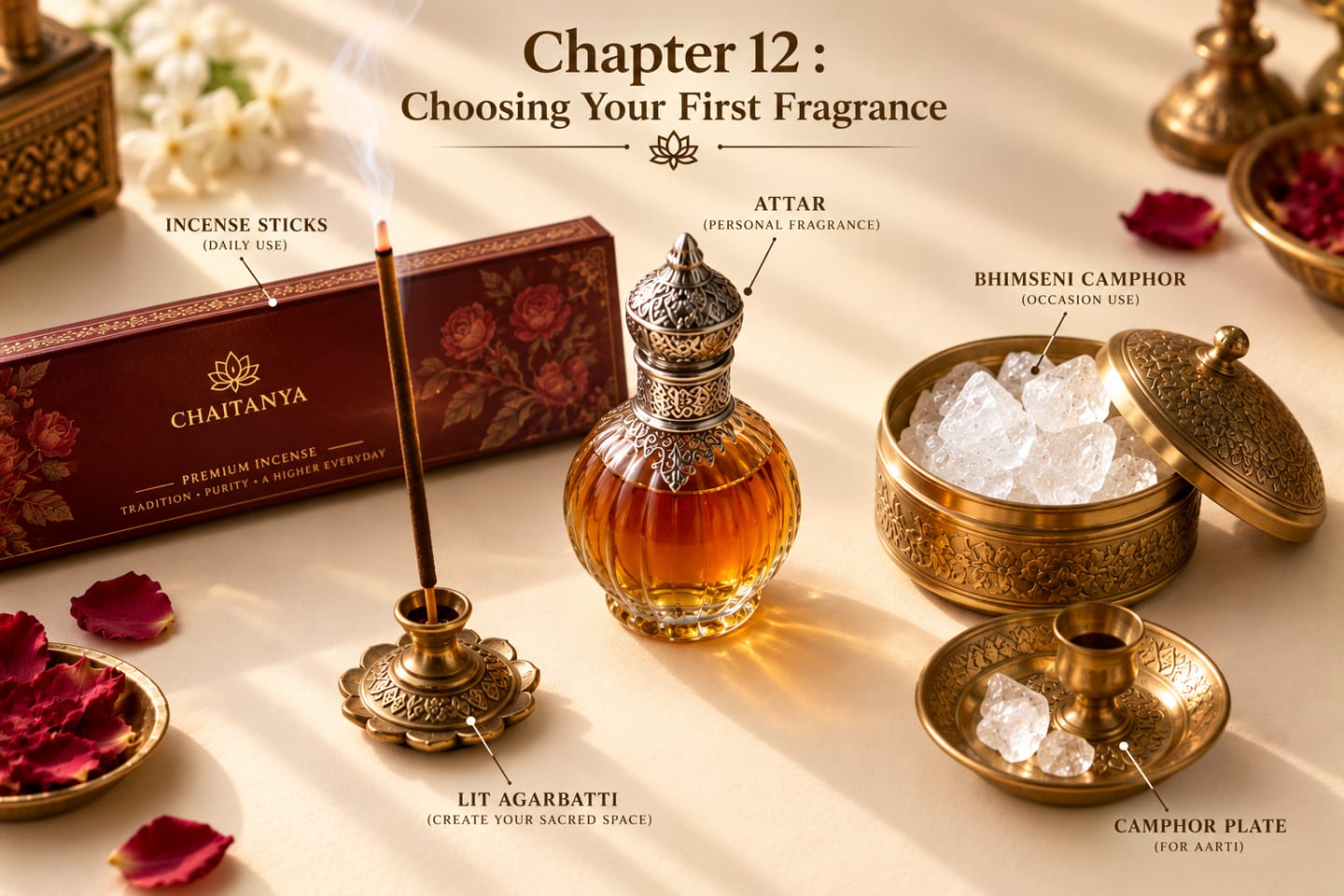
Start with five fragrances: mogra or jasmine for daily morning aarti, rose for Lakshmi Fridays and guests, sandalwood for meditation, lavender for evening wind-down, and a sambrani cup for dusk fumigation. These five cover weekday, weekend, and evening — expand based on which family you gravitate toward.
Published · Updated · Chaitanya Global Research Team
Eleven chapters. Three traditions (perfume, attar, incense fragrance). Thirteen fragrance families of the Indian home. The perfume pyramid, longevity, throw, sillage. The moment × family map for both surfaces — space and skin. The full supply chain from Kannauj to Mysore to Assam to Grasse to Kashmir. That is the theory.
This chapter is the practice. Not another set of concepts — a decision tree. Five questions. Your answers assemble a curated starter set of three fragrances — one incense for daily household use, one attar for personal wearing, one material reserved for the moments that carry weight.
If this is the only page you read, this is the page that turns eleven chapters of reading into a fragrance library you actually own.
Question 1 · Where will fragrance live in your life?
Circle the answer that fits your household best.
A · Only in the space. You want fragrance to fill the household — morning aarti, evening deepak — but do not personally wear fragrance on your body. Your ritual is spatial.
B · Only on the body. You want fragrance you wear — an attar for the wrists and throat, applied after the morning bath. You do not typically burn incense at home, or if you do, someone else lights it.
C · Both, in parallel. You want fragrance in the space and on the body. The tradition uses both, and you want the full library.
Question 2 · What direction of fragrance calls to you?
A · Sweet and floral. Rose, jasmine, champa, mogra. Warm, feminine, generous, celebratory.
B · Warm and woody. Sandalwood, oud, amber. Rich, contemplative, temple-devotional.
C · Fresh and cool. Vetiver, lavender, camphor, mint. Calming, cleansing, meditative, cool.
D · Deep and resinous. Frankincense, guggul, myrrh. Serious, cathedral-grade, moment-weight.
E · A blend. You don't have a single preference; different moments deserve different fragrances.
Question 3 · Which time of day matters most in your household?
A · Morning aarti (6-8 AM). Your day starts with the ritual. The morning fragrance is the one that sets your household tone.
B · Evening dusk (5-7 PM). The evening reset — the household closes, gathers, settles. Your fragrance moment is the transition into night.
C · Personal wearing (after morning bath). The fragrance moment is when you apply attar before going out — the fragrance you carry through the day on your body.
D · All three — you observe the full household rhythm. Morning, evening, personal — the fragrance library serves each.
Question 4 · What is your household's ritual formality?
A · Simple daily. A single agarbatti in the morning is your practice. You do not perform elaborate pujas at home.
B · Regular household. Daily agarbatti + occasional dhoop for festivals + evening lamp. A well-run household mandir with sensible rhythm.
C · Serious devotional. Twice-daily worship, weekly special pujas, monthly full-moon rituals, festival observances, occasional havan.
D · Meditation-focused. Your fragrance is oriented around personal sitting rather than deity-forward worship.
Question 5 · Is there a specific reason you are starting or expanding your fragrance practice now?
A · New life stage. Marriage, new baby, retirement, moving to a new home — some transition has made the ritual and fragrance life more important than before.
B · Loss or crisis. Grief in the family, illness, an unresolved situation — the fragrance practice is being drawn toward moments that matter.
C · Meditative deepening. Personal practice — meditation, yoga, spiritual study — that fragrance will support.
D · Simple restoration. You want to reclaim a tradition that has drifted from daily life. Nothing dramatic; just returning.
E · Curiosity + wanting to build a proper household library. You have read the grantha and want to establish a full library from a considered starting point.
Your curated starter set
Based on your answers, the tradition assembles three items for your household. Not thirteen, not seven — three. The minimum viable set that lets every fragrance moment your first months will bring find its correct material.
1 · One daily-driver incense (based on Question 2 + Question 4)
- If you answered 2-A (sweet/floral): Chaitanya Rose Rich Floral or Sweet Gourmand Floral agarbatti — Signature tier
- If you answered 2-B (warm/woody): Chaitanya Warm Woody (Mysore Chandan) or Sacred Amber agarbatti — Signature tier
- If you answered 2-C (fresh/cool): Chaitanya Herbal Meditative (Vetiver) or Camphoraceous agarbatti — Signature tier
- If you answered 2-D (deep/resinous): Chaitanya Earthy Resinous (Loban) agarbatti — Heritage tier (this family is heavier and the Signature stick tier is usually the right entry point)
- If you answered 2-E (blend): Chaitanya Sacred Amber agarbatti — the most universally-flexible family for daily household use
If your Question 4 answer was 4-C (serious devotional): upgrade the choice above from Signature to Heritage tier. The Heritage stick has more halmaddi content, wet-rolled, three-note structure — appropriate to serious daily use.
Duration: 4-8 weeks of daily use.
2 · One attar for personal wearing (based on Question 1 + Question 3)
- If you answered 1-A (only in the space): skip this item. The starter set is 2 items for you, plus item 3 below.
- If you answered 1-B (only on the body) or 1-C (both):
- If 3-A (morning-focused): Chaitanya Musk Rich Floral attar or Warm Woody (Mysore) attar — for daily wear
- If 3-B (evening-focused): Chaitanya Warm Oriental attar or Kesar Amber attar — for evening wear
- If 3-C (personal wearing is your primary moment): Chaitanya Ruh Gulab attar (Kannauj) — the classical Indian daily-signature attar for anyone starting a serious attar tradition
Duration: 6-9 months of daily wear (attars are extraordinarily concentrated — 3ml lasts a long time).
3 · One occasion material for the moments that carry weight (based on Question 5)
- If you answered 5-A (new life stage): Chaitanya Sacred Amber Heritage dhoop + bhimseni camphor crystals — the warmth and completion for milestone moments
- If you answered 5-B (loss/crisis): Chaitanya Earthy Resinous — Grade A loban — enough (100g+) to sustain a serious mourning period or difficult month
- If you answered 5-C (meditative deepening): Chaitanya Herbal Meditative (Vetiver) Heritage dhoop — for the meditation seat
- If you answered 5-D (simple restoration): Chaitanya bhimseni camphor crystals + brass camphor plate (arti-daan) — restore the aarti completion that most modern households have lost
- If you answered 5-E (proper library): Chaitanya Sacred Amber Heritage dhoop cone set (6-pack) — one cone per major festival for the year
The total starter set
Depending on your answers, either 2 or 3 items (2 if you skipped the attar).
That is the material investment for a properly-founded household fragrance library — a foundation that will last 4-9 months of daily use before replenishment, that gives the household the correct material for every fragrance moment its first six months will bring across both surfaces (space and body), and that establishes a fragrance identity your household can build on.
What you skip in year one
Just as important as what to buy is what not to buy in the first year. Common mistakes:
Do not buy every family. Thirteen families is a comprehensive library, but building it all at once is expensive and unnecessary. Start with the two-or-three from your quiz answers. Add one new family every quarter as the practice deepens.
Do not buy the cheapest agarbatti tier as "starter". The ₹40 dipped-oil agarbatti will teach you nothing about the tradition and may actually put you off — the fragrance is thin, synthetic, and unrepresentative. Start with Signature tier at minimum; the difference in your experience of the practice will be enormous.
Do not commit to a single brand for life. Your first year is a fragrance-education year. Try Chaitanya as your foundation, but also try one or two other serious houses (there are perhaps five or six in India worth taking seriously) so you develop a comparative sense of quality.
Do not skip camphor. Even if none of your Question 5 answers led to it, bhimseni camphor is the material that most modern Indian households have lost, and its absence damages the completeness of every aarti. A small container of bhimseni is worth ₹150-300 and lasts a year. Get it regardless of your other answers.
What comes next in the Grantha
This grantha is Volume 2 of nine. If you have read this far, the seven volumes ahead are already yours in outline:
- Volume 3 · Samagri — The materials of the pooja tray, each one restored to its reasoning
- Volume 4 · Malas & Beads — Rudraksha, tulsi, sphatik, chandan — the sacred wearables and their traditions
- Volume 5 · Sacred Objects — Cowrie, shankh, yantra, bell, damaru — the ritual instruments
- Volume 6 · Diya & Flame — The language of the lamp, the fuels, the vessels
- Volume 7 · Ritual Kits — What goes into each household puja and why
- Volume 8 · Festival Calendar — Month by month through the sacred year
- Volume 9 · Home Ritual — Morning aarti, sandhya, meal blessing, threshold
Each shipping in sequence over the coming months. Each free. Each delivered as a beautifully-designed PDF the moment it is ready.
The single sentence that closes this grantha
You are not choosing a perfume. You are inheriting two thousand years of Indian fragrance tradition — attar, incense, temple compound, ritual anointment — and this grantha's work has only been to help you speak its vocabulary a little more fluently.
Apply your first drop. Light your first stick.
End of Volume 2.

Sampling before committing
Why sampling matters. The households this chapter describes usually settle on one or two fragrances and keep them for years. Most arrive there by accident - a gift, whatever the shop had in stock. Choosing deliberately means smelling the families side by side.
A one-week method:
- Choose one stick from each of four or five families - a floral, a wood, a resin, a fresh, a masala
- Burn one per evening, at the same time and in the same room
- Note the opening, the heart after ten minutes, and what remains in the room an hour later
- Repeat the two you noticed most, once more each, in the morning
- Settle on one for daily practice and one for festival or guest use
A practical aid. An assortment of small packs across the families - such as Chaitanya's Fragrance Discovery Box - lets a household make this comparison without buying a full pack of each.
Published by the house of Chaitanya · www.chaitanya.global
Kits & products from this chapter
Available wholesale, or under your own label.


