Choosing Your First Sacred Object Set
If you have read this far, you are ready. Here is where to start.
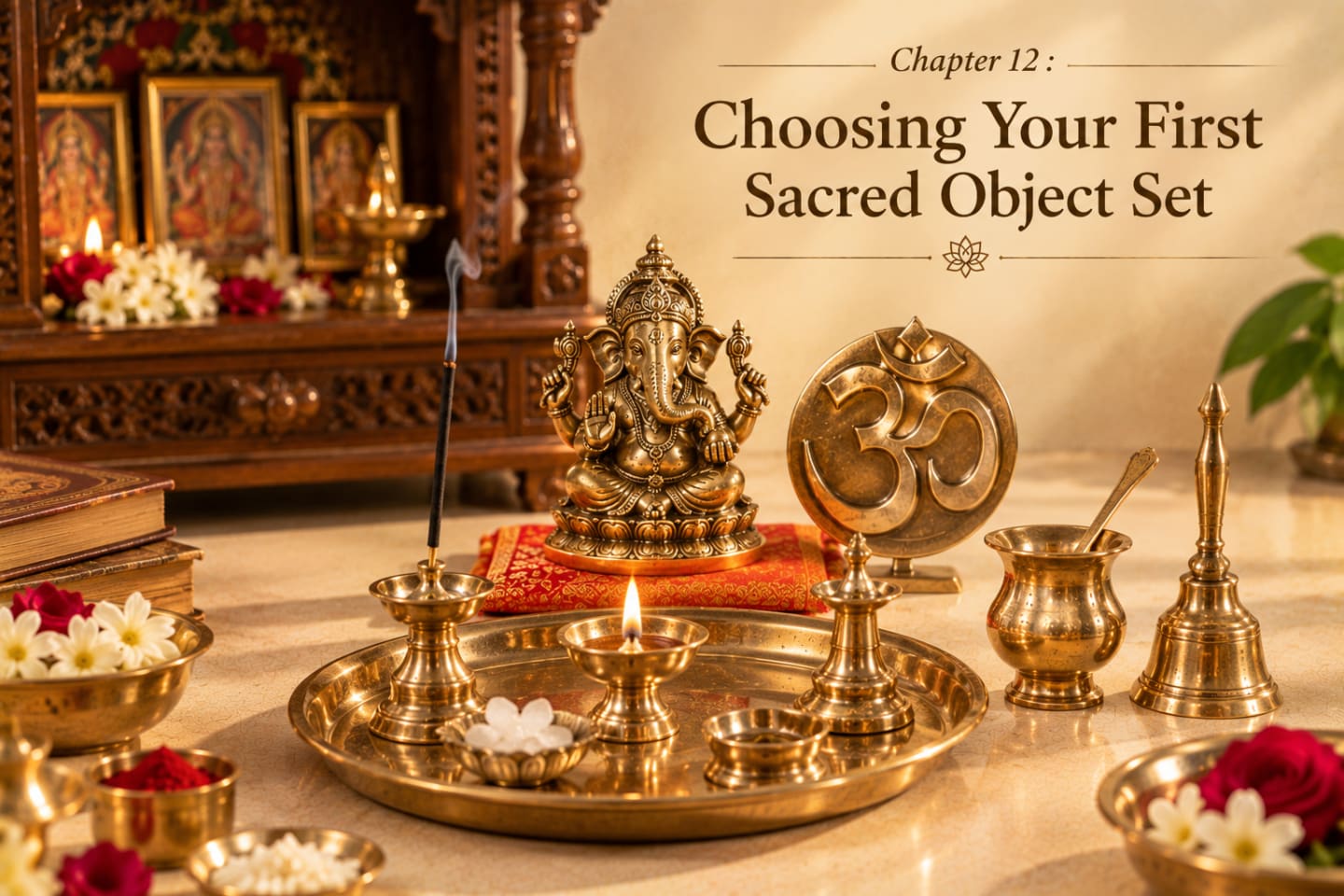
Start with five foundational objects: a brass diya for daily aarti, a small brass bell, an aarti thali with compartments, a panchapatra with spoon for offering water, and an incense holder. Add next: a murti of your family deity, a shankh, and a kalash. Invest in quality brass that will last decades.
Published · Updated · Chaitanya Global Research Team
Eleven chapters. The four classes of sacred object. The household mandir architecture. Shankh, ghanta, damaru. Kalash. The aarti set. Yantras. Murtis. Sacred stones. Traditional symbols. The sourcing chain named honestly.
This chapter is the practice. Not another set of concepts — a decision tree. Five questions. Your answers assemble your first (or upgraded) sacred object set — the actual physical inventory that turns a shelf into a proper household mandir.
If this is the only page you read, this is the page that turns eleven chapters of reading into a mandir you actually set up next weekend.
Question 1 · What is your household's current mandir status?
A · No mandir yet. You do not currently have a dedicated devotional space in the household. You are starting fresh.
B · Basic minimum. You have a small shelf with a picture or two of your household deity, perhaps a diya and some agarbatti. But nothing you would call a properly-established mandir.
C · Regular observance. You have an established mandir with reasonable inventory (murti, some brass items, samagri stocked). You are here to upgrade quality and fill gaps.
D · Serious devotional. You have a well-established mandir. You are here to add specific higher-tradition objects — panchaloha murti, sphatik yantra, shaligram, or specific festival objects.
Question 2 · What is your household's deity focus?
A · Vishnu / Krishna / Rama (Vaishnava tradition).
B · Shiva / Rudra (Shaiva tradition).
C · Devi / Lakshmi / Durga / Sarasvati (Shakta tradition).
D · Ganesha primary.
E · General household / multi-deity. No single primary focus.
Question 3 · What is your available mandir space?
A · Small wall bracket or shelf (~30×40cm) — the pooja alcove format.
B · Medium wall zone or corner cabinet (~60×80cm) — the pooja niche format.
C · Dedicated small room — the pooja room format.
D · Large dedicated space — the pooja hall format.
Question 4 · How fully do you want to equip the mandir?
A · Essentials — Signature tier throughout, focus on essentials.
B · Fuller practice — Heritage tier for primary items, Signature for peripherals.
C · Extended practice — Heritage default with Royal for the primary murti or yantra.
D · Full classical practice — Royal tier throughout, panchaloha primary murti, specific tantric-tradition items possible.
Question 5 · Is there a specific occasion driving the establishment?
A · Grihapravesh (new home entry, recent or upcoming).
B · Life-stage transition (marriage, new baby, retirement, new business).
C · Family observance renewal (parent's passing prompting resumed practice; conversion to serious observance).
D · Meditative deepening (personal practice deepening).
E · Simple readiness (no specific driver; you are ready).
Your curated first sacred object set
Based on your answers, three tiers of set — Basic, Regular, Serious — corresponding roughly to Questions 1 and 4.
Basic Kit — for A/B on Q1 and A/B on Q4
The minimum viable properly-established mandir. What you need to observe daily aarti with the tradition's essential objects.
The mandir itself:
- Small wooden mandir unit or wall bracket
Central deity:
- Vaishnava household: Small brass Krishna or Vishnu murti (10-15cm)
- Shaiva household: Small brass shivling (5-8cm) or small carved Narmada shivling
- Shakta household: Small brass Devi murti (Durga, Lakshmi, or Sarasvati)
- Ganesha primary: Small brass Ganesha murti (10-15cm)
- General: Small brass Ganesha (always installed first)
The daily aarti set (Chaitanya's standard Signature aarti kit):
- Small brass thali (~14cm)
- Small brass diya (~6cm)
- Small brass ghanta with Ganesha handle
- Small brass panchapatra with udhrani
- Small brass arti-daan (camphor plate)
- Small brass agarbatti stand
Sacred symbols (permanent presence):
- Brass Om or Swastik wall plaque
- Small framed print of primary deity (backup or complement to murti)
Sustains daily aarti for years. Everything the tradition considers essential; nothing extra.
Regular Kit — for B/C on Q1 and B/C on Q4
The properly-stocked household mandir. Everything the Basic Kit provides, plus expanded inventory for weekly and festival observances.
Additions to Basic Kit:
Upgraded central deity:
- Heritage-tier brass murti (larger, hand-finished) or panchaloha murti (small)
Additional deities:
- Ganesha (if not primary)
- Hanuman (as household guardian)
Shankh:
- Standard vamavarti shankh
Yantra:
- Primary yantra for household tradition (Sri Yantra for Devi, Ganesh Yantra for Ganesha-focus, etc.)
- Vastu Yantra (recommended for any new/upgraded mandir)
Kalash:
- Copper Heritage-tier kalash for festival ceremonies
Additional aarti items:
- Larger arti-daan for festival aarti
- Silver or copper udhrani upgrade
Traditional symbols:
- Copper or brass Trishul (Shaiva) or Sudarshan chakra plaque (Vaishnava)
- Peacock feather (Krishna household)
Serious Kit — for C/D on Q1 and C/D on Q4
The devotional household kit. Everything the Regular provides, plus Royal tier upgrades and specific higher-tradition objects.
Additions to Regular Kit:
Panchaloha central murti:
- Swamimalai-cast panchaloha primary deity (12-20cm)
Sphatik yantra:
- Sphatik Sri Yantra or tradition-yantra
Sphatik shivling (Shaiva household):
- Sphatik shivling with silver base
Shaligram (Vaishnava household, with priest consultation):
- Genuine Kali Gandaki shaligram with certification
- Only if household is prepared for daily elaborate worship
Silver kalash for premium ceremonies:
- Silver Royal-tier kalash
Damaru (Shaiva household with specific practice):
- Traditional wood-and-skin damaru
Specific tantric-tradition objects (per household lineage):
- Yantra collections, specific mantra-tradition objects — variable
What you skip in year one
Do not acquire objects of traditions you do not observe. A general household does not need shaligram, dakshinavarti shankh, or specific Shaiva-tantric damaru. Buy what your household actually observes.
Do not acquire multiple murtis of the same deity. One properly-consecrated primary murti is worth ten unconsecrated decorative pieces. Choose one and honour it.
Do not skip consecration. A new murti, yantra, or shaligram should be consecrated (through temple priest, elder practitioner, or personal ritual per Chapter 8). The tradition does not endorse installing unconsecrated deity forms.
Do not commit to shaligram without preparation. Shaligram installation carries specific classical worship commitments. Households not prepared for daily elaborate worship should not install shaligram; a Vishnu or Krishna murti is fully valid.
Do not buy sacred objects as decoration. The tradition distinguishes sacred objects from decorative art. Buying yantras or murtis for aesthetic display without devotional practice is the modern retail sector's confusion, not the tradition's.
Do not exceed your practice level. Basic Kit maintained faithfully for a year is superior to Serious Kit acquired quickly and left unmaintained. Start where you can maintain; grow as your practice deepens.
What comes next in the Grantha
This grantha is Volume 5 of nine. If you have read this far, the four volumes ahead are already yours in outline:
- Volume 6 · Diya & Flame — The language of the lamp
- Volume 7 · Ritual Kits — What goes into each household puja and why
- Volume 8 · Festival Calendar — Month by month through the sacred year
- Volume 9 · Home Ritual — Morning aarti, sandhya, meal blessing, threshold
Each shipping in sequence. Each free. Each delivered as a beautifully-designed PDF the day it ships.
The single sentence that closes this grantha
You are not buying brass and stone. You are inheriting a two-thousand-year-old vocabulary of sacred objects that the Indian household has been placing on its mandir every morning to make the deity's presence physically continuous with the ordinary rhythm of household life — and this grantha's work has only been to help you speak that vocabulary a little more fluently.
Set your first mandir.
End of Volume 5.

Published by the house of Chaitanya · www.chaitanya.global
Kits & products from this chapter
Available wholesale, or under your own label.


