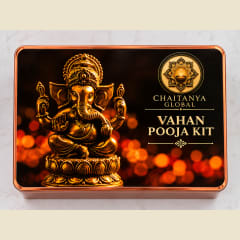
The Diwali Kit
The most flame-intensive night of the ritual year. A specific Lakshmi puja at the centre. A row of clay diyas at the threshold. New account books opening. A coin blessed. This is the tradition's most materially-abundant household kit.
A Diwali puja kit (Lakshmi-Ganesh puja on Amavasya night) requires: Lakshmi and Ganesh murtis, red cloth, rangoli set, diyas (minimum 21 including one akhand deepak), ghee, agarbatti, dhoop, camphor, panchamrit, coconut, betel leaves, fruits, dry fruits, lotus flowers, coins and currency notes for blessing, kalash.
Published · Updated · Chaitanya Global Research Team
Festival guides: date, samagri checklist and vidhi for Diwali 2026 (8 Nov) · Govardhan Puja 2026 (10 Nov)
Every October or November, on the new moon of the month of Kartik, the household enters Diwali — the year's most materially-abundant ritual moment. Volume 6 Chapter 9 opened the flame practice of Diwali. This chapter opens the complete kit — everything the household needs assembled in one place for the five-day Diwali sequence, with the main Lakshmi puja night at the centre.
Where Ganesh Chaturthi (Ch 3) is one deity across ten days and Navratri (Ch 4) is nine deities across nine days, Diwali is one specific main-night ritual (Lakshmi puja on Amavasya of Kartik) elaborated across five days of related observances. The kit is correspondingly focused but expanded — Lakshmi-specific at the centre, with the five-day sequence radiating outward.
The five-day Diwali sequence
Day 1 · Dhanteras (धनतेरस). Two days before main Diwali. The classical day for buying new metals — silver coin, brass utensil, gold. Small evening puja to Yama (yama-deepa lit at threshold).
Day 2 · Choti Diwali / Naraka Chaturdashi. One day before. Krishna's victory over Narakasura celebrated in some traditions. Small increase in diya-lighting.
Day 3 · Diwali proper / Lakshmi Puja. The main night. Full Lakshmi puja + row-lighting.
Day 4 · Govardhan Puja / Annakut. Krishna's lifting of Mount Govardhan. Food-mountain (annakut) offering.
Day 5 · Bhai Dooj. Sister-brother celebration.
The kit inventory below supports the full five days but concentrates on Day 3's central puja.
The Diwali kit inventory
The daily aarti kit (Ch 2) remains foundation. Diwali adds:
Lakshmi-specific presence items:
- Lakshmi murti or image — brass, silver, panchaloha, or framed print. Small Lakshmi + small Ganesha typically paired (Ganesha installed first even in Lakshmi-focused ceremony)
- Small silver or brass Lakshmi pada (footprints) — traditional threshold-installation object
- Red silk or cotton cloth — draped at mandir base
- Red chunari (small red-and-gold ceremonial cloth) — for Lakshmi murti
- Small silver coin — traditional Lakshmi coin (Rs 5 or Rs 10 silver commemorative preferred)
Kalash setup (see Vol 5 Ch 5):
- Copper or silver kalash — smaller version acceptable for household
- Water + mango leaves + coconut + red thread (standard Poorna Kalash assembly)
- Small silver coin inside the kalash water
Flowers and offerings:
- Red flowers — lotus (if available), rose, hibiscus, red marigold — daily fresh
- Lotus specifically if available (Lakshmi's classical flower)
- Yellow marigold — for the doorway rangoli borders
- Red-and-yellow marigold garlands — for the murti
Row-lighting materials:
- Clay Diwali diyas — traditional quantities: 21 (minimum), 51 (standard), 108 (serious), or higher
- Mustard oil — 1-2 litres for clay diya row-lighting
- Coconut oil — 1 litre if using clay diyas alongside samai (South Indian tradition)
- Additional A2 cow ghee — 500ml for the mandir Lakshmi puja diya
- Panchamukhi diya — five-wick, for Lakshmi mandir centre
- Long cotton wicks for extended-burn diyas
Prasad materials:
- Kheer ingredients (rice, milk, sugar, cardamom, dry fruits, saffron) — Lakshmi's classical prasad
- Ladoo (boondi or motichoor) — traditional Diwali sweet
- Barfi and misti — Bengali households
- Fresh fruits — banana, apple, seasonal
- Coconut — 2 whole coconuts, one for kalash + one for offering
- Panchamrit ingredients (see Vol 3 Ch 5)
- Sugarcane sticks — traditional Bengali and East Indian addition
Ceremonial samagri (extra Lakshmi tier):
- Chandan — genuine Mysore preferred for Lakshmi practice; ~25g of fresh paste preparation
- Kumkum (traditional Kanchipuram formula) — 100g
- Akshata (yellow-tinted with saffron) — 500g
- Sindoor — for Lakshmi's tilak
- Small pot of haldi paste — for markings
- Traditional-formula rose water (small bottle) — for the puja
New account book (for business households):
- Fresh red-cloth-bound account book (bahi-khata) — traditional business tradition
- Small brass pen holder + red-ink pen for the ceremonial opening
- Small silver Ganesha coin to be placed inside the account book
- Small silver Swastik plaque for the first-page marking
Rangoli materials:
- Traditional rangoli powders — white (rice flour), yellow (turmeric), red (kumkum), green (crushed dry leaves)
- Small mould templates or freehand practice
- Coloured powder for elaborate rangoli at doorway
Firecracker note:
Chaitanya does not stock firecrackers. Households wishing to observe this modern-era practice source separately. The tradition's honest position: firecrackers are a modern-era addition (18th-19th century) rather than classical tradition; the classical Diwali is flame-based, not explosive-based. Modern practice varies widely.
The Diwali main-night ritual sequence (Day 3)
Morning:
- Complete household cleaning
- Rangoli drawn at doorway
- Fresh Lakshmi cloth and flowers arranged in mandir
- Small threshold pooja to Yama (residual from Dhanteras)
Evening (main Lakshmi puja):
- Kalash established at mandir with Ganesha + Lakshmi paired
- Panchamukhi diya lit at mandir
- Complete Lakshmi puja with all offerings
- Full aarti with special Diwali aarti verses
- Prasad offering (kheer, ladoo, fresh fruit)
- New account book opened with Swastik + first entry
- Small silver coin blessed at mandir
Night (row-lighting):
- Clay Diwali diyas placed at threshold, terrace, balcony, windows
- All diyas lit around sunset
- Household gathering for prasad distribution
- Continuing observation through the night — flame maintained
Late night:
- Some households maintain akhand-style flame at mandir overnight
- Household retires with mandir zone lit
Day 4 morning:
- Govardhan puja + Annakut food offering
- Continuation of flame practice at reduced intensity
The three tiers of Diwali kit
Signature Kit (added to the daily kit):
- Small brass Lakshmi + Ganesha murti pair
- Standard clay diya set (21 diyas)
- Standard mustard oil (1L) for row-lighting
- 500ml ghee for mandir diya
- Basic Diwali samagri supply
- Standard rangoli powders
Heritage Kit (added to the daily kit):
- Heritage-quality Lakshmi + Ganesha murti pair (larger, better craftsmanship)
- Copper kalash
- 51 clay diyas + 21 additional for various positions
- Coconut oil + mustard oil for row-lighting
- 1L A2 ghee for mandir + panchamukhi
- Complete Heritage-tier samagri
- Silver coin for offering + account book
- Traditional-formula kumkum, genuine Mysore chandan
- Panchamukhi brass diya
Royal Kit (added to the daily kit):
- Premium silver Lakshmi + panchaloha Ganesha murti pair
- Silver kalash
- 108 hand-formed clay diyas + 21 special larger clay lamps
- Premium fuels: 2L A2 ghee + 2L coconut oil + 1L mustard oil
- Complete Royal-tier samagri (all Royal grades)
- Multiple silver coins for offering + account book
- Silver diya for Lakshmi puja centre
- Kashmir saffron for prasad preparation
- Silver-embellished new account book
Regional variants
North Indian (Punjabi, UP, MP):
- Emphasis on new-account-book ceremony (business households)
- Elaborate ladoo and barfi prasad
- Full row-lighting focus
Maharashtra:
- Faral (traditional Diwali savoury snacks) as prasad
- Specific Marathi Lakshmi puja verses
- Substantial threshold rangoli
Bengali (Kali Puja overlap):
- Same-night Kali Puja parallel to Lakshmi puja
- Different offerings (Bengali sweets rather than North Indian)
- Community-scale Kali pandal alongside household Lakshmi
South Indian:
- Emphasis on samai + oil rather than clay row-diyas
- Coconut oil rather than mustard for row-lighting
- Regional sweet prasad (mysore-pak, chakli)
- Different regional Lakshmi mantras
Gujarati:
- Bestu Varas (Gujarati new year) — day after Diwali
- Extended five-day sequence with regional additions
- Specific Gujarati account-book ceremony for business households
Jain tradition:
- Diwali marks Mahavira's nirvana
- Different prasad focus (Jain-appropriate sweets)
- Reduced flame emphasis in some Jain traditions
What Chaitanya makes for Diwali
Everything below is made in Signature, Heritage and Royal grades and supplied wholesale or under your own label to grocery chains, importers and distributors.
Prepared kits. Available 3-4 weeks before Diwali. Signature, Heritage, Royal tiers. Regional variants supported.
Clay diya supply. Peak inventory pre-Diwali. Chaitanya works with Rajasthan and Delhi-periphery potter communities (see Vol 6 Ch 11). Bulk quantities available, supporting the classical potter economy.
New account books (for business households). Traditional red-cloth-bound account books, the first page marked with Swastik and Ganesha invocation.
Sourcing dedication. Diwali is Chaitanya's busiest sourcing season — dedicated Diwali team maintains freshness discipline (all samagri assembled within 2 weeks of dispatch).
“Diwali is the household's most flame-abundant night. Lakshmi at the centre. Ganesha at her side. The kalash filled with water and a silver coin. The clay diyas by the hundred at threshold and terrace. New account books opened. The household is literally radiant, and the tradition considers this the appropriate condition for inviting Lakshmi into the coming year.”
Published by the house of Chaitanya · www.chaitanya.global
Kits & products from this chapter
Available wholesale, or under your own label.